Lessons · Lesson 1 of 6
- 01 · One shipment, seven documents, and eighty-five pairs of boxes
- 02 · What each document proves, and what everybody assumes it proves
- 03 · The twenty-minute cross-check
- 04 · Two correct documents that disagree
- 05 · The same correction, at six prices
- 06 · The document calendar, built backwards from the vessel
One shipment, seven documents, and eighty-five pairs of boxes
See one export shipment as a single set of facts, written down seven times, and count how many pairs of boxes have to agree.
Lesson 1 of 6 · 22 min
One shipment
It is 9 October, in a converted spinning shed on the Cairo road out of Damanhur. Zohara Garments is finishing PO RV-4471. The buyer is Roskvist Retail, a homeware and clothing chain in Norvedal. Its distribution centre sits outside the port city of Halstrand.
The order is 18,000 women's woven viscose two-piece sets, style CD-517. A set is a camp-collar shirt and a wide-leg trouser. The two are sold together, hung together, and ticketed as one item. Two colours: Terracotta 10,800 sets, Pewter 7,200. Six sizes. The price is FOB Alexandria USD 11.40 a set, so USD 205,200.00 of goods. FOB — free on board — means the seller's price stops once the goods are on the ship. The sale term here is CFR Halstrand, which means Zohara also pays the ocean freight. Zohara's forwarder Anfusa Logistics has quoted USD 1,780.00 a container for the sea leg, so the invoice will be raised at USD 208,760.00.
Twelve sets go in a carton, one colour and one size run in each. That is 1,500 cartons. Each carton holds 7.44 kg of goods and weighs 8.34 kg with its packaging. So the shipment is 11,160.00 kg net and 12,510.00 kg gross, and it fills 108.00 cubic metres. That is two forty-foot high-cube containers, 750 cartons in each. They sail on the Tessala Voyager, voyage 118W, on board at Alexandria on 11 October, due in Halstrand on 1 November.
The cartons are marked:
ROSKVIST RETAIL
PO RV-4471 / STYLE CD-517
COLOUR: TERRACOTTA
C/NO 1 TO 900
MADE IN EGYPT
Everything above is a fact about one box of clothes. Nothing in this course is about the clothes.
A document copies facts, and that is the whole problem
Seven separate parties are about to write those facts down. None of them will look at the garments. Each one copies the facts from somewhere else, onto its own form, for its own purpose.
| Document | Who issues it | Who cannot move without it |
|---|---|---|
| Commercial invoice | Zohara | The bank, both customs authorities, the buyer's accounts payable |
| Packing list | Zohara's finishing floor | The forwarder, the terminal, the buyer's goods-in |
| Bill of lading | Tessala Line, through Anfusa | Whoever wants the containers released at Halstrand |
| Certificate of origin | The Damanhur chamber of commerce, on Zohara's declaration | Norvedal customs, if any preference is claimed |
| Inspection certificate | Verinta Inspection Services, for Roskvist | Roskvist's own release to pay, and the credit |
| Export declaration | Zohara, to Egyptian customs | The container leaving the port |
| Import entry | Krevold Customs Brokers, to Norvedal customs | The container leaving the terminal |
Read the middle column again. Six of the seven are written by someone who has never seen the goods. The seventh, the packing list, is written by a scanner. Every one of them is a copy of facts held somewhere else. So the set is accurate only if the copies agree with each other. Nobody checks any of them against the garments.
Count the boxes
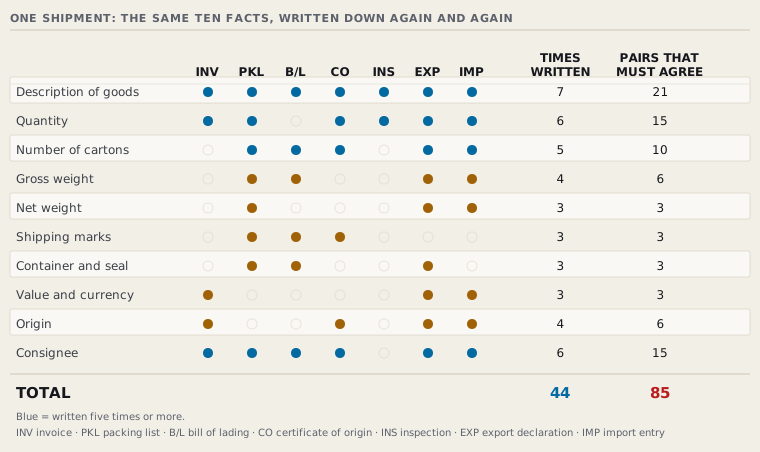
The drawing counts something worth counting. Ten facts about this shipment are written down 44 times across the seven documents. The description of the goods appears on all seven. The quantity appears on six. The consignee's name appears on six.
Now count a second way. A fact written in one place cannot disagree with itself. A fact written in k places makes pairs: k times k minus one, divided by two. Add up the ten facts and you get 85 pairs of boxes that have to agree. That is one ordinary shipment, one style, two colours.
Nobody checks 85 pairs. A good merchandiser checks the six pairs that carry the weight instead, and lesson 3 is that list. But you cannot shorten a list until you know how long it is, and most people who handle export documents have never counted.
Control where the facts come from
Here is the sentence this course is built on: the error is almost never a wrong document. It is two correct documents that disagree.
A wrong document is easy. Somebody types 1,600 cartons instead of 1,500, the packing list stops adding up, and the first person who adds a column finds it. That is a typing error, and it dies young.
The expensive kind survives because every document is correct. It happens when two documents are typed from two different parents. A parent is simply the file or document you copy from. One document is typed from the order file, the other from the warehouse system. The two parents describe the same shipment in different units, or on different dates, or at different stages of a change nobody passed on. Each document copies its own parent faithfully. Each one stands up on its own. Together they stop the shipment.
So the control is not proofreading. The control is parentage: one sheet of facts, agreed and frozen, that every document is typed from.
Two documents that are deliberately vague, and why
Two documents in the set will refuse to carry some of these facts. That refusal is a feature, not a gap.
The bill of lading will describe the cargo as 1,500 cartons said to contain women's woven viscose two-piece sets. It will not say 18,000. Tessala Line did not open the cartons and will not certify what is inside them. Lesson 2 shows what that phrase does to your claim if a carton turns out to be empty.
The inspection certificate reports on a sample drawn on one day at one address. It will not say the order is good. It says what one inspector saw of one sample.
Both documents are narrower than people assume, and both are narrower on purpose. A document that promised more is a document nobody would sign.
Check yourselfThe packing list says 1,500 cartons and the invoice says 18,000 sets. Is that a discrepancy?Show the answer
Not yet. They are two different facts, and both can be true: a carton holds twelve sets, and 1,500 times 12 is 18,000. It becomes a discrepancy the moment a third document states the quantity in a unit you cannot reconcile with the others unless you already know the pack ratio — and the document does not state the pack ratio. That is exactly what happens to this shipment in lesson 4.
What this course does and does not cover
This course owns the box and the paper: the set, the agreement between its members, and the discipline for changing one of them.
- Which tariff heading CD-517 falls under, and what the customs value is built from, belong to 12.2.
- Whether Norvedal grants preferential duty on Egyptian origin, and what the agreement requires to qualify, belong to track 26 and to 8.5.
- The credit itself — how it is opened, what it costs, and how the money actually moves — belongs to track 13. This course meets the bank only as one more reader of the same documents.
- The order's critical path, and the clocks that produce the ship date in the first place, belong to track 7.
Prompt · Build the shipment fact sheet before anything is typed
The day the packing is finished and six documents are about to be written by five different people.
Act as an experienced export documentation manager. I am about to have a full document set prepared for one shipment. I want one frozen fact sheet that every document will be typed from. Shipment facts: exporter [NAME AND FULL ADDRESS], buyer and consignee [FULL LEGAL NAME AS THE CONTRACT SPELLS IT], notify party [NAME], PO [NUMBER], style [CODE], goods [FULL DESCRIPTION INCLUDING FIBRE, CONSTRUCTION, GENDER AND GARMENT TYPE], quantity [NUMBER] in unit [UNIT], pack ratio [HOW MANY SELLING UNITS IN A CARTON, AND HOW MANY GARMENTS IN A SELLING UNIT], cartons [NUMBER], net weight [KG], gross weight [KG], volume [CBM], carton dimensions [CM], shipping marks [PASTE THEM], containers and seals [NUMBERS], delivery term [TERM AND NAMED PLACE], currency and unit price [AMOUNT], total value [AMOUNT], country of origin [COUNTRY], port of loading and discharge [PORTS], vessel and voyage [NAMES], on-board date [DATE], payment terms [TERMS], and any credit or contract wording that must be reproduced verbatim [PASTE IT]. Do the following. First, produce the fact sheet as a single table of facts with each fact stated once, in the exact wording that must appear downstream, and flag every fact I have not given you rather than assuming it. Second, for each fact, list which documents in the set will carry it, and give me the total number of times each fact will be written down. Third, name every fact that will be expressed in a different unit or format on different documents, and tell me the exact words to add to each document so the two can be reconciled without any knowledge from outside the file. Fourth, tell me which two facts on this shipment are most likely to fork, and why. Fifth, give me the five checks I should run on the drafts, in the order that finds the expensive error first. Do not summarise; give me the table.
AI can make mistakes — check anything you act on.