Lessons · Lesson 4 of 6
- 01 · One shipment, seven documents, and eighty-five pairs of boxes
- 02 · What each document proves, and what everybody assumes it proves
- 03 · The twenty-minute cross-check
- 04 · Two correct documents that disagree
- 05 · The same correction, at six prices
- 06 · The document calendar, built backwards from the vessel
Two correct documents that disagree
Follow one quantity box through six correct decisions to a customs hold and a bank refusal, and price the result.
Lesson 4 of 6 · 24 min
Nobody made a mistake
On 11 October the Tessala Voyager sails with two containers of CD-517 on board. Every document in the file is correct. On 24 October the buyer's bank refuses the presentation. On 3 November Norvedal customs holds the entry.
The two events have one cause. It is a single box on a single form. Six people filled it in, read it or approved it, and none of them did anything wrong.
This lesson follows that box.
Six decisions, all of them right
One. Roskvist buys sets. The purchase order, the price, the retail ticket and the credit are all in sets. A shirt and a trouser sold together are one thing to a retailer. Correct.
Two. Zohara's finishing floor scans garments. A shirt and a trouser are sewn separately, pressed separately, checked separately and hung separately. A factory that counted only sets could not tell you it was forty trousers short. So the warehouse system holds 36,000 units for this order. Correct — and a factory that did it the other way would be worse run.
Three. The packing list is generated from the warehouse system rather than typed from the order, so it reports what was actually packed. Lesson 2 called that the strong kind of packing list, and it is. It reads 1,500 CTNS, 36,000 PCS. Correct.
Four. The commercial invoice is raised from the order file. An invoice has to correspond to the credit, and the credit is in sets. It reads 18,000 SETS at USD 11.40. Correct.
Five. The certificate of origin application has one combined box: quantity and kind of packages, description of goods. Zohara's export coordinator needs the carton count and the shipping marks. Those are on the packing list. They are not on the invoice. So she fills the box from the packing list, and it goes to the Damanhur chamber reading 1,500 CARTONS, 36,000 PCS. Correct — she used the document that carried what the form asked her for.
Six. Anfusa files the export declaration, also from the packing list, for the same reason. Correct.
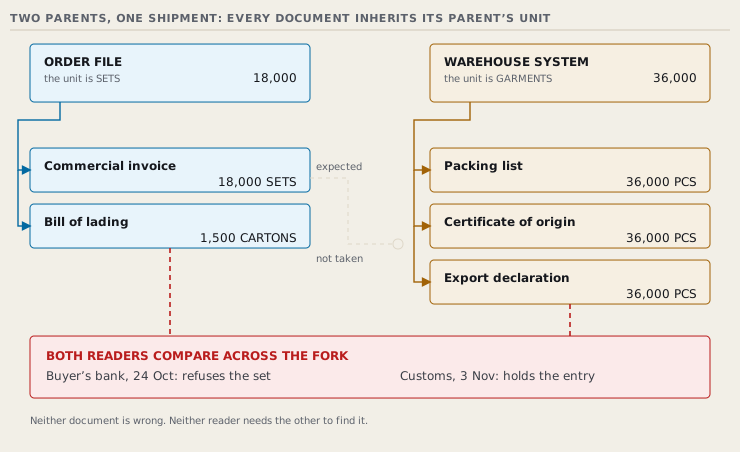
The fork was created by a field nobody was thinking about
Decision five is the one that matters. Notice what it was actually about. The coordinator was not choosing a source for the quantity. She was choosing a source for the carton count and the marks. The quantity came along in the same box, because the form combined them.
That is the general shape of this failure, and it is worth carrying out of this course. A document forks from its siblings on the field you were not thinking about. You reach for a parent because it has the fact you need. Every other fact on that form quietly inherits the same parent.
Why nobody caught it
Five parties handled the file before it left Egypt. None of them held two documents from different families at the same time.
- Zohara's own check compared the invoice with the packing list. Those two agree on cartons, on value and on marks — which is what the checker compared.
- Anfusa checked the bill of lading against the booking.
- The chamber checked the certificate against the packing list it was typed from, so of course it agreed.
- Verinta had finished a week earlier and never saw a document.
- Roskvist's merchandiser was sent the invoice copy, alone.
The set was checked five times, in five pairs, and no pair crossed the fork. This is why lesson 3's check 1 converts every quantity into one unit before comparing anything. The conversion is what makes the fork visible. Reading documents in pairs is what hides it.
Two complaints, one box
24 October, Halstrand. The buyer's bank examines the presentation and refuses it. The certificate of origin says 36,000 PCS. The credit and the invoice say 18,000 SETS. Both cannot describe the same shipment unless the reader supplies a fact that is on no document in the set. Payment stops, pending the applicant's waiver.
3 November, Halstrand. Krevold lodges the import entry from the invoice, declaring 18,000 sets, with the certificate of origin attached in support. Norvedal customs compares the two figures and queries the entry. Release stops.
Two institutions, two entirely different purposes, one box. The bank is reading for consistency, because a documentary credit is settled on documents and not on goods. Why it is entitled to refuse a set that contradicts itself belongs to track 13, which owns the credit. The customs authority is reading because the certificate supports a claim on the entry. Neither needed the other to find it.
What it cost
The certificate of origin cannot simply be corrected. The chamber cancels and re-issues it against the surrender of the original. So the original has to travel back from Halstrand to Damanhur before a replacement exists. That round trip is what turns a typing question into three weeks.
| Line | Amount | Paid by |
|---|---|---|
| Discrepancy fee, Halstrand Handelsbank's tariff | USD 95.00 | Zohara |
| Certificate of origin cancelled and re-issued, Damanhur chamber's fee | USD 26.00 | Zohara |
| Express courier, two runs | USD 74.00 | Zohara |
| Re-lodgement of the documents, Ibis Commercial Bank's tariff | USD 40.00 | Zohara |
| Payment delayed 28 days on USD 208,760.00, at Zohara's overdraft rate of 15.2% a year | USD 2,434.20 | Zohara |
| Container detention, Tessala Line's tariff, 10 days on two containers at USD 118.00 | USD 2,360.00 | Roskvist |
| Terminal storage at Halstrand, 9 days on two containers at USD 62.00 | USD 1,116.00 | Roskvist |
| Krevold's fee for amending and re-filing the entry | USD 165.00 | Roskvist |
| Overflow storage, 1,500 cartons at USD 0.38 a carton a week for two weeks | USD 1,140.00 | Roskvist |
| Total | USD 7,450.20 |
That is USD 0.41 a set, or 3.57% of the invoice value — on an order whose whole factory margin is a good deal thinner than that.
The finding that is not in the total
Split the total by who pays it. Zohara carries USD 2,669.20. Roskvist carries USD 4,781.00, which is 1.8 times as much.
Now ask who could have prevented it. Every one of the six decisions was taken inside Zohara, or by Zohara's agent. Roskvist could not have seen the fork. It was never sent two documents from different families until the bank refused the set.
So the larger share of the cost falls on the party with no ability to prevent it, and the smaller share on the only party that could. That is not an accident of this shipment. It is the standing incentive of export documentation, and it is why the check that would have caught this is chronically under-resourced at the end of the chain where the documents are made. If you are the exporter, the case for the twenty minutes is not your USD 2,669.20. It is that your customer pays USD 4,781.00 and remembers.
Check yourselfWhich of the six decisions would you reverse?Show the answer
None of them, and that is the point. Reversing decision two — counting sets on the finishing floor — would blind the factory to a shortage in one half of the set. Reversing decision four would put a unit on the invoice that the credit does not use. The correct intervention is not to change a decision. It is to add a fact: state the pack ratio on the face of every document that expresses the quantity in pieces, and run lesson 3's check 1 on the drafts.