Lessons · Lesson 1 of 6
- 01 · A code is an argument, and the argument has an order
- 02 · Knitted or not, and what a coating does to the answer
- 03 · The fibre threshold, and the substitution that moved the code
- 04 · The value is built, not copied off the invoice
- 05 · Tooling, and where the design work was done
- 06 · When the answer is contested, and what it costs downstream
A code is an argument, and the argument has an order
Why two good brokers gave one jacket two different codes, and the fixed order of steps that decides which of them can defend it.
Lesson 1 of 6 · 22 min
Two entries, one jacket
On 4 September two customs entries were prepared in Kessland for the same jacket. Two people wrote them, and both knew their job. One filed the jacket under the heading for knitted anoraks and wind-jackets. The other filed it under the heading for garments made of coated knitted fabric. Nothing about the jacket changed between the two entries. Nobody lied. The gap between them was USD 18,917.04.
A heading is one line in a country's customs tariff. It is where a product is filed, and the duty rate hangs off it. A broker is the licensed agent who files the customs entry for the importer.
The order is PO PVL-3318. PO means purchase order. It was placed by Peveril Outdoor, an outdoor clothing importer in Kessland, on Suvira Apparel in Katunayake, Sri Lanka. Two styles, both hooded jackets, both for autumn:
- OJ-217, 18,400 units, a bonded knitted shell. That means a knitted face fabric glued to a waterproof membrane and then to a knitted backing layer. FOB Colombo USD 21.41.
- OJ-219, 6,200 units, the same jacket drawn the same way, but with a woven shell. FOB Colombo USD 19.86.
FOB stands for "free on board". It is the price of the goods loaded onto the ship at the export port, before any freight is added.
Ocean freight and marine insurance to Kessland are USD 0.94 a unit on both styles.
The rules do not let you start from the answer
Classification feels like naming a thing. It is not. It is a formal argument with a fixed order of steps, and that order is itself a legal rule.
The Harmonized System, or HS, is the shared product-coding system used by most trading countries. It is maintained by the World Customs Organization. It opens with a short set of General Interpretative Rules that every country applying the system is bound by. The first of those rules does two things that most people who classify goods have never read.
It says that classification is decided by the terms of the headings and by any relative section or chapter notes. And it says that the titles of sections, chapters and sub-chapters are there for ease of reference only and have no legal force.
That second sentence ends most arguments. "Outerwear" is not a legal category. Neither is "technical apparel", "shell", "midlayer" or "activewear". A section title binds nobody. The only text that decides anything is the heading text itself, plus the notes that modify it.
So the argument runs in this order, and the order is not optional:
- Which chapter. Decided by the section and chapter notes, before you read any heading.
- Which heading, on the terms of the headings as the notes modify them. If exactly one heading applies, you stop at the four-digit level. Most garments stop here.
- Only if the goods are incomplete, unfinished, or a mixture, the second rule tells you how to treat them.
- Only if two or more headings still genuinely apply, the third rule settles it in its own order. Most specific description first. Then, if that does not decide it, the material or component that gives the goods their essential character. Only if neither works, the heading that comes last in numerical order.
- Packing and containers.
- Then the subheadings, one level at a time, comparing only subheadings that sit at the same level.
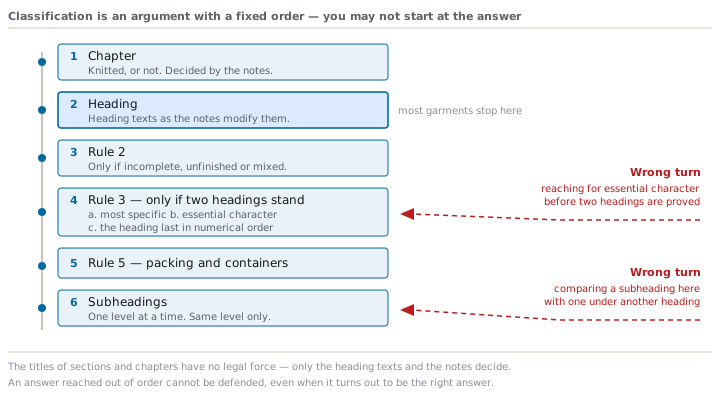
Read that list again and notice what it forbids. You may not decide the answer first and then look for a rule to support it. You may not reach for essential character because it feels like the right conversation. Essential character is the second limb of the third rule, and it is not available until you have proved that two headings both apply. You may not compare a subheading in one heading with a subheading in another. And you may not use a chapter title as an argument at all.
Three correct answers to three different questions
Here is what actually happened on PVL-3318. It is worth setting out, because nobody in it made a mistake.
Marit Toft, the licensed broker at Ostwald Clearance, started where the rules start. Chapter first: is the fabric knitted? Yes. The face fabric is a knitted construction, and the chapter split in this part of the tariff is knitted against not knitted, before anything about the garment is considered. Then the heading: a hooded jacket with a full-length front opening, made up as an outer garment, reads onto the heading covering anoraks and wind-jackets. She stopped there, because exactly one heading applied. Rate on Peveril's tariff: 11.4%.
Verrall and Co, the broker Peveril's freight desk had used for two earlier seasons, started somewhere else. It looked at the garment, saw a waterproof shell, and went to the heading covering garments made of coated knitted fabrics. Rate: 6.8%.
The interesting part is that Verrall's answer might be right. There is a real question here, and lesson 2 is about it. But Verrall's reasoning cannot support that answer, because it began at the conclusion. It never asked the question the heading actually turns on, which is whether this fabric is legally a coated fabric. So it has no evidence to offer when somebody asks.
That is the shape of almost every classification failure. Ask three competent people what a garment is and you get three correct answers to three different questions:
- The designer answers what it is for. A shell for cold, wet weather.
- The merchandiser answers what the buyer calls it. The autumn hooded jacket, the one in the range plan.
- The broker, under time pressure, answers what we used last time. A code inherited from a style that no longer exists.
None of those is the question the rules ask. The rules ask what this garment physically is, read against the heading texts and the notes, in that order.
What the difference is worth
Peveril's tariff, on the sea shipment of OJ-217 alone:
| Anorak heading | Coated-garment heading | |
|---|---|---|
| Customs value a unit (FOB plus freight and insurance) | 22.35 | 22.35 |
| Rate on Peveril's tariff | 11.4% | 6.8% |
| Duty a unit | 2.5479 | 1.5198 |
| Duty on 18,400 units | 46,881.36 | 27,964.32 |
USD 18,917.04, which is USD 1.0281 a jacket. For scale, the whole ocean freight and insurance bill on that shipment is USD 17,296.00. The classification decision is worth more than the entire freight negotiation. It was made in one afternoon, by somebody nobody in merchandising had met.
Check yourselfVerrall's answer might turn out to be correct. Why is its argument still unusable?Show the answer
Because customs does not buy an answer. It buys a reasoning. An entry that reaches the coated-garment heading without ever asking whether the fabric is legally a coated fabric has no evidence behind it. So it cannot be defended at audit, it cannot support a refund claim, and it cannot be relied on next season. If Verrall is right, Toft's method is how you prove it: start at the chapter, read the note, get the test done, and arrive at the same heading with a file behind it.
The file, not the code
What you deliver in a classification is not a number. It is a short file that lets somebody else reach the same number two years later, when the sample has gone and everyone has left.
Four documents, and a merchandiser can produce three of them without asking anybody:
- The garment. A sealed sample kept on file, with its date and the style it belongs to.
- What the fabric is, from the mill rather than from the tech pack. Construction, composition by weight, and any coating or lamination, with what it is and how it was applied.
- The drawing and the spec, showing the front opening, the fastening, the hood and the lining.
- The argument, in the order above, one line a step, ending in the heading and the reason.
The fourth is the one nobody writes. It is the only one with any value in a dispute.
Prompt · Build my classification argument in the right order
When two people have given you two codes for the same garment, or when a broker asks for an HS code and you are about to guess one.
Act as a customs classification specialist who has lost arguments by starting at the answer and will not do it again. I want a classification ARGUMENT for one garment, built in the order the General Interpretative Rules require, not a code. The garment: [DESCRIBE IT AS IT WILL BE IMPORTED]. Fabric of the outer shell: [KNITTED OR WOVEN, CONSTRUCTION, WEIGHT]. Fibre composition of the shell by weight: [PERCENTAGES]. Lining: [FABRIC AND COMPOSITION, OR NONE]. Any coating, membrane, lamination or bonding: [WHAT IT IS, HOW APPLIED, ON WHICH FACE, AND WHETHER IT IS VISIBLE TO THE NAKED EYE; say UNKNOWN if you have not looked]. Front opening: [FULL LENGTH OR PART, FASTENING, AND WHICH WAY THE FRONT OVERLAPS]. Hood: [YES OR NO, LINED OR NOT]. Other features: [POCKETS, CUFFS, HEM, ANY TRIM THAT CHANGES THE MAKE-UP]. Importing country: [COUNTRY]. Do the following, in this order and no other. First, decide the CHAPTER and say which note decided it. Second, list every heading whose text could genuinely cover this garment, quoting the part of the text that does the work, and say which ones the notes exclude. Third, if exactly one heading survives, stop there and say so. Fourth, only if more than one survives, apply the third rule in its own order: most specific description, then essential character, then the heading last in numerical order. Say which limb decided it. Fifth, descend the subheadings one level at a time and say what fact each level turns on. Then, separately: list every fact in my description that you had to assume rather than read, and for each one tell me what evidence would settle it and who can produce it. Do not give me a code beyond the six-digit level, because the rest is the importing country's own subdivision and I have not given you its tariff. Do not tell me the duty rate. If a step cannot be completed on what I gave you, say which step and what is missing rather than guessing.
AI can make mistakes — check anything you act on.
Where you cannot get to one answer with confidence, most customs administrations will give you a binding one before the goods arrive. It is called an advance ruling. Course 8.5 covers what that obligation rests on and when it is worth using. Lesson 6 of this course prices what it is worth on this order, and what to do while you wait.