Lessons · Lesson 3 of 6
- 01 · A code is an argument, and the argument has an order
- 02 · Knitted or not, and what a coating does to the answer
- 03 · The fibre threshold, and the substitution that moved the code
- 04 · The value is built, not copied off the invoice
- 05 · Tooling, and where the design work was done
- 06 · When the answer is contested, and what it costs downstream
The fibre threshold, and the substitution that moved the code
Below the heading the tariff splits by what the garment is made of, and a blend near half and half is a knife edge nobody on the fabric side can see.
Lesson 3 of 6 · 21 min
Under the heading, the tariff asks what it is made of
Lesson 1 stopped at the heading. Most of the money is below it.
The interpretative rules have a last rule. It governs everything under the four-digit level, and it says two things worth memorising. First, subheadings are classified according to the terms of those subheadings and any related subheading notes, applying the rules above them again as you go. Second, and this is the half people break, only subheadings at the same level are comparable.
That means you cannot hold a one-dash subheading in one heading up against a two-dash subheading in another and pick the one you like. You descend one level at a time. You stay inside the heading you have already proved, and you compare only against the alternatives that sit beside it. It is the same discipline as lesson 1's order, applied to the digits nobody reads out loud.
For clothing, the first split under most garment headings is by what the garment is made of. Of cotton. Of man-made fibres. Of wool or fine animal hair. Of other textile materials. The rates attached to those lines are not the same.
How a blend is decided
A jacket shell is rarely one fibre. The section notes settle that too, and the rule is blunt. Where a textile product is made of two or more textile materials, it is classified as if it consisted wholly of the one textile material that predominates by weight over any other single material.
By weight. Not by cost. Not by the fibre the marketing copy leads with. Not by the one the customer feels. And "predominates over any other single material" is not the same as "more than half". In a three-fibre blend the winner can be well under 50%. In a two-fibre blend it is exactly a 50% line, and a two-fibre blend is what most jacket shells are.
OJ-217's face fabric was specified at 52% polyester, 48% cotton. Polyester predominates, so the garment goes down the man-made-fibre line, and Peveril's tariff charges 11.4%.
Two percentage points from that line is another line, at 13.9%.
The substitution
On 6 August Tanaru Bonding told Suvira it was short of the specified polyester yarn count and could not hold the delivery. It offered a substitute face fabric from stock: same weight, same construction, same finish, 51% cotton, 49% polyester, and USD 0.10 a metre cheaper.
Consumption on OJ-217 is 1.50 m of face fabric a jacket. So the substitution saves USD 0.15 a jacket, and Suvira offered to pass all of it back. Peveril's sourcing manager approved it the same afternoon. That was the right call on everything in front of him: the delivery was saved, the hand was identical, the shade matched the standard, and the price went down.
Here is what happened to the duty.
| Original blend | Substitute blend | |
|---|---|---|
| Composition of the face fabric | 52% polyester | 51% cotton |
| Tariff line | of man-made fibres | of cotton |
| Rate on Peveril's tariff | 11.4% | 13.9% |
| FOB Colombo | 21.41 | 21.26 |
| Customs value a unit | 22.35 | 22.20 |
| Duty a unit | 2.5479 | 3.0858 |
| Duty on 18,400 units | 46,881.36 | 56,778.72 |
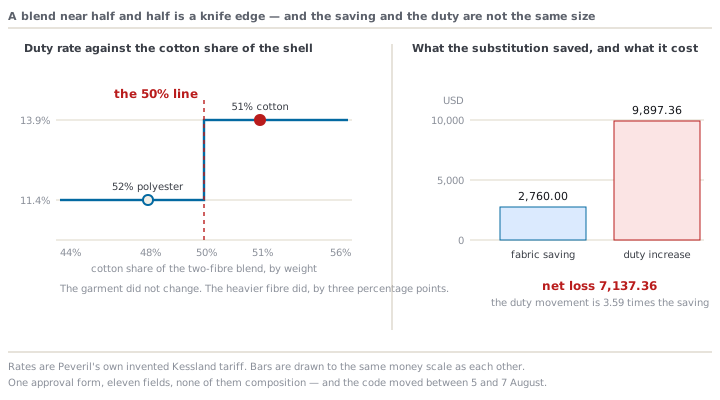
The fabric saving is real: USD 2,760.00 across the order. The duty increase is USD 9,897.36. Net, the substitution cost Peveril USD 7,137.36. The duty movement is 3.59 times the size of the saving that justified it.
Notice two details in that table, because both are places people slip.
The customs value moved too. The substitution reduced the FOB, so the base the rate applies to fell from USD 22.35 to USD 22.20. If you compare the old duty against the old value at the new rate, you overstate the damage. The correct comparison is each rate against its own value. It is still bad.
The rate did not move because the garment changed. The garment is identical: same block, same trims, same hood, same weight, same performance. The only thing that changed is which of two fibres is heavier. It changed by three percentage points, across a boundary at fifty.
The knife edge, and the tolerance that does not save you
A two-fibre blend anywhere near half and half is a classification risk in itself. There is a second trap sitting on top of it.
The fibre-content declaration on a care label lives under a labelling regime. Labelling regimes generally allow a tolerance around a declared composition, because fibre analysis on a finished garment is not exact. A garment lawfully labelled 51% cotton can test at a little either side of that.
The tariff is not asking a labelling question. It wants to know which fibre actually predominates by weight in the goods presented. A blend declared at 51% cotton and tested at 49% is fully compliant on the label and on the wrong side of the tariff line. The two rules are not in conflict. They answer different questions, and nobody told you they were different.
That produces the only control that actually works on this class of risk:
Where a two-fibre blend is inside about five percentage points of a fifty-fifty split, do not classify it from the specification. Test it.
Peveril's laboratory in Kessland quotes USD 88.00 for a quantitative fibre-composition analysis on a made-up garment. Against a duty movement of USD 9,897.36, the test is worth 112 times what it costs, and it takes four working days. The reason it does not get booked is not cost. It is that nobody owns the question.
The mistake nobody made
Suvira's fabric-substitution approval form has been in use for six years and it is a good form. It has fields for: article number, mill, weight, width, construction, shade approval reference, hand assessment, peel strength, price, minimum order quantity and delivery date. All eleven were filled in correctly on 6 August.
There is no field for composition. The form was designed for the substitution everybody expected, which is the same fabric from a different mill, or a different yarn count in the same blend. In those, composition does not change and therefore does not need a field.
So the chain ran like this, and every link is correct:
- Tanaru offered a real solution to a real yarn shortage.
- Suvira put it on the standard form and filled it in properly.
- Peveril's sourcing manager approved it on price, hand, shade and date, which are the four things the form asked him about.
- The broker was not consulted, because a fabric substitution is not a customs event and no rule at Peveril says it is.
- The entry was filed on the code that had always been used. That code was correct on 5 August and wrong on 7 August.
USD 7,137.36, produced by five correct decisions and one missing field.
Check yourselfA blend moves from 52% polyester to 51% cotton and the FOB falls. Which value do you apply the new rate to?Show the answer
The new one. The customs value is built from the price actually paid or payable for the goods as they are being imported. So a substitution that lowers the FOB lowers the base as well as raising the rate. Applying the new rate to the old value overstates the loss, here by enough to change the conversation. Applying the old rate to the new value understates it. Each rate goes against its own value, and the difference between the two totals is what the decision cost.
Everything so far has been about the rate. The rest of this course is about the other half of the multiplication. It moves more often, and more quietly: the value the rate is charged on.