Lessons · Lesson 4 of 6
- 01 · A code is an argument, and the argument has an order
- 02 · Knitted or not, and what a coating does to the answer
- 03 · The fibre threshold, and the substitution that moved the code
- 04 · The value is built, not copied off the invoice
- 05 · Tooling, and where the design work was done
- 06 · When the answer is contested, and what it costs downstream
The value is built, not copied off the invoice
What the duty is charged on when the invoice carries one all-in number, and why the valuation methods have to be tried in order rather than chosen between.
Lesson 4 of 6 · 20 min
The half that moves quietly
Duty is a rate multiplied by a value. Lessons 1 to 3 were about the rate. The rate changes rarely and loudly: a fabric changes, a heading changes, somebody argues. The value changes constantly and quietly, and it is created by your own paperwork.
Course 8.5 builds a customs value from an FOB up. FOB, free on board, is the price of the goods loaded at the port of export. That course covers whether the destination charges on a CIF or an FOB basis, and the additions for buyer-supplied materials and for royalties payable as a condition of sale. Read it, because this lesson does not repeat it. What this lesson owns is the case 8.5 does not reach: what happens when the invoice does not show a build at all.
Transaction value, and why you cannot shop between methods
The internationally agreed primary method is transaction value. That is the price actually paid or payable for the goods when sold for export to the country of importation, with a specified list of additions. It is set out in the WTO Customs Valuation Agreement, formally the Agreement on Implementation of Article VII of the GATT 1994.
Transaction value is not automatic. It is available only where four conditions hold. There is no restriction on the buyer's disposal or use of the goods beyond the ordinary ones. The sale or price is not subject to some condition whose value cannot be determined. No part of the proceeds of resale goes to the seller, unless an adjustment can be made. And the buyer and seller are not related, or, if they are, the relationship did not influence the price.
Where transaction value is unavailable, the Agreement supplies five further methods. Here is the part that changes how a merchandiser reads a broker's email: they are applied in strict sequence, not chosen between. The value of identical goods, then the value of similar goods, then a deductive value worked back from the resale price in the importing country, then a computed value built from the cost of production, and last a fall-back applying the earlier methods flexibly. Only one pair may be swapped, the deductive and computed methods, and only at the importer's request.
You may not reach for a comparable shipment because the invoice is inconvenient. If transaction value can be determined, it is the answer.
Check yourselfYour broker says: the supplier will not break down the price, so we will value this entry using last season's identical shipment. What is wrong with that?Show the answer
It skips a method that is still available. The price actually paid or payable is known, because it is on the invoice. So transaction value can be determined, and the sequence does not let you leave it. What the broker is really saying is that he cannot make the deductions he wants without a breakdown. That is a different problem with a different fix: get the breakdown, or accept the higher value. Reaching for identical goods is not a shortcut past a documentation gap. It is a method that is not open.
One clean number
In late August, 2,400 units of OJ-217 were short-shipped from the first sea container and had to fly. Peveril's merchandising team had spent two seasons arguing with three parties about who owed what on air freight. So it took a decision that reads well in any minute book: ask Suvira to quote one all-in delivered price, everything included, to Peveril's warehouse door.
Suvira quoted USD 29.90 a unit, delivered duty paid. One line on the commercial invoice: 2,400 pieces, style OJ-217, USD 29.90 each.
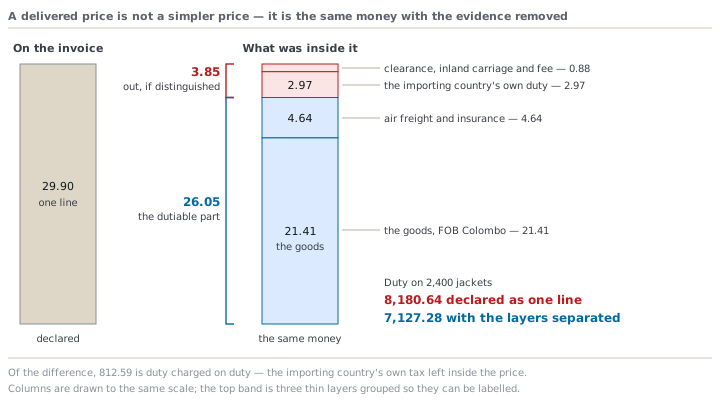
It is a good price and it was built honestly. Peveril's finance team obtained the build three months later, when it was too late to matter:
| Layer | A unit | What it is |
|---|---|---|
| FOB Colombo | 21.41 | The goods |
| Air freight and insurance to Kessland | 4.64 | Carriage to the border |
| Kessland duty at 11.4% | 2.97 | A tax of the importing country |
| Clearance, port and handling in Kessland | 0.34 | Services after arrival |
| Inland carriage, port to Peveril's warehouse | 0.33 | Transport after importation |
| Suvira's fee for arranging it | 0.21 | A service, not the goods |
| All-in delivered price | 29.90 | The one number on the invoice |
The clause the whole thing turns on
The Agreement's interpretative material is explicit that certain charges are not part of the customs value. They are: the cost of transport after importation, duties and taxes of the country of importation, and charges for construction, erection, assembly, maintenance or technical assistance undertaken after importation.
Then it adds seven words that decide this entry: provided that they are distinguished from the price actually paid or payable.
Distinguished. Shown separately. On the document the entry is made from, at the time it is made. Not reconstructed from a supplier's spreadsheet in November. Not explained in an email. Not asserted by the importer.
Nothing on Suvira's invoice was distinguished from anything. So the declared value was USD 29.90.
| One all-in line | Separated on the invoice | |
|---|---|---|
| Declared customs value a unit | 29.90 | 26.05 |
| Rate | 11.4% | 11.4% |
| Duty a unit | 3.4086 | 2.9697 |
| Duty on 2,400 units | 8,180.64 | 7,127.28 |
USD 1,053.36 overpaid. That is USD 0.4389 a jacket, and 14.8% more duty than was owed. On a shipment already flying, which is to say already the expensive one.
Inside that overpayment sits the line that upsets people the first time they see it. The Kessland duty of USD 2.97 a unit was itself inside the declared value. So Peveril paid 11.4% on its own duty: USD 812.59 of duty charged on duty, on 2,400 jackets. That is not a penalty and nobody did anything improper. It is simply what happens when a tax of the importing country is not distinguished from the price of the goods.
Why nobody caught it
The decision to buy one all-in number was taken to remove an argument, and it removed it. The freight desk stopped reconciling three sets of charges. The invoice was checked, and it was correct. The broker declared what the invoice said, which is what a broker is supposed to do. The duty was paid, on time, with no query.
Everything worked. The only thing that happened is that the one document capable of reducing the duty was replaced by a simpler document. It was replaced by people solving a real problem that had nothing to do with customs.
That is the shape of this whole course, and it is why a merchandiser is the right person to catch it. The decisions that move duty are almost never taken by anyone who is thinking about duty.
What to ask for, in one sentence
You do not need to become a valuation specialist. You need one habit.
Whenever a price is quoted on any term beyond the port of export, ask the supplier to show the breakdown on the invoice itself: goods, international carriage and insurance, and each post-arrival charge on its own line.
Suppliers agree to this far more often than people expect, because it costs them nothing. The numbers already exist in their quotation. What they will not do is produce it three months later with a customs officer reading over your shoulder. And by then it would not help, because the value was determined on the document that was actually presented.
Prompt · Take this delivered price apart before it is declared
The day a supplier or forwarder quotes you one all-in number to a destination beyond the port of export, and before an entry is filed on it.
Act as a customs valuation specialist advising an importer who buys on delivered terms and has never asked what is inside the price. Take one quoted price apart. The quote: [PRICE PER UNIT AND CURRENCY], term [INCOTERM AND NAMED PLACE], quantity [UNITS], goods [DESCRIBE], seller [WHO AND WHERE], buyer [WHO AND WHERE], mode [SEA, AIR OR ROAD]. What I know or can guess about the build: FOB or ex-works price [AMOUNT OR UNKNOWN], international freight [AMOUNT OR UNKNOWN], insurance [AMOUNT OR UNKNOWN], duty [AMOUNT OR UNKNOWN], clearance and port charges at destination [AMOUNT OR UNKNOWN], inland carriage after arrival [AMOUNT OR UNKNOWN], the seller's fee for arranging any of it [AMOUNT OR UNKNOWN]. My destination values goods on a [CIF OR FOB] basis. Duty rate I expect [PERCENT]. Do the following. First, rebuild the quote as a layered price and mark each layer as part of the customs value, outside it, or arguable. Second, compute the duty two ways: on the whole quoted price as a single undivided line, and on the properly built customs value. Give me the difference per unit and on the shipment. Third, tell me how much of that difference is duty charged on duty, if the term makes the seller pay the import duty. Fourth, write me the exact wording I should ask the seller to put on the commercial invoice so each deductible layer is DISTINGUISHED from the price paid, and say why an email or a later spreadsheet will not do the same job. Fifth, name anything in this arrangement that could take me out of transaction value altogether, such as a related seller, a resale condition, or a restriction on my use of the goods. Label every figure you had to assume, and give me the totals again with those assumptions set to zero so I can see how much of your answer rests on them.
AI can make mistakes — check anything you act on.