Lessons · Lesson 2 of 6
Cleared is not available
Follow one pair of containers from discharge to the warehouse floor, and price the gap that opens after customs has already finished.
Lesson 2 of 6 · 22 min
The email everybody believed
Tuesday 24 March, 11:47. Corbray Brokerage handles Marbeck Vantoria's imports at the Port of Ostrand. It sends four lines to the import desk.
Entry accepted and released 24/03 11:40. No exam. Two 40 ft units, MARB-SDN-6120. Congratulations, ahead of plan.
The import desk forwards it to the buying office in the same minute and adds one word: "cleared". The merchandiser updates the order: customs complete, 2 days ahead of the calendar. The spring floor-set for the WJ-518 field jacket is Monday 30 March. Six days in hand.
Half the jackets reached the distribution centre floor on Tuesday 31 March. The other half on Thursday 2 April. Both halves missed the floor-set.
Nothing went wrong. No document was rejected. No container was examined. Every party did its job at normal speed. This lesson is the hour-by-hour account of how seven days appeared after customs had finished, and what those days cost.
The nine days, hour by hour
| When | What happened | Who owned it |
|---|---|---|
| Thu 19 Mar | Import declaration lodged pre-arrival | Corbray Brokerage |
| Sat 21 Mar | Vessel berths at Ostrand | The carrier |
| Sun 22 Mar, 06:00 | Discharge complete. Terminal free time starts | The terminal |
| Tue 24 Mar, 11:40 | Released by customs | Customs |
| Wed 25 Mar, 09:15 | Bank releases the original bills of lading to Marbeck | Marbeck treasury |
| Wed 25 Mar, 16:20 | Carrier issues the delivery order | The carrier |
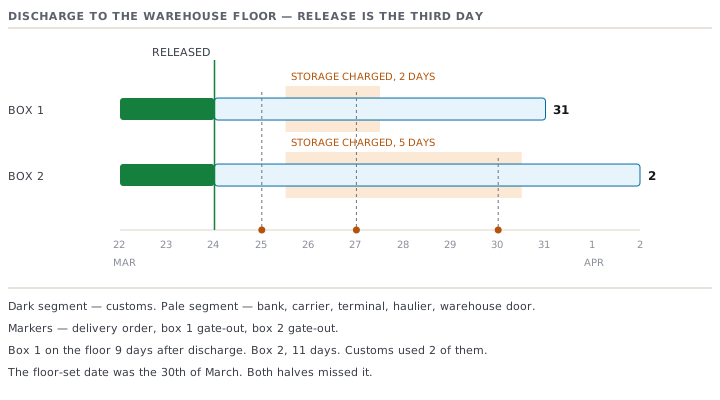
| Thu 26 Mar | Terminal storage begins on both units | The terminal |
| Fri 27 Mar | Container 1 gates out on the haulier's booked slot | The haulier |
| Mon 30 Mar | Container 2 gates out on the haulier's next slot | The haulier |
| Tue 31 Mar | Container 1 received and put away | The Marbeck DC |
| Thu 2 Apr | Container 2 received and put away | The Marbeck DC |
Read the owner column again. After 24 March, customs appears nowhere. The remaining seven and nine days were made by a bank, a carrier, a terminal booking system, a haulage contract and a warehouse receiving calendar.
The five gates after release
Gate one: the bill of lading. The bill of lading is the carrier's receipt for the goods and the proof of who may collect them. The carrier will not hand goods to anybody who cannot prove they are entitled to them. With an original negotiable bill, that proof is the document itself, handed over. Sindiyan's originals went to Marbeck's bank under the payment terms. The bank released them on the morning of 25 March, once Marbeck had checked and accepted the documents. Marbeck's document-checking desk runs a two-working-day cycle. That cycle is the whole of the 24-to-25 March delay. It belongs to track 13, which owns the trade-finance reason a bank is holding your delivery documents at all. Note the trade-off honestly: the bank holds them because that is the security the seller was paid against. An express bill of lading would remove the gate, and remove the seller's security with it.
Gate two: the delivery order. Issued at 16:20 on 25 March, too late to pull a box the same day. The carrier also required the freight to be paid, which it was.
Gate three: the terminal's storage clock. On its own published tariff, the Ostrand terminal gives 4 free calendar days from discharge. Then it charges USD 42.00 a container a day for the next four days, and USD 84.00 a day after that. Free time covered 22, 23, 24 and 25 March. Storage started on the 26th for both units, when the delivery order was less than a day old.
Gate four: the terminal slot. Ostrand runs a vehicle booking system. Marbeck's haulier holds two container slots a week on this lane, on Fridays and Mondays. Container 1 took the Friday slot on 27 March. Container 2 waited for Monday 30 March.
Gate five: the receiving door. Marbeck Vantoria's distribution centre takes container deliveries by appointment on Tuesdays and Thursdays only. Container 1 gated out on Friday and was received on Tuesday 31 March. Container 2 gated out on Monday and was received on Thursday 2 April.
Five gates, five owners, and not one of them is customs.
What it cost
| Line | Working | Amount |
|---|---|---|
| Terminal storage, container 1 | 2 days at USD 42.00 | USD 84.00 |
| Terminal storage, container 2 | 4 days at USD 42.00 plus 1 at USD 84.00 | USD 252.00 |
| Container detention | Both empties returned inside the carrier's free days | USD 0.00 |
| Late to floor-set, container 1 | 7,200 jackets, 1 day, at Marbeck's own USD 0.09 a unit a day | USD 648.00 |
| Late to floor-set, container 2 | 7,200 jackets, 3 days, same rate | USD 1,944.00 |
| Total | USD 2,928.00 |
Two things in that table are worth a pause.
The detention line is zero. That is not luck. It is a different clock. Storage is what the terminal charges for a box sitting in its yard, counted from discharge. Detention is what the carrier charges for its box being away from the terminal, counted from gate-out. Container 2 sat for nine days building up storage and never built up a minute of detention, because it had not left. People merge the two into one word and then plan for the wrong one.
The USD 0.09 a unit a day is Marbeck's own internal figure. It is the provision its planners carry for a garment that arrives after its floor-set date. It is not a market rate, and there is no such thing as a market rate for it. Your company has its own number, or it should. If it does not, lesson 5 shows how to work one out. Without it you cannot make any of the decisions below.
The mistake nobody made
Go back through the eleven rows of the timeline and look for the error. There is not one.
The broker lodged the entry two days before the vessel arrived, which is good practice. Customs released in two days against a calendar allowance of three. The bank released the documents the morning after acceptance. The carrier issued the delivery order the same day it had the right to. The terminal charged its published tariff. The haulier used the slots it holds. The distribution centre received on its normal days.
Every single decision was correct, and the result was a missed floor-set. This course keeps returning to that shape. The reason it happens here is structural: nobody owned the interval. Corbray owned the events up to release. The treasury owned the documents. The haulier owned the slots. The DC owned the door. The merchandiser owned the floor-set date, and had a calendar with one box on it.
It was computable on 20 February
The most useful thing about this gap is that none of it was a surprise. Every input existed a month before the vessel sailed.
- Ostrand publishes 4 free days and its storage tariff.
- Marbeck's haulage contract gives two slots a week on this lane, Fridays and Mondays.
- Marbeck Vantoria's distribution centre publishes its container receiving days a month ahead.
- The payment terms on PO SDN-6120 send the original bills of lading through a bank, and Marbeck's own document desk runs a two-day cycle.
Put those four facts against an arrival on Saturday 21 March and the answer falls out. Earliest possible delivery order: Wednesday. First haulage slot: Friday. First receiving day: Tuesday. 31 March. A merchandiser with a nine-box calendar would have written that date in February, and would have warned the buying team the floor-set was at risk before the container was even packed.
What USD 935.00 would have bought
None of the five gates was fixed. Each one had a price.
- An out-of-window container receipt at the Marbeck DC costs the warehouse USD 180.00 in overtime. Container 1 could have been received on Friday 27 March.
- A premium slot in the Ostrand booking system costs USD 310.00, and a dedicated haulage move outside the contracted slots costs USD 265.00. Container 2 could have gated out on Friday 27 March too.
Both containers on the floor on Friday 27 March, three days before the floor-set. The bill would have been USD 935.00 of extra handling plus USD 168.00 of storage instead of USD 336.00. That is USD 1,103.00 against the USD 2,928.00 actually spent. The difference is USD 1,825.00, and the jackets would have been on the shop floor on time.
The one line to change
Stop reporting cleared. Report available on the floor, and report it as a date.
Customs release is an input to that date. It is not a substitute for it. In a status meeting the two sentences sound the same, and they are more than a week apart. Make your import desk, your broker and your own updates all carry the same field, and make it the field the buying team actually acts on.
Check yourselfContainer 2 sat in the terminal for nine days after discharge. Why was the carrier's detention charge zero, and what would have made it non-zero?Show the answer
Detention is the carrier's charge for its container being away from the terminal, and container 2 did not leave until 30 March. What ran for nine days was storage: the terminal's charge for the box taking up space in its yard. Detention would have started at gate-out on 30 March, and would only have become payable if the empty had not come back inside the carrier's free days. It was returned on 6 April, inside them. The trap is that a delay before gate-out and a delay after it are billed by different parties on different clocks. A plan that budgets for one is uncovered on the other.