Lessons · Lesson 5 of 6
What a clearance day is worth
Work out the clearance allowance your calendar should carry from your own broker's history and your own cost of being late, instead of from habit.
Lesson 5 of 6 · 19 min
Where did three days come from
Every calendar in this course has the same box on it: customs, 3 days. Ask the merchandiser who wrote it where the three came from. The answer is always some version of that is what we have always used.
It is not a stupid number. It is close to the average, which is why it survives. It is also wrong, in a specific and expensive way, and the material to correct it is sitting in your broker's file.
Your own distribution, not the market's
Corbray Brokerage timestamps every event on every consignment. It was asked for one table: days from discharge complete to customs release, for the 96 Marbeck Vantoria consignments in the year to March. This is what came back.
| Days | Consignments | Share | Cumulative |
|---|---|---|---|
| 1 | 22 | 22.92% | 22.92% |
| 2 | 31 | 32.29% | 55.21% |
| 3 | 22 | 22.92% | 78.13% |
| 4 | 11 | 11.46% | 89.58% |
| 5 | 5 | 5.21% | 94.79% |
| 6 | 2 | 2.08% | 96.88% |
| 8 | 2 | 2.08% | 98.96% |
| 11 | 1 | 1.04% | 100.00% |
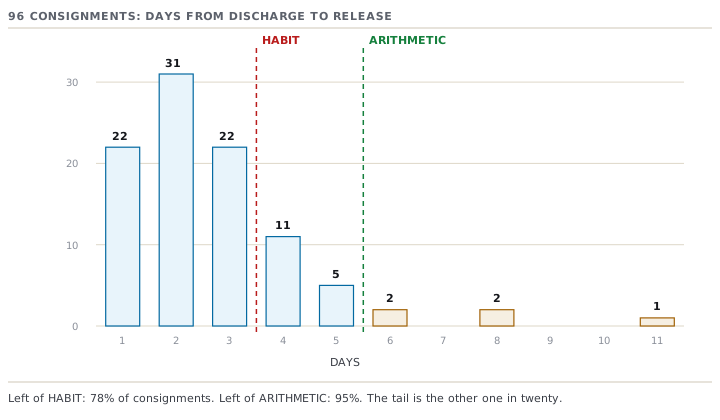
The mean is 2.69 days and the median is 2. So the habitual three days is generous against the average, and it still covers only 78.13% of consignments. One shipment in five arrives at a calendar that has already run out.
That is the first correction. A calendar is not built against an average, because you do not ship an average consignment. You ship this one.
The two prices
Which allowance is right depends on two numbers that have nothing to do with customs. Both of them belong to your own company.
What a day of buffer costs. You buy a day of buffer by shipping a day earlier. The ex-factory date moves back, the goods spend an extra day in transit, and they sit at the distribution centre an extra day before anybody wants them. A Marbeck Vantoria consignment of 14,400 jackets at its own landed cost of USD 21.60 a piece — built the way track 8.5 builds one — is USD 311,040 of value. Marbeck's internal capital charge is 9.0% a year, so a day of that is USD 76.69. Its distribution centre charges its own buying teams USD 41.31 a day to hold a consignment of this size ahead of its floor date. Call it USD 118.00 a day.
What a day of exception costs. Marbeck's planners provide USD 0.09 a unit a day for a garment that arrives after its floor-set date. On 14,400 jackets that is USD 1,296.00 a day.
The ratio between the two is the whole decision: USD 118.00 against USD 1,296.00, which is 9.10%.
The rule
Prompt · Price the buffer against the exception
Use this when you are about to write a clearance allowance into a calendar and the only reason for the number is that it is the one you used last season.
Act as a supply chain analyst who is comfortable with probability and refuses to give a single-point answer where a distribution exists. I want to size the clearance allowance in my calendar from evidence rather than habit. My data, from my broker's own file: for the last [N] consignments into [MARKET], the number of days from discharge to customs release was [PASTE THE LIST, OR THE COUNT AT EACH NUMBER OF DAYS]. My costs: consignment size [PIECES], landed cost per piece [AMOUNT], my company's annual cost of capital [PERCENT], any daily warehouse holding charge for arriving early [AMOUNT], and my company's own provision for a unit arriving after its required date [AMOUNT PER UNIT PER DAY — if I do not have one, tell me who owns that number and what question to ask them]. Do the following. First, give me the distribution as a table with counts, shares and a cumulative column, plus the mean, the median, and the days at which ninety and ninety-five per cent of consignments have cleared. Second, compute what one day of buffer costs me and what one day of exception costs me, showing how you build each. Third, apply the rule that another day of buffer is worth buying while the chance of needing it is greater than the ratio of those two costs, and step through it day by day. Fourth, produce a total expected cost for each allowance from one day to ten. Tell me where the minimum is AND how flat the curve is around it. If two allowances sit within the error of my inputs, say so rather than quoting a winner. Fifth, tell me who pays for the extra days, because a longer clearance allowance usually means an earlier ex-factory date, and name what I should say to the factory. Sixth, list what would invalidate this analysis, and how often I should rebuild it. Do not recommend a number to a decimal place.
AI can make mistakes — check anything you act on.
Add another day of buffer as long as the chance of actually needing it is greater than the ratio of the two costs. Below that ratio, the buffer costs more than the exception it prevents.
Read the probabilities straight off the cumulative column:
- Chance of needing more than 3 days: 21.88%. Well above 9.10%, so buy day 4.
- Chance of needing more than 4 days: 10.42%. Still above 9.10%, so buy day 5.
- Chance of needing more than 5 days: 5.21%. Below 9.10%. Stop.
The allowance is five days, not three. Check that against the total cost of each policy, taking the expected exception days from the distribution.
| Allowance | Buffer cost | Expected exception cost | Total |
|---|---|---|---|
| 3 days | USD 354.00 | USD 607.50 | USD 961.50 |
| 4 days | USD 472.00 | USD 324.00 | USD 796.00 |
| 5 days | USD 590.00 | USD 189.00 | USD 779.00 |
| 6 days | USD 708.00 | USD 121.50 | USD 829.50 |
Five days is the cheapest, at USD 779.00 against USD 961.50 for the habitual three. That is USD 182.50 a consignment. Across Marbeck Vantoria's 96 consignments a year, it is USD 17,520.00.
What the two extra days actually cost somebody
The buffer is not free, and the person who pays for it is not the person who benefits. Two more days of clearance allowance means the ex-factory date moves two days earlier. That shortens the factory's production window by two days, on a calendar that track 7 owns and that was already tight.
That is a real cost, and it lands on the factory, not on the importer. So the conversation to have is not "we are adding two days". It is "we are adding two days, here is the distribution it came from, and here is what we will do about the ex-factory date". A buffer imposed without that conversation gets absorbed by the factory shipping late, which is exactly the outcome the buffer was bought to prevent.
A buffer only works if nobody spends it
The most common way a correctly sized buffer fails is not that the distribution changes. It is that everybody can see it.
Publish a five-day clearance allowance and within two seasons it becomes a five-day-later ex-factory date. Every person upstream who is under pressure will take the slack that is lying there in plain sight. The buffer was bought to absorb a customs event, and it has quietly been re-spent on a sampling delay.
Three disciplines keep it:
- Put the buffer at the end, between availability and the commercial date. A buffer spent before the risk it covers has protected nothing.
- One owner. The person who owns the floor-set date owns the buffer. It is not published upstream as slack in the sampling or production calendar.
- Measure whether it is being used. If the allowance is five days and the last twenty consignments have all cleared in two, that is not a buffer working. That is a buffer that has already migrated somewhere upstream and is no longer between you and the risk.
Three honest limits
This is your traffic, not a market fact. Ninety-six consignments through one broker, in one market, on one commodity. Corbray's distribution does not describe Norhavn. It does not describe another importer's traffic in Vantoria. And it does not describe your first shipment on a new lane. Build it per market and per broker, or do not build it.
It assumes next year looks like last year. That holds until a new advance-filing requirement lands, a port congests, an authority changes its risk profile for your commodity, or your own supplier changes. Recompute the table each season. It takes an hour, and your broker exports it.
It needs a real exception cost. Everything above turns on Marbeck's USD 0.09 a unit a day. If your company has never worked that number out, the optimum is genuinely undefined. Falling back on three days is then not a plan. It is a guess wearing a plan's clothes. Getting the number is a conversation with whoever owns the markdown provision, and it is the single most useful hour a merchandiser can spend on this subject.
Check yourselfYour broker's history shows 89.58% of consignments cleared within four days. Buffer costs USD 118.00 a day and an exception costs USD 1,296.00 a day. Should you carry four days or five?Show the answer
Five, or arguably four, but definitely not three. The test is whether the chance of needing another day beats the cost ratio, which is 118.00 divided by 1,296.00, or 9.10%. The chance of needing more than four days is 100.00% minus 89.58%, which is 10.42%. That is above the ratio, so the fifth day pays for itself. The chance of needing more than five is 5.21%, below the ratio, so the sixth does not. In total cost the two policies are USD 796.00 and USD 779.00. They are close enough that either is defensible, and that is exactly what you should say out loud rather than quoting the winner to the cent.