Lessons · Lesson 1 of 6
Nine events, five owners, one box
Replace the one box on your calendar marked customs with the nine real events between a loaded container and a pallet on your floor, and put a name against each one.
Lesson 1 of 6 · 20 min
One order, three borders
3 March, Alexandria. Sindiyan Apparel of Zagazig has just loaded PO SDN-6120 onto the vessel: 28,800 women's cotton-twill field jackets, style WJ-518, one colour, five sizes. The price is FOB Alexandria USD 18.40. FOB means the factory's price up to the moment the goods are on board. Order value USD 529,920.
The order is not one shipment. Marbeck is a mid-market clothing group. It buys through one buying office, but it imports through three separate companies in three separate customs territories. The jackets are split between them:
| Consignee | Jackets | Cartons | Gross weight | Volume | Mode |
|---|---|---|---|---|---|
| Marbeck Vantoria | 14,400 | 1,200 | 9,720 kg | 115.2 m3 | Two 40 ft high-cube containers |
| Marbeck Norhavn | 8,640 | 720 | 5,832 kg | 69.12 m3 | One 40 ft high-cube container |
| Marbeck Falkstead | 5,760 | 480 | 3,888 kg | 46.08 m3 | Part of a consolidated container |
Twelve jackets go in a carton. Each carton weighs 8.10 kg gross. The merchandiser who built the calendar for this order is good at the job and has run this lane for four seasons. Her plan has one box between the vessel and the distribution centre. It says customs, 3 days.
That box is the subject of this course. It is wrong, and the number inside it is not the problem.
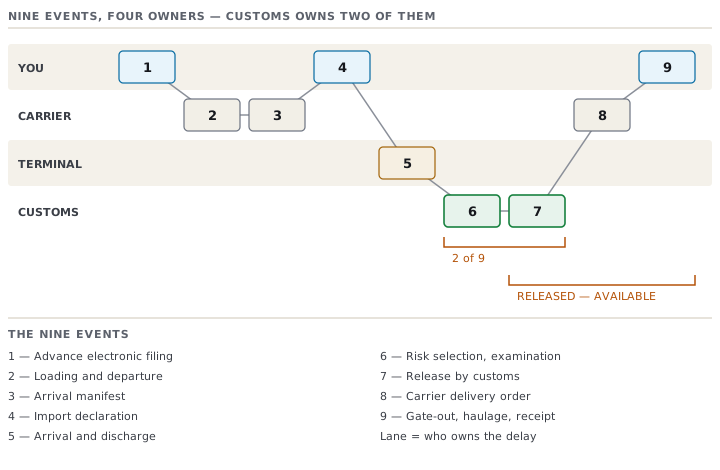
The box that says customs is one of nine events
The container doors are sealed at Zagazig. Weeks later a pallet of WJ-518 is ready to pick in a Marbeck warehouse. Nine separate things have to happen in between. They happen in order. Most of them cannot start until the one before has finished. And customs owns exactly one of them.
| Event | Owner | Earliest it can happen | What blocks it | |
|---|---|---|---|---|
| 1 | Advance electronic filing of cargo information | The importer or the carrier, depending on the market | Before loading, or before arrival | Nobody has the final packing data |
| 2 | Loading and departure | The carrier | Cut-off at the origin terminal | The filing above is not accepted |
| 3 | Arrival manifest lodged | The carrier | Before arrival | Nothing you own |
| 4 | Import declaration lodged | Your broker | Often before arrival | The document set is not in the broker's hands |
| 5 | Arrival, berthing and discharge | The carrier and the terminal | On the vessel's schedule | Berth congestion, weather |
| 6 | Risk selection and any examination | Customs | On or before arrival | Nothing you own once the entry is in |
| 7 | Release by customs | Customs | When 4, 5 and 6 are done | Duty payment, in markets where it gates release |
| 8 | Carrier's delivery order | The carrier | When freight is paid and the bill of lading is surrendered | Your own bank, your own accounts payable |
| 9 | Gate-out, haulage and receipt at the warehouse | Your haulier and your own warehouse | When 7 and 8 are both done | Terminal slots, warehouse receiving windows |
Look at the owner column. Five different organisations appear there, and only one of them is the customs authority. Three of the nine events are yours: the advance filing, the declaration and the last one. Yours means the delay happens inside your own company, or at a company you pay.
That is the first correction the calendar box needs. It does not say "customs, 3 days". It says "the last four events, three of which I own, 3 days".
Two words that are not the same
The most expensive confusion in import clearance is between two words that sound alike.
Released is something customs does. The authority has finished with the consignment. The entry is accepted, the duty is paid or secured, and customs no longer objects to the goods entering the country. That is event 7.
Available is a physical fact about your warehouse. The goods are on your floor, counted, put away, and a picker can reach them. That is event 9.
In between sit the carrier's delivery order, the terminal gate, a truck, a road, and your own receiving door. On the Vantoria leg of this order those two events are seven days apart for half the shipment and nine days apart for the other half. Lesson 2 walks that gap hour by hour. Nobody was late. No document was wrong. Customs did nothing but release the goods quickly.
So a merchandiser who reports "cleared" to the buying team has told them nothing useful. The buying team hears "available".
Three clocks, and only one of them is customs
While the nine events run, three clocks are running too. They are not the same clock.
Free time at the terminal. The terminal stores your container for a stated number of days after discharge at no charge, then bills you by the day. This clock starts at discharge. It does not care whether customs has released the goods. A consignment held for a document query keeps building up storage the whole time.
Free time on the container. The carrier lends you its box for a stated number of days. That count usually starts when the box leaves the terminal, and the carrier bills you by the day until you return it empty. So this clock starts later than the first one, and it keeps running after your goods are already in the warehouse.
Your own commercial clock. The date the jackets have to be on a shop floor, in a photograph, or in a customer's hands. This is the only clock that is about the product. It is also the only one nobody at the port can see.
The two port clocks come from the contracts you signed with the carrier and the terminal, not from customs. Track 12.4 calls that the carriage relationship. The third clock belongs to track 7, which owns the order's critical path. Nothing in your calendar reconciles the three for you.
The four questions that decide a market's calendar
Four answers about a destination market decide what your calendar has to look like. They come before the duty rate matters. The duty rate is track 12.2's ground, and the landed-cost arithmetic that follows is track 8.5's. The four questions are the same in every market. The answers are not.
- What has to be filed, by whom, and how long before the goods move? A filing due before the container is loaded at origin puts a deadline inside the factory's packing week, not inside the destination's clearance week.
- Can the import declaration be lodged before the vessel arrives? If it can, events 4 and 5 overlap and the clearance week gets shorter. If it cannot, they queue.
- Does duty payment gate the release, or is it settled afterwards on an account? If payment gates release, your treasury department is now on the critical path, with its own cut-off times.
- How many separate authorities can put a hold on the same box? Customs is rarely the only one. A product-safety body, a textile-labelling authority or an agricultural inspectorate looking at a wooden pallet can each stop the goods on their own. Some of them do not talk to customs at all.
Lesson 6 answers those four for Vantoria, Norhavn and Falkstead. One sailing on 3 March produces three different calendars. The answers are not opinions, and they are not hard to get. Your broker in each market knows all four, and has never been asked.
Check yourselfYour broker emails at 11:40 to say the container has been released. Your buying director asks when the goods will be on the floor. What do you still not know?Show the answer
Everything after event 7. Whether the carrier has issued a delivery order, which needs the freight paid and the bill of lading surrendered. Whether your haulier can get a terminal slot. And whether your own warehouse takes container deliveries on the day the haulier can come. On the Vantoria leg of PO SDN-6120 those three unknowns are worth seven days for half the shipment and nine for the rest. None of them is a customs question.
What to do on Monday
Prompt · Build the nine-event clearance calendar for one market
Use this before you write a clearance allowance into a calendar for a destination market. Use it again whenever a shipment is reported as cleared and the buying team still cannot be told when the goods will be on the floor.
Act as an experienced import operations manager who has cleared apparel into this market for years and has no interest in flattering anybody. I want a clearance calendar for one consignment, built as a chain of events rather than a single allowance. Shipment facts: origin port [PORT], destination market [MARKET], destination port [PORT], carrier [NAME], vessel ETA [DATE], mode [FCL OR LCL AND CONTAINER TYPE], commodity [DESCRIPTION], quantity [PIECES] in [CARTONS] cartons, gross weight [KG], volume [CBM], Incoterm [TERM], payment terms [TERMS AND WHETHER ORIGINAL BILLS OF LADING GO THROUGH A BANK]. My parties: forwarder [NAME], customs broker [NAME], haulier [NAME], my own distribution centre [LOCATION AND ITS CONTAINER RECEIVING DAYS]. Do the following. First, lay out the nine events between the origin cut-off and the goods being available to pick. Against each one, put the owning organisation, and where it is my own company, the department. Second, answer four questions for this destination market and say how confident you are in each: what advance filing is required, by whom, and how long before the goods move; whether the import declaration can be lodged before arrival; whether duty payment gates release or is settled afterwards; and how many separate authorities can place a hold. Third, tell me which of the nine events sit on the critical path for MY ship date and which have slack. Fourth, list the three clocks running in parallel — terminal free time, container free time and my own commercial date — and say where I have to look up each one. Fifth, produce the calendar as dated rows from the vessel ETA to availability, marking every date that depends on somebody in my own company. Sixth, tell me which inputs you had to assume, and for each one name the person or document that would settle it. Do not give me a single customs allowance in days. If you cannot break it down, say so.
AI can make mistakes — check anything you act on.
Take one destination market and one recent consignment. Write the nine events down the page with three columns: the date each one really happened, the name of the person or company that made it happen, and the gap in days from the event above. Do not estimate anything. Get the real timestamps from the broker's file, the carrier's tracking and your own warehouse receipt.
You will find one of two things. Either the largest gap sits somewhere in events 7 to 9, which means your calendar's clearance allowance is being spent on something that is not clearance. Or the largest gap is at event 4, which means the document set reached your broker too late. Lesson 4 shows how a small delay there turns into weeks.
Either way, you now have a calendar with nine boxes and a name in each. That is the deliverable of this course, and it is worth more than any number in it.