Lessons · Lesson 2 of 6
- 01 · Agent or carrier: what your forwarder actually sold you
- 02 · Reading a quote: the freight figure and everything after it
- 03 · Making two quotes comparable
- 04 · Nominated or your own: who chooses the forwarder, and what it costs
- 05 · The booking, the cut-offs, and the roll
- 06 · The broker: choosing one, and what you must give them
Reading a quote: the freight figure and everything after it
Take one forwarder's quotation apart line by line, and rebuild it as the number that actually leaves the bank account.
Lesson 2 of 6 · 20 min
The email, and the invoice
Halvorn Logistics quoted PO NBK-7714 in one sentence:
USD 1,340 per 40'HC, Alexandria to Rotterdam, transit 21 days, rate valid to end of month.
That is an honest quotation. It says what it is quoting: ocean freight, port to port. It does not pretend to be anything else. Nine weeks later the same shipment had cost USD 3,491 to move from Fanara's loading bay to Norlbeck's distribution centre.
The number in the email is 38.4% of the number that was paid. Nothing went wrong to produce the other 61.6%. Every one of those lines is a real service somebody performed, and almost all of them could have been foreseen on the day the quote was sent.
| Block | Line | USD |
|---|---|---|
| Origin | Export customs declaration | 65 |
| Origin | Inland haulage, factory to Alexandria | 385 |
| Origin | Port service and lift-on | 40 |
| Origin | Terminal handling, origin | 210 |
| Origin | Bill of lading documentation | 55 |
| Origin | Verified gross mass submission | 15 |
| Origin | Seal | 8 |
| Origin | Origin subtotal | 778 |
| Ocean | Basic ocean freight — the quoted number | 1,340 |
| Ocean | Low-sulphur fuel surcharge | 186 |
| Ocean | Peak-season surcharge | 250 |
| Ocean | Carrier security fee | 12 |
| Ocean | Freight documentation | 45 |
| Ocean | Ocean subtotal | 1,833 |
| Destination | Terminal handling, destination | 305 |
| Destination | Import customs entry | 95 |
| Destination | Port release and handling | 60 |
| Destination | Delivery to the distribution centre | 420 |
| Destination | Destination subtotal | 880 |
| Door to door | 3,491 |
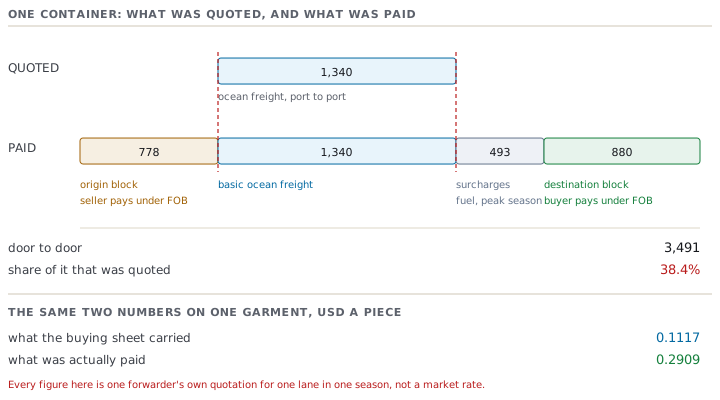
The three blocks, and why they behave differently
Origin charges are local. They are billed in the exporting country, and under FOB they are the seller's cost. Fanara paid all seven of those lines. This is the block a factory can actually negotiate, and the block a factory most often never looks at, because the lines arrive in the accounts as one entry called "export expenses".
The ocean block belongs to the carrier, and it is where the surcharges live. A surcharge is an extra charge named separately from the freight rate. Two of them are worth understanding rather than simply accepting:
- The low-sulphur surcharge is not an invention. Ships burn fuel oil, and an international convention caps how much sulphur that oil may contain. Outside emission control areas the cap came down to 0.50% by mass from 3.50% at the start of 2020. Compliant fuel costs more. Carriers recover the difference through a named surcharge that moves with a published fuel index. That is exactly why it is quoted separately: it is the part of the price the carrier will not fix with you for three months.
- The peak-season surcharge is pure supply and demand. It is applied for a stated period, and it is the one that turns a rate agreed in May into a different rate in September. A quotation that says "rate valid to end of month" is telling you about the basic freight, not about this.
Destination charges are local again. They are billed in the importing country, and under FOB they are the buyer's cost. Norlbeck paid those four lines and never showed them to Fanara. How they roll up into a landed cost per garment, alongside duty and the customs value, is course 8.5. Here we are only counting them.
The lines that only appear if something happens
The twenty lines above are the ones you can predict. A freight file also carries conditional charges, and they usually depend on your behaviour rather than the carrier's:
- Detention is the daily charge for keeping the carrier's container beyond the free period, whether it is at your factory or in the consignee's yard. Halvorn charges USD 48 a day after ten free days at destination.
- Demurrage is the daily charge for leaving the container inside the terminal beyond the free period. Different clock, different owner. It is often confused with detention, and the confusion matters, because the two have different free periods and different ways out.
- Amendment fees are charged for changing a document after it has been issued, or a declaration after it has been filed.
- Storage is charged at the origin depot if you deliver early, and at the destination terminal if nobody collects.
None of these are on the quote. All of them are in the tariff behind it. Ask for that tariff before you book, not after the first invoice.
The mistake nobody made
Norlbeck's buying sheet has a field called freight. On the VG-330 line, that field said 0.1117, which is USD 1,340 divided by 12,000 pieces. It came from Halvorn's quotation. It was entered by a merchandiser who had asked the right person for the right thing. It was arithmetically correct.
The freight Norlbeck actually paid, door to door, was 0.2909 a piece. The gap is 0.1792 a piece. That is USD 2,151 on this container, and Norlbeck moves 46 containers a season on this lane, so USD 98,946 across the season — sitting inside a cost sheet that every reviewer had signed.
Nobody lied. Halvorn quoted ocean freight and labelled it ocean freight. The buying sheet asked for freight and got freight. The failure is in the join between an honest quotation and a field with the same name and a wider meaning. It is invisible because both halves are right.
The fix is one sentence added to the buying sheet: freight here means door to door, all blocks, including the charges the destination office bills us. After that, a quotation answering a narrower question cannot be pasted into it.
Check yourselfUnder FOB Alexandria, which of the three blocks does the factory pay, and why does that make the factory the wrong person to ask 'what does freight cost'?Show the answer
The factory pays the origin block only. On this shipment that is USD 778 of the USD 3,491. It never sees the ocean surcharges or the destination charges, because under FOB they belong to the buyer. So a factory quoting "freight" from its own experience is quoting a quarter of the number, honestly. Anyone building a landed cost needs all three blocks, and only the party who pays each block can produce it.