Lessons · Lesson 1 of 6
- 01 · Agent or carrier: what your forwarder actually sold you
- 02 · Reading a quote: the freight figure and everything after it
- 03 · Making two quotes comparable
- 04 · Nominated or your own: who chooses the forwarder, and what it costs
- 05 · The booking, the cut-offs, and the roll
- 06 · The broker: choosing one, and what you must give them
Agent or carrier: what your forwarder actually sold you
Use the documents in your own file to tell whether your forwarder booked the ship or became the ship, and see what that changes when you claim.
Lesson 1 of 6 · 22 min
One container, one loss, and a claim that went almost nowhere
Fanara Apparel, in Abu Hammad, ships PO NBK-7714 to Norlbeck, a mid-market outerwear retailer in Rotterdam. Style VG-330 is a quilted gilet: 12,000 pieces at USD 14.20 each, FOB Alexandria. Order value USD 170,400. FOB means the seller's price stops once the goods are on board; everything after that is the buyer's cost.
The gilets are packed 16 to a carton, so 750 cartons. Each carton is 60 by 40 by 36 centimetres. That is 0.0864 cubic metres and 9.6 kilogrammes per carton, and 64.8 cubic metres and 7,200 kilogrammes of gross weight in one forty-foot high-cube container.
The forwarder is Halvorn Logistics. Norlbeck chose it. The box sails from Alexandria and arrives at Rotterdam. When it is opened at Norlbeck's distribution centre, forty-one cartons at the door end are water-stained right through to the garments. Forty-one cartons is 656 gilets. At the invoiced price that is USD 9,315.20 of ruined stock.
Everybody does the right thing. The damage is noted on the delivery receipt. The cartons are photographed. A survey is arranged. A claim goes in. Norlbeck's cargo insurer pays it. How that policy works, what it covers and how a claim is presented is course 12.8, and this course stops at the door of it. What matters here is what the insurer does next on Norlbeck's behalf: get the money back from whoever carried the goods.
That recovery came back at USD 1,102.08.
Nobody made a mistake. The gap of USD 8,213.12 was created by two words in a document that four people read, and by one line of typing that none of them was looking for.
There are two contracts of carriage, and you may only have one of them
A freight forwarder can stand in two completely different places. The word "forwarder" covers both.
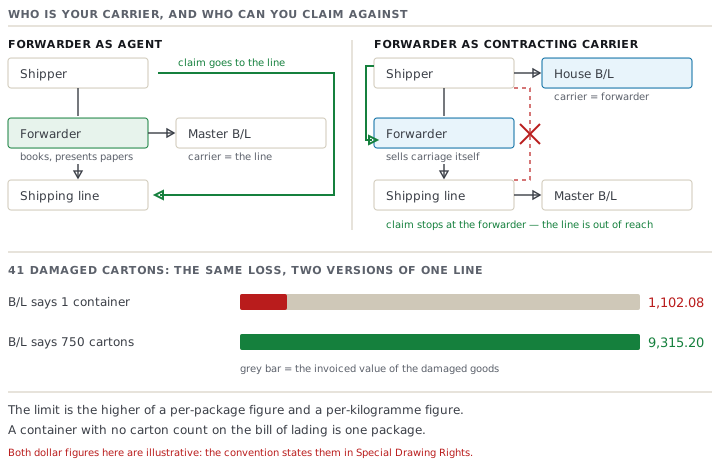
As an agent, it arranges carriage for you. It books space, presents documents, pays the terminal on your behalf, and charges you a fee for doing it. The contract of carriage is between you and the shipping line. If the goods are damaged at sea, you claim against the line. Your forwarder is liable only for its own failures as an agent: booking the wrong vessel, missing a deadline, presenting a document late.
As a contracting carrier, it sells you carriage in its own name. It has bought space from a line wholesale and is reselling it to you retail. It issues its own transport document on its own paper, naming itself as the carrier. That document is a house bill of lading. The contract of carriage is between you and the forwarder. The shipping line has never heard of you: its contract is with the forwarder, under a master bill of lading, and it answers to the forwarder alone.
Both are legitimate. Both are everywhere. The one you have decides who you sue, under which set of liability rules, up to what limit, and within what deadline.
Three tests, and you can run all of them in five minutes
You do not need the forwarder's trading conditions to answer this. You need the file.
- Whose paper is the transport document on, and who is named as carrier? Open the bill of lading and find the carrier's name. It is usually printed at the head and repeated above the signature. If it is the shipping line, you have a master bill and the line is your carrier. If it is the forwarder, you have a house bill and the forwarder is your carrier.
- How were you invoiced? An agent bills a fee, and passes the terminal, the line and the haulier through at cost with their invoices attached. A contracting carrier bills you one number for carriage and never shows you what it paid. If the invoice says "ocean freight" as a single figure with a margin hidden inside it, the forwarder is selling you carriage.
- How is the signature qualified? A bill signed "as agent for" a named line is exactly what it says. A bill signed by the forwarder with no other name above it is the forwarder signing in its own right.
On NBK-7714 all three tests point the same way. The document in Norlbeck's file is Halvorn's own house bill of lading. Halvorn is named as carrier. Halvorn invoiced one all-in figure. The shipping line's master bill names Halvorn as shipper and Halvorn's own destination office as consignee. Norlbeck's claim was always against Halvorn, and never against the line.
The limit, and the line of typing that set it
A carrier's liability for loss or damage is not open-ended. Most ocean bills of lading are governed by an international convention, and it caps the payout at a figure per package, or per kilogramme of the gross weight of the goods lost or damaged, whichever is higher. The convention states both figures in Special Drawing Rights. That is an international unit of account, and its value in dollars moves every day, so any dollar figure you quote is a snapshot rather than a fact.
The two dollar figures below are illustrative only. Take the per-package limit at USD 940 and the per-kilogramme limit at USD 2.80 for the sake of the arithmetic. Look up the real ones, converted on the day, when it is your money.
Now the question that decides everything: on a container shipment, what is a package?
The convention answers it. Where goods travel in a container, the number of packages listed in the bill of lading as packed inside it is the number of packages. Where the bill lists none, the container itself is one package.
Halvorn's house bill described the cargo as "1 x 40'HC said to contain garments". The shipping instruction Fanara sent said 750 cartons. The packing list said 750 cartons. The bill of lading said one container.
| Bill says one container | Bill lists 750 cartons | |
|---|---|---|
| Packages damaged | 1 | 41 |
| Per-package limit, illustrative | 940 | 38,540 |
| Per-kilogramme limit on 393.6 kg | 1,102.08 | 1,102.08 |
| Limit that applies, the higher of the two | 1,102.08 | 38,540 |
| Invoiced value of the damaged goods | 9,315.20 | 9,315.20 |
| Recovered | 1,102.08 | 9,315.20 |
Because the limit is the higher of the two sums, the weight calculation saved the claim from being worse still. Forty-one cartons of 9.6 kilogrammes is 393.6 kilogrammes, and at USD 2.80 that is USD 1,102.08. It beats a single package at USD 940. It is still USD 8,213.12 short of the loss.
Four people read that bill of lading. The merchandiser checked the consignee and the description. The documentation clerk checked the on-board date. The bank checked it against the credit. Norlbeck's import team checked the container number. Nobody read the package count as a liability figure, because on every other document in the file it is just a logistics detail.
What else the capacity changes
The deadline for suing. The convention gives you a year from delivery. A forwarder's own standard trading conditions often set a much shorter period, and they apply when it acts as agent and frequently sit behind its house bill too. Read the number on the back of the document you actually hold, and put it in the diary the day a claim opens.
Who can even talk to the line. Under a house bill, Norlbeck has no contract with the shipping line and no right to ask it anything. Every question about the vessel, the stow and the survey goes through Halvorn, who is also the party the claim is against.
Whether the limit is one set of rules or several. A door-to-door product is a multimodal contract, and multimodal liability is not a single number. That is lesson 3.
Check yourselfYour forwarder emails a rate of USD 1,340 for a container, then invoices you exactly USD 1,340 with no terminal or haulage invoices attached. What capacity is it in, and what does that tell you about the document you should expect?Show the answer
It is selling you carriage as a contracting carrier. An agent's invoice is a fee plus costs passed through, with the third-party invoices behind it. One clean number with nothing visible passed through is a seller's price with a margin inside it. So expect a house bill of lading with the forwarder named as carrier. And check the package count on it, because your claim limit is now worked out from that line.