Lessons · Lesson 5 of 6
- 01 · Agent or carrier: what your forwarder actually sold you
- 02 · Reading a quote: the freight figure and everything after it
- 03 · Making two quotes comparable
- 04 · Nominated or your own: who chooses the forwarder, and what it costs
- 05 · The booking, the cut-offs, and the roll
- 06 · The broker: choosing one, and what you must give them
The booking, the cut-offs, and the roll
Follow one booking from request to gate-in, see it rolled anyway, and price the four ways out against the calendar it damaged.
Lesson 5 of 6 · 21 min
A booking is not space
Fanara's shipping clerk sends a booking request to Halvorn on Tuesday 1 September: one forty-foot high-cube, Alexandria to Rotterdam, cargo ready 10 September, PO NBK-7714. A booking confirmation comes back the same afternoon, with a booking number, a vessel, a voyage, and a ladder of cut-offs. A cut-off is a deadline you have to clear to keep your place on that sailing.
Everyone treats that confirmation as space on a ship. It is closer to a restaurant reservation on a night when the restaurant has taken more reservations than it has tables. That is legitimate, because a proportion of bookings never show up.
| Rung | Deadline | What happened |
|---|---|---|
| Booking confirmed | Tue 1 Sep | Confirmed the same day |
| Empty container released | Wed 9 Sep | Collected from the depot |
| Stuffing at the factory | Thu 10 Sep | 750 cartons loaded, sealed |
| Verified gross mass submitted | Fri 11 Sep, 12:00 | Submitted 10:20 |
| Shipping instructions submitted | Fri 11 Sep, 16:00 | Submitted 14:05 |
| Gate-in at the terminal | Sat 12 Sep, 14:00 | Gated in 13:40 |
| Vessel departs | Sun 13 Sep | Rolled |
Every rung was cleared. The last one was cleared by twenty minutes, which is uncomfortable and is still inside the deadline. The container did not sail. It was rolled, which means the carrier moved it to a later vessel.
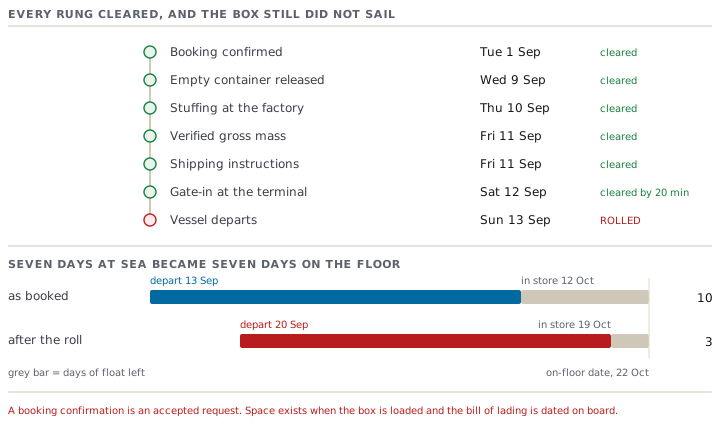
Why it rolled
The vessel was full. When a carrier has to shut cargo out, it does not choose at random, and it does not choose by who was last through the gate. It works down a priority order, and spot bookings with no contract behind them sit at the bottom of it.
Fanara's container was a spot booking. Not because anybody chose spot. Norlbeck's contract with the carrier allocates a number of containers a week on this lane. That allocation is taken first come, first served, and three of Norlbeck's other suppliers had booked earlier in the same week. By Tuesday afternoon the week's allocation was gone, and Halvorn booked the only thing left.
Four suppliers booked correctly. One of them was rolled by the other three. None of the four knew the other three existed.
What a week costs on a calendar
| Step | As booked | After the roll |
|---|---|---|
| Departs Alexandria | Sun 13 Sep | Sun 20 Sep |
| Arrives Rotterdam | Sun 4 Oct | Sun 11 Oct |
| Into the distribution centre | Tue 6 Oct | Tue 13 Oct |
| In store | Mon 12 Oct | Mon 19 Oct |
| On-floor date for the range | Thu 22 Oct | Thu 22 Oct |
| Days of float left | 10 | 3 |
Two other things moved with it. The purchase order says shipment not later than 14 September, and the rolled sailing is six days past that. So it is a document problem as well as a calendar problem, and what a bank does with a late shipment date against a credit is track 13. The distribution centre also books receiving in weekly slots, so seven days at sea became seven days at the door. A one-week roll is a one-week roll all the way through.
The four ways out, priced
| Option | What it costs, USD | What it buys |
|---|---|---|
| Wait for the next sailing | 0 | 3 days of float, and no protection against a second roll |
| Wait, with a loading guarantee | 320 | The same 3 days, with the carrier committed to load |
| Air the launch quantity, sea the rest | 11,335.36 | 3,104 pieces early; the rest arrives 19 October |
| Air the whole shipment | 42,320 | The full order in store before the original date |
The air numbers are worth working through, because air is charged on chargeable weight. That is the greater of the actual weight and a volumetric weight, and the volumetric weight is the volume divided by a figure the forwarder quotes on the lane — here 6,000 cubic centimetres to the kilogramme.
The full shipment is 64.8 cubic metres. At that divisor it is 10,800 kilogrammes of chargeable weight, against an actual gross weight of 7,200. Halvorn quotes 3.85 a kilogramme all-in, Cairo to Amsterdam. So the air freight is 41,580, plus 260 of trucking to Cairo and 480 of delivery in the Netherlands, giving 42,320. Against the sea shipment's 3,491 that is 38,829 more. Per garment it is 3.53 a piece against 0.2909 — twelve times the freight, on a gilet whose FOB is 14.20.
The part shipment is 194 cartons, or 3,104 pieces, in the two colours the launch actually needs. Its chargeable weight is 2,793.6 kilogrammes against an actual 1,862.4, so 10,755.36 of air freight plus 580 of trucking, giving 11,335.36. That is 3.65 a piece on what flies.
And a caution the option table hides: splitting the shipment does not split the container. The remaining 8,896 pieces still travel in one forty-foot box at 3,491, so their freight rises from 0.2909 to 0.3924 a piece. A split always costs more than the air ticket alone.
Norlbeck took the second option. Three days of float is thin but real, and the whole exposure is the risk of a second roll. So the money went on removing that risk, rather than on buying back a week it did not need. Three hundred and twenty dollars against a thirty-eight-thousand-dollar alternative is not a close decision. And it is only available to somebody who asked what a loading guarantee costs before they needed one.
What to do differently, and none of it is expensive
- Give the forwarder a rolling forecast, six weeks out, of what you will ship and when. Allocation taken first come, first served rewards whoever emails earliest. Allocation set against a forecast can be split by need. This is the fix for the mistake nobody made. It costs a spreadsheet, and it is the buyer's job, not the supplier's, because only the buyer can see all four suppliers.
- Ask for the roll policy in the tender. Question 8, after lesson 3's seven: when a vessel is oversold, in what order is cargo shut out, and where does my booking sit in it?
- Ask what a loading guarantee costs in peak weeks, and put the number on the file, so that the decision on the Monday takes ten minutes instead of a day.
- Never plan the last rung to the minute. Gate-in at 13:40 for a 14:00 cut-off passed. It also removed every option Fanara had if the truck had been stopped, and it made the roll look like the factory's fault to everybody who saw only the timestamp.
- Treat the booking confirmation as a request that has been accepted, not as space. Space exists when the container is loaded and the on-board notation is dated.
Check yourselfYour container gated in inside every cut-off and was rolled. Which of the four options above is the cheapest thing to have bought, and when could you have bought it?Show the answer
The loading guarantee, at 320. And it had to be bought before the roll, on the next sailing, as protection against it happening twice. Nothing you buy after a roll brings the lost week back. The only cheap purchase is the one that stops the second one. Everything else on the table buys time back at air freight rates, at twelve times the cost of the sea freight it replaces.