Lessons · Lesson 4 of 7
- 01 · Two instruments, and the gap between them
- 02 · Who was supposed to insure
- 03 · What the policy actually says, and what it will not say
- 04 · Insufficiency of packing: the exclusion written for apparel
- 05 · The claim file, and the ninety minutes at the door
- 06 · General average: a bill for somebody else's emergency
- 07 · Whether to insure this shipment at all
Insufficiency of packing: the exclusion written for apparel
See how a surveyor separates covered wetting from excluded condensation, and price the packing changes that decide which of the two you get.
Lesson 4 of 7 · 15 min
Why this one exclusion belongs to garment people
Every cargo policy excludes loss caused by insufficiency or unsuitability of packing or preparation of the subject matter. It is one line in a list of exclusions, and it is the line that refuses apparel claims.
The reason is structural. Garments are light. They hold moisture. They are packed months before they sail, stacked high in a steel box, and carried across a big change of climate. Nothing else in general cargo has all five of those properties at once. The exclusion also has a second half that surprises people: it applies where the packing was done by the assured or their employees, or before the insurance attached. Thistlewood are the assured, and they never touched a carton. Fuwwah packed the container at Belqas, days before the journey began, and so before the cover attached. The exclusion still applies.
A buyer's cargo policy is exposed to their supplier's packing specification, and nobody tells either party.
The two things that wet a container of parkas
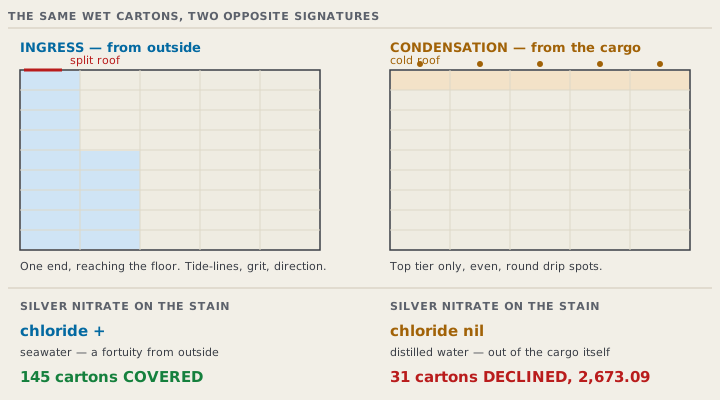
Ingress. Water from outside, through an opening: a split roof, a failed door seal, a punctured panel, a wave over the deck. It is accidental, it is nobody's packing, and it is covered.
Condensation, which the trade calls container rain. Water that was already inside, in the cargo. Cotton fibre carries moisture in ordinary warm storage. The moisture figure the trade uses for cotton is about 8.5% of its dry weight. Style PK-540 has a cotton canvas shell weighing about 0.42 kg of each 0.90 kg parka. So the container holds about 3,024 kg of cotton, and that cotton is carrying about 257 kg of water. A quarter of a tonne, inside the goods, before you count the cartons and the packing material.
Load that container warm at Belqas, put it on deck, and run it into a cold night off Finisterre. The steel roof cools faster than the cargo. The air inside reaches its dew point against the underside of the roof, water condenses there, and it drips. It falls on the top tier of cartons, works down, and marks the goods from above.
There is a third mechanism worth naming, because it is the same failure in another form. Corrugated board loses much of its compression strength as it takes up moisture. A stack that was perfectly sound in a dry warehouse can collapse in a humid container. On this stow, 900 cartons went in nine tiers high — 100 stacks — so a bottom carton carries eight cartons at 7.8 kg, which is 62.4 kg of static weight before the ship moves at all. Crushing at the bottom of a stack in a container that was never breached is a packing failure, and it reads as one.
How the surveyor decides which one you had
Harlowe Marine Surveys attended at Willebroek on 28 November. Two tests, neither of which takes long, decided USD 2,673.09 of this claim between them.
The chloride test. Seawater contains chloride. Condensation is distilled water and does not. A drop of silver nitrate on a damp stain from seawater throws a white deposit. On condensation it does nothing. It is a chemistry-set test, and it is the single most decisive thing in a wet-cargo survey.
The pattern. Water coming through a roof split enters at one place and runs. It leaves tide-lines, a direction, and often grit or rust. Condensation falls evenly from the whole roof. It marks the top tier first, in round drip spots, and the lower tiers get progressively cleaner. The two look identical in a photograph of one carton, and completely different across a stow.
| Finding | Cartons | Parkas | Reading | Outcome |
|---|---|---|---|---|
| Tide-lined, chloride positive, forward corner, tiers 1 to 5 | 78 | 624 | Ingress through the split roof | Total loss, covered |
| Chloride positive, staining to the shell only | 67 | 536 | Ingress, cleanable | Depreciated 60%, covered |
| Drip-spotted from above, chloride negative, top tier only | 31 | 248 | Condensation | Declined — insufficiency of packing |
Now the sentence that makes this the most important lesson in the course.
Had the roof not split, every one of the 176 cartons would have shown the top-down, chloride-negative pattern, and the whole claim would have been nil. The accident is what made 145 cartons payable. The condensation was going to happen either way. It was decided at Belqas in October, by a packing specification nobody read as an insurance document.
What the packing specification should have said, and what it costs
None of the fixes is clever, and none of them is expensive per container. All of them are missing from most apparel packing specs, because a packing spec is written for the shop floor and the shelf, not for the voyage.
| Change | Why | Cost per container |
|---|---|---|
| 24 container desiccant bags, hung on the walls and the door | Absorbs the moisture that would otherwise reach the dew point | 86.40 |
| A ventilated kraft top cover over the whole stow | Catches roof drip before it reaches a carton | 41.00 |
| A heavier board grade on the bottom two tiers, at 0.14 a carton | Keeps compression strength when the board goes humid | 126.00 |
| Stow the top tier clear of the roof and away from the doors | The two places condensate and seal leaks arrive | none |
| Total | 253.40 |
Here the honest answer has to be earned, not asserted. Fuwwah ships 46 containers a year to Thistlewood. Putting the full package on all of them costs USD 11,656.40 a year, which is more than double what Thistlewood pay for the whole cargo policy. That is not a good decision.
The good decision is targeted. Only the northbound winter sailings run a temperature change big enough to reach the dew point inside the box, and only the cotton-rich styles carry the water. 18 of the 46 sailings meet both tests. Protecting those and leaving the rest costs USD 4,561.20 a year.
The distinction that saves an arguable claim
The exclusion is not unanswerable, and the answer is in its own wording. It bites where the packing was done by the assured, or before the cover attached. Where a third party packs after attachment — a consolidator stuffing a groupage container mid-journey, a warehouse repacking damaged cartons on the underwriter's own instruction, a carrier restowing at a port of refuge — the exclusion is a much weaker argument, and the loss may fall back inside the cover.
That is not a licence to pack badly and blame the shed. It is a reason to record in the file who did each act of packing, and on which date. The moment the cover attached is a fact somebody will have to prove two months later, from documents that either exist or do not.
Check yourselfA survey finds mould on the inner tier of a container of cotton shirts. No breach, no chloride, no weather event on the voyage record. Your buyer's underwriter declines. Is there anything to argue?Show the answer
Very little about the wetting itself. No breach and no chloride is the signature of moisture that came out of the cargo, which is the assured's or the shipper's packing and preparation, not an accident. Two things are worth establishing. First, were the goods sent out damp? That is a preparation failure belonging to the supplier, and it may be a claim against them under the sale contract rather than under the policy. Second, did anybody repack or restow the container after the cover attached? Both are questions about dates and documents, which is why the packing record matters more than the argument.
Prompt · Read my packing specification as an underwriter would
Before a winter sailing, or the first time a surveyor asks for the packing specification.
Act as a marine cargo surveyor who has written insufficiency-of-packing findings, and tell me what would be found against my own specification. Cargo facts: style [CODE], garment [DESCRIPTION], fibre content of the shell [PERCENTAGES AND FIBRES], garment weight [KG], quantity [PIECES], [PIECES] to a carton, [NUMBER] cartons, carton dimensions [CM], carton gross weight [KG], tiers high in the stow [NUMBER], container type [SIZE]. Packing specification as it currently reads: [PASTE IT IN FULL, INCLUDING BOARD GRADE, LINER, POLYBAG, DESICCANT IF ANY, AND ANY STOW INSTRUCTION]. Voyage: loading port [PORT] in [MONTH], discharge port [PORT], routing [DESCRIBE], expected temperature at loading and at discharge [DEGREES], and on deck or under deck if you know. Now do the following. First, estimate how much water the cargo itself is carrying, from the fibre content and the moisture that fibre normally holds, and show the working. Second, tell me which of the three apparel failure modes this stow is exposed to — condensation from the cargo, water in through a breach, and a humid stack collapsing under compression. Rank them for this voyage, and give a reason for the ranking. Third, work out the static load on a bottom-tier carton, and say whether the specified board grade is believable at high humidity rather than dry. Fourth, list every change worth making, each with a cost per container. Split them into changes worth making on every sailing, and changes worth making only on sailings that meet a condition you state. Fifth, give the annual cost of each list against [NUMBER] containers a year, and the number of those that meet the condition. Sixth, write the three lines I should add to the packing section of the tech pack, in specification language. Seventh, tell me which two photographs to require from the loading, and exactly what each one would prove in a claim. Where you need a figure I have not given you, ask for it rather than assuming a market average.
AI can make mistakes — check anything you act on.