Lessons · Lesson 1 of 7
- 01 · Two instruments, and the gap between them
- 02 · Who was supposed to insure
- 03 · What the policy actually says, and what it will not say
- 04 · Insufficiency of packing: the exclusion written for apparel
- 05 · The claim file, and the ninety minutes at the door
- 06 · General average: a bill for somebody else's emergency
- 07 · Whether to insure this shipment at all
Two instruments, and the gap between them
Price the gap between what a carrier will pay and what a cargo policy will pay, on one real container, and see why garments come off worst.
Lesson 1 of 7 · 15 min
One container, two letters
MV Nordvahl Sirius sailed from Alexandria on 3 November. Container NDVU 421880-2 was on deck, in bay 34. Inside it were 7,200 women's padded parkas in cotton canvas, style PK-540. Fuwwah Outerwear made them at Belqas for Thistlewood Retail. 900 cartons, 8 parkas to a carton, 7,020 kg of cargo, 64.8 cubic metres. The price was FOB Alexandria USD 21.50 a piece. FOB means the factory's price with the goods loaded at the port of departure. So the container held USD 154,800.00 of garments.
On 9 November the ship met heavy weather in the Bay of Biscay. A stack of containers on deck collapsed. Three went over the side. Ours stayed on board, but its roof split at the forward corner. For two days the sea came in through the split.
By the end of the month the merchandiser at Thistlewood had two letters on her desk. One was from Nordvahl Line, the carrier, refusing to pay. One was from Vasteral Marine, the cargo underwriter, appointing a surveyor. Most people read those as two attempts at the same thing. They are not. They are two different instruments, and this whole course lives in the distance between them.
A duty of care against a promise to pay
The carrier owes you a duty of care. They must look after the goods. If they fail, they must compensate you. But their liability comes from the international carriage conventions and from their own bill of lading — the transport contract the carrier issues for the goods. That liability comes with defences (heavy weather, a fault in the goods themselves, the shipper's own act), a short deadline to sue, and above all a limit. The limit has nothing to do with what your cargo is worth.
The underwriter owes you an indemnity. Not care — a contract. It says: when an insured event happens, we put you back where you were, up to an agreed value, subject to named exclusions and an excess. The excess is the first slice of any claim, which you carry yourself.
Three practical differences follow. Every one of them comes back later in this course.
- What you must prove. Against the carrier you must prove three things: the goods were sound when you handed them over, they were damaged when they came back, and no defence applies. Against the underwriter you prove one thing: an accidental loss during the insured journey. The second is a much shorter conversation.
- When you must act. The carriage conventions set a short, absolute deadline for starting a court case — around a year from delivery, not the several years an ordinary contract claim gives you. Read the period off your own bill of lading and put it in the diary on the day you ship.
- How much you can get. This is the one that decides the money. It is arithmetic, not argument.
The arithmetic that decides it
Thistlewood insure through Brenmoor Marine Broking, under an annual open cover with Vasteral Marine. An open cover is a standing policy that picks up every shipment as it sails. The certificate for this shipment says: insured value USD 172,457.28, which is the usual 110% of the CIF value. CIF is the price with freight and insurance included; track 8 explains it, and explains why the sum is circular. Premium 0.075%, so USD 129.34. Excess USD 1,500.00 on each and every claim.
Now suppose the container had gone over the side with the other three. Put the two instruments side by side.
Nordvahl's bill of lading limits their liability to the higher of USD 920.00 per package or USD 2.75 per kilogramme of the goods lost. The container weighs 7,020 kg, so the kilogramme basis gives USD 19,305.00. The package basis gives USD 920.00, because the container counts as one package — which is the point of the next section. The higher of the two is USD 19,305.00.
| The carrier | The cargo policy | |
|---|---|---|
| Basis | Higher of per package or per kilogramme | Agreed insured value |
| Amount | 19,305.00 | 172,457.28 |
| Less excess | — | 1,500.00 |
| What you actually receive | 19,305.00 | 170,957.28 |
| Only if | You defeat every defence, in time | The loss was accidental and not excluded |
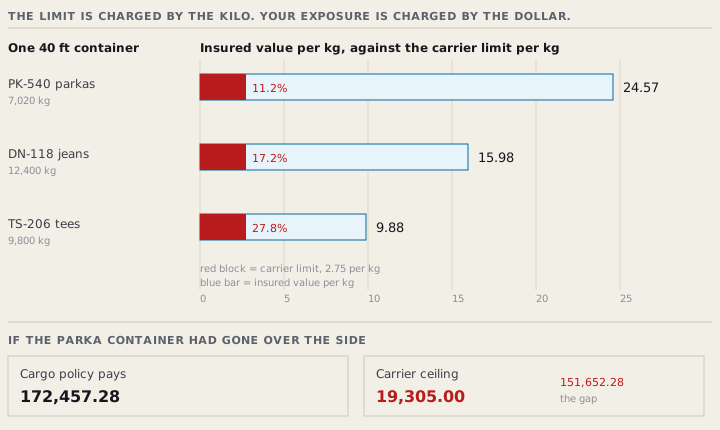
The carrier's ceiling is 11.2% of what the cargo is insured for. The gap is USD 151,652.28 on one container.
Why garments are the worst cargo in the box
The reason is not that carriers dislike apparel. It is that the limit is charged by the kilogramme and your exposure is charged by the dollar. Garments have an extreme ratio between the two.
Divide the insured value by the gross weight. This container is worth USD 24.57 a kilogramme, against a limit of USD 2.75 a kilogramme. That is 8.9 times. Take three shipments from Fuwwah's own book in the same quarter, and you can see it is not luck:
| Cargo | Gross kg | Insured value | Value per kg | Share the limit covers |
|---|---|---|---|---|
| PK-540 padded parkas, 40 ft HC | 7,020 | 172,457.28 | 24.57 | 11.2% |
| DN-118 denim jeans, 40 ft HC | 12,400 | 198,140.00 | 15.98 | 17.2% |
| TS-206 jersey tees, 40 ft HC | 9,800 | 96,822.00 | 9.88 | 27.8% |
A container of floor tiles fills its weight allowance long before it fills its value, so the limit would cover the loss several times over. A container of light, expensive, high-labour goods will not. The lighter and dearer the garment, the smaller the share the carrier's ceiling covers. That is the opposite of the usual instinct, which says an expensive shipment must be a well-protected one.
The box on the bill of lading nobody fills in
Now the sentence that is worth more than the rest of this lesson.
The Visby amendments to the sea carriage rules deal with containers directly. Where goods travel in a container, the packages listed in the bill of lading as packed inside it are the packages used for the limit. If the bill of lading lists none, the container itself is one package.
Fuwwah's shipping instruction to the forwarder gave the number of packages as 1 — one forty-foot container — and described the goods as PADDED PARKAS. The forwarder built the bill of lading from that booking. Nobody at either end thought the packages box was a number anyone would ever add up.
The actual damage was 145 cartons of seawater-soaked parkas, 1,131.0 kg. Read that two ways. With the container as one package, the limit is the higher of USD 920.00 and 1,131.0 kg at USD 2.75, so USD 3,110.25. With the cartons listed, it is 145 packages at USD 920.00, which is USD 133,400.00. That is far above the loss, so the limit stops binding at all and the argument becomes the ordinary one about who is liable.
The proven loss on that cargo is USD 25,829.39, which you will build in lesson 5. So the packages box is worth up to USD 22,719.14 on this one shipment. And it is filled in by a clerk nobody has ever told it matters.
What this course does with the rest of it
The gap above is why cargo insurance exists at all. The rest of this course is about what decides whether the policy really pays: who was supposed to buy it (lesson 2), what it covers and refuses (lesson 3), the exclusion written for cargo exactly like this (lesson 4), the evidence that must exist before anybody asks for it (lesson 5), a bill that arrives even on undamaged cargo (lesson 6), and the honest question of whether a shipment is worth insuring at all (lesson 7).
Two neighbouring courses own things this one deliberately leaves alone. 12.4 owns the forwarder, the carrier and the broker as parties: who they are, what they owe you, how they are paid. 8.3 owns the Incoterms rules, including which of them makes a seller insure and on what minimum terms. This course takes those as read and follows the money.
Check yourselfYour buyer says the shipment is safe because the carrier is liable for it. In one sentence, why is that not an answer?Show the answer
Because the carrier's liability is limited by the weight or the package count of the goods, not by their value, and a container of garments is worth many times per kilogramme what the limit pays per kilogramme — on this shipment the ceiling is 11.2% of the insured value. The carrier's liability is a partial recovery you chase afterwards, not cover.
Prompt · Price the liability gap, then map who insures each leg
Before a season's first sailing, or the first time anybody asks whether a shipment is covered.
Act as a marine cargo insurance broker who is paid a flat fee and has no reason to oversell cover. I want two things for one shipment: the liability gap priced, and an insurance map leg by leg. Shipment facts: seller [FACTORY, TOWN, COUNTRY], buyer [BUYER, COUNTRY], purchase order [NUMBER], style [CODE], quantity [PIECES], packed [PIECES] to a carton in [NUMBER] cartons, gross weight [KG], volume [CBM], container type [SIZE]. Commercial terms: the Incoterm and named place exactly as the order states them, [TERM], unit price [AMOUNT], order value [AMOUNT], ocean or air freight [AMOUNT], port of loading [PORT], port of discharge [PORT], final delivery place [PLACE]. Insurance as it stands today: who buys it [SELLER OR BUYER], insurer or open cover [NAME], rate [PERCENT], basis of the insured value [SAY 110% OF CIF OR OTHER], excess [AMOUNT], and the clause set named on the certificate [SET]. Carrier facts: line [NAME], and the limitation wording on their bill of lading, including the per-package and per-kilogramme figures and the box headed number of packages as it is actually filled in. Now do the following. First, work out the insured value and the value per kilogramme. Set that against the carrier's limit per kilogramme, and tell me what share of a total loss the carrier's ceiling would cover, as a percentage. Second, do the same for a partial loss of [NUMBER] cartons, and show the limit both ways: with the cartons listed on the bill of lading, and with the container treated as one package. Say plainly what the packages box is worth in money on this shipment. Third, list the journey as legs, from the finished-goods store to the buyer's warehouse. For each leg, name whose risk it is under the Incoterm and which policy is actually in force. Use the word none where there is none. Fourth, identify every uninsured leg and price the largest believable loss on it. Fifth, name the products that would close each gap — inland transit, marine cargo, seller's interest or contingency — and say which one answers which gap. Sixth, give me the three questions I should put to my broker at renewal. Do not give me a market average for anything. Use only the figures I have given you, and list every assumption you had to make at the end.
AI can make mistakes — check anything you act on.