Lessons · Lesson 2 of 7
- 01 · Two instruments, and the gap between them
- 02 · Who was supposed to insure
- 03 · What the policy actually says, and what it will not say
- 04 · Insufficiency of packing: the exclusion written for apparel
- 05 · The claim file, and the ninety minutes at the door
- 06 · General average: a bill for somebody else's emergency
- 07 · Whether to insure this shipment at all
Who was supposed to insure
Map the insurance duty onto the legs of one journey, and find the leg where two correct decisions leave nobody covered.
Lesson 2 of 7 · 14 min
Four correct decisions and an uninsured loss
Two weeks before the Bay of Biscay, on 28 October, three trailers were carrying PO TW-8807 to Alexandria. The second one was hit on the port access road. Nobody was hurt. 40 cartons went off the bed and were run over: 320 parkas, beyond saving.
Fuwwah's shipping manager was not worried. The goods were on Thistlewood's insurance, an annual open cover that reads warehouse to warehouse. He sent the police report to Antwerp and asked for a claim number.
Vasteral Marine refused it in four lines. The sale was FOB Alexandria. Risk had not passed to Thistlewood. The goods were still Fuwwah's. So their assured had no insurable interest in those cartons at the moment of the loss. An insurable interest means you stand to lose money if the goods are lost. And the transit clause attaches to journeys the assured has an interest in, not to every movement of every carton a supplier ever loads.
Now look at what had to go wrong for that to happen.
- The purchase order said FOB Alexandria. Correct. It is what the two companies agreed, and it is the term on every order between them.
- Thistlewood's open cover was written warehouse to warehouse on their own journeys. Correct. That is the standard wording and it is what they should have.
- Fuwwah's insurance broker had offered them an inland transit policy in March at USD 1,340.00 a year, covering every movement from the factory gate to the ship. Fuwwah said no, because the buyer insures the goods. Defensible. Most factory finance directors say this, and on the sea leg it is true.
- The traffic clerk booked three trailers instead of one, to spread the load and avoid a single point of failure. Correct, and it held the loss to a third of what it could have been.
Four defensible decisions, one uninsured loss. That is the shape this course keeps returning to. It is why who insures? must be asked about legs, not about a three-letter term.
Insurance follows interest, not the Incoterm
The Incoterm splits two things between seller and buyer: who pays for what, and the moment risk passes. Track 8.3 sets that out properly, and this course does not repeat it. What 8.3 gives you is the moment. A policy responds to something else: whether the person claiming had an interest in those goods at the moment of the loss.
The two ideas meet at the moment risk passes. Everywhere else they are independent. So an insurance map is built with two questions, asked leg by leg:
- At which exact moment does risk pass to the buyer? Under FOB, CFR and CIF, when the goods are on board at the named port of shipment. Under the FCA, CPT and CIP family, when they are handed to the first carrier, or loaded on the buyer's collecting vehicle. Worth saying once: for a container handed over at a terminal days before it is loaded, FOB is the wrong rule and FCA is the right one. But that fix belongs to 8.3, and until your company makes it, FOB means your risk runs all the way to the ship.
- Whose policy is actually in force on each side of that moment? Not whose policy mentions the journey. Whose policy has an assured with an interest.
Where the two answers do not meet, there is an uninsured leg. It is nearly always the seller's inland leg. The seller's insurance is usually a fire-and-burglary policy on stock at the premises, and it stops at the factory gate. The buyer's marine cover has nothing to attach to until risk passes.
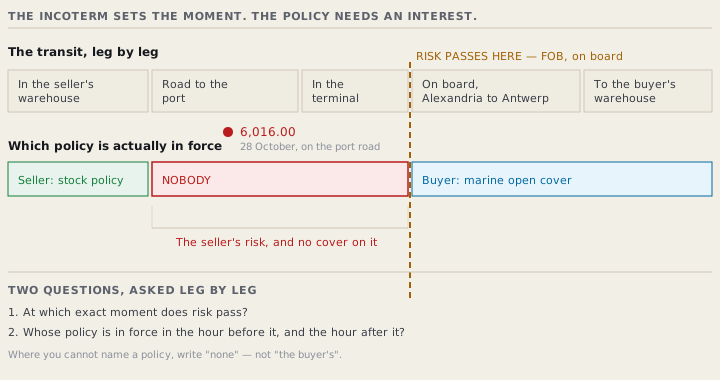
| Leg | Whose risk | Which policy responds | Gap |
|---|---|---|---|
| Finished goods in Fuwwah's warehouse | Seller | Seller's fire and burglary on stock | Covered |
| Factory gate to Alexandria by road | Seller | None | Uninsured |
| In the terminal awaiting loading | Seller | None | Uninsured |
| On board, Alexandria to Antwerp | Buyer | Buyer's open cover | Covered |
| Discharge to the buyer's warehouse | Buyer | Buyer's open cover | Covered |
What the seller can buy, and what each one is for
Three different products get confused with each other. They are not interchangeable, and a broker will sell you whichever one you name.
Inland transit cover. A policy on the seller's own movements, from the factory to the port or the airport. It is the one Fuwwah turned down, and it is the one that would have paid on 28 October. It is priced against the yearly value of movements, not per shipment.
Marine cargo cover. The policy on the sea or air leg. Whoever carries the risk on that leg needs it. On FOB terms, that is the buyer.
Seller's interest cover, also called contingency cover. Most merchandisers have never heard of this one, and it answers a question the other two do not. You sold FOB. Risk passed on board. The cargo is lost. Under the sale contract the buyer still owes you the money. But the buyer's own policy was faulty, or had lapsed, or the buyer simply refuses to pay, and you are holding documents and no goods. Seller's contingency cover pays only if the buyer's cover fails, which is why it is cheap. It does not replace anybody's main policy. It protects you against somebody else's paperwork.
Pricing the decision Fuwwah actually made
The cost of making the parkas again is the honest number, because they had to be replaced to fill the container.
| Line | Amount |
|---|---|
| 320 parkas at the factory cost to make, USD 16.80 | 5,376.00 |
| Overtime and rushed fabric to remake inside 6 days | 640.00 |
| Loss to Fuwwah | 6,016.00 |
| Annual inland transit premium quoted in March | 1,340.00 |
The loss is 4.49 years of the premium they turned down, and it landed in the first year. That is not proof that insurance always pays for itself; lesson 7 shows a case where it very nearly does not. It is proof that the decision was made with no number in front of it. Fuwwah's finance director had never been shown what an inland loss would cost, because nobody had mapped the legs.
The other direction: when you are the one who insures
The mirror of Fuwwah's mistake belongs to sellers on CIF and CIP terms. They must insure for the buyer's benefit, and they often buy the cheapest thing that meets the duty. 8.3 covers that trap in detail: the two rules require different levels of cover, and the minimum is a short list of named disasters rather than a lighter version of everything. The point to carry into the next lesson is simple. A certificate of insurance proves a policy exists. It does not prove the policy will pay. Reading the certificate is lesson 3.
Check yourselfYou sell FCA your factory. A container is damaged in the terminal at the port, four days after your driver dropped it and eight days before it is loaded. Whose loss is it?Show the answer
The buyer's. Under FCA, risk passes when the goods are handed to the carrier the buyer nominated — at your factory in this case, when the container was collected. Everything after that hand-over is the buyer's risk, so their marine policy has something to attach to. That is exactly why FCA is the right rule for containerised cargo and FOB is not: FOB leaves the seller carrying the terminal days, on a risk they cannot see or control. The rule change belongs to 8.3; the insurance consequence is here.