Lessons · Lesson 5 of 7
- 01 · The credit arrives, and it is a specification
- 02 · The amendment is the only fix, and three parties must agree
- 03 · What a discrepancy actually is
- 04 · Refusal, waiver, and the discrepancy you cannot cure
- 05 · Three dates, one calendar, and the document with the longest tail
- 06 · Confirmation is a product, and it has a price
- 07 · What a credit protects you against, honestly
Three dates, one calendar, and the document with the longest tail
Find which of a credit's three dates actually binds you, build the document calendar backwards from it, and name the document whose lead time you have never measured.
Lesson 5 of 7 · 21 min
Three dates, and only one of them is the deadline
Every documentary credit carries three dates and one place, and they do different jobs.
The latest shipment date. Field 44C. Your goods must be on board by it, and the transport document has to prove it. Miss it and you have a discrepancy you cannot cure, because the date is printed on a bill of lading somebody else issued.
The presentation period. Field 48. This is the number of days after the shipment date within which your documents must be presented. If a credit says nothing here, UCP 600 supplies a default period. That is a good reason to read field 48 rather than assume it.
The expiry date and place. Field 31D. A presentation may never be later than this, whatever field 48 allows. And the place is half of the term. The credit expires at a named bank's counters, and until your documents reach that counter they have not been presented.
Course 8.3 sets the expiry and the presentation period against each other and shows that they are two separate clocks. This lesson takes the next step, which is the one that costs money. The deadline is the earliest of them. On most credits that is the presentation period, and it is the only one of the three that nobody ever negotiates.
Everyone pushes on the expiry, because it looks like the deadline and because it is the one the applicant instinctively resists. The period after shipment costs the applicant nothing at all. It does not change the goods, the price, the delivery date or their bank's risk by anything they would notice, and it is granted almost for the asking. Qaitbay Garments asked for the expiry twice and never once asked for field 48.
Where the credit is available decides which clock a local counter can stop
Field 41A says where the credit is available and how. On BCB/IL/0884 as first advised, it was available with the issuing bank, in Muscat, by payment at sight. So the presentation is not made when Bahari Bank in Alexandria stamps your folder. It is made when the documents physically reach a counter in Muscat. A four-day courier leg therefore sits inside your expiry date, and your real last day is the expiry minus the courier.
Move the availability to a bank in your own country and that leg disappears from the expiry clock. It is one of the two things confirmation usually buys you, and lesson 6 prices it.
Here is the trap, and it caught Qaitbay exactly. Moving the place of availability does nothing at all to the presentation period. Field 48 counts days from the shipment date, full stop. It does not care which counter you walk into. So the change that felt like breathing space bought days on the clock that was never binding, and none on the clock that was.
Build the calendar backwards, with a name and a measured lead time on every line
The practitioner move is not to check the dates. It is to build a document calendar backwards from the earliest of them, and to put two things against every document that you can be wrong about: who issues it, and how many days it actually takes. Measured on your last three orders, not estimated.
| Document | Issued by | Depends on | Planned lead time | Ready |
|---|---|---|---|---|
| Beneficiary's certificate | Qaitbay | A courier despatched within 3 days of shipment | Same day | 16 June |
| Invoice and packing list | Qaitbay | Final carton count | Same day | 14 June |
| Inspection certificate | Argosy Inspection Services | Inspection booked 7 days ahead, report 6 days after | 13 days | 16 June |
| Bill of lading, full set | The shipping line | On-board date | 4 days after sailing | 17 June |
| Certificate of origin | Chamber of commerce | The final invoice | 2 working days | 22 June |
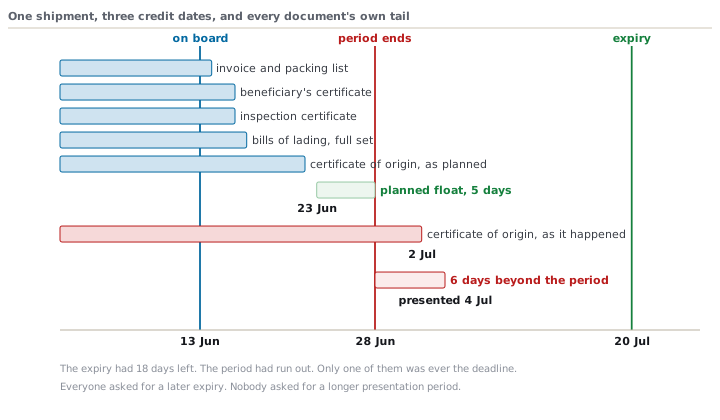
Last presentation day under a 15-day period: 28 June. Longest planned tail: the certificate of origin, ready 22 June. Planned presentation 23 June, float five days.
That is a comfortable-looking plan, and it was wrong in one place. The chamber of commerce took ten working days instead of two.
The document with the longest tail is never the one you watch
Everybody in a garment factory watches the bill of lading. It is the document that feels like the shipment, it arrives late, and it is the one people telephone about. On this order it took four days, exactly as planned, and it was never the problem.
The certificate of origin was submitted on 18 June and came back on 2 July.
The reason is worth the whole lesson. Amendment 1 corrected the fabric weight in field 45A to 240 gsm, so Qaitbay re-issued the invoice with the amended description. The chamber of commerce certifies origin against the exporter's registered product description in its own records, and that registration still carried the wording from the original tech pack. The description on the invoice and the description in the chamber's file no longer matched. So the application was queried, corrected, queried again, and certified on the second round.
Nobody made an error. The amendment was correct, the re-issued invoice was correct, and the chamber was doing precisely its job. An amendment to a credit has a tail outside your building, and the party at the end of that tail checks your documents against records nobody amended.
What the calendar is worth
The float on this order was five days on paper and negative six days in fact. Had field 48 read 21 days, the last presentation day would have been 4 July, the documents were complete on 2 July, and one of the four discrepancies would not have existed. That was worth USD 60.00 and one line in an amendment request nobody wrote.
Lesson 4 is honest about what that would and would not have saved. What the calendar buys reliably is not a rescue. It is knowing on 2 April which document is going to be last, so that the telephone call happens in April instead of the query happening in June.
Two rules to take away, and both are free.
Negotiate field 48, not field 31D. Ask for the longer presentation period in the same request as everything else. It is the cheapest amendment on the list, and it is the clock that binds.
Measure your own lead times, per document, per issuer. Not the ones on the standard checklist. The ones your last three orders actually took, including the chamber, including the consulate, and including the inspection agency's report turnaround as opposed to its inspection date. The longest one is your presentation date, and it is very rarely the bill of lading.
Prompt · Build the document calendar backwards
Once the credit is accepted and before the vessel is booked, while you still have time to move the thing that will be last.
Act as an export documentation planner. I want a document calendar for one shipment under a documentary credit. Build it backwards from the earliest binding date, not forwards from today. Credit facts: latest shipment date [DATE], presentation period [DAYS] days after shipment date, expiry [DATE] at the counters of [BANK AND CITY], credit available with [BANK] by [PAYMENT, NEGOTIATION OR ACCEPTANCE], confirmed or unconfirmed [STATE WHICH]. Shipment facts: planned on-board date [DATE], port of loading [PORT], carrier [LINE], my courier transit time to the place of expiry [DAYS]. Documents required, with who issues each and my own measured lead time from my last three orders: [LIST EACH DOCUMENT, ISSUER, AND DAYS -- INCLUDE THE CHAMBER OF COMMERCE, ANY CONSULAR OR LEGALISATION STEP, THE INSPECTION AGENCY'S REPORT TURNAROUND AS DISTINCT FROM ITS INSPECTION DATE, AND THE CARRIER'S TIME TO RELEASE ORIGINAL BILLS OF LADING AFTER SAILING]. Do the following. First, work out all three deadlines and say which is the earliest and why, allowing for the place of expiry and the courier. Second, lay the documents out as a backwards calendar with a ready date for each, and identify the critical one, which is the longest tail. Third, state the float in days, and say honestly whether it is enough. Fourth, list every document that depends on another document being final first, because those are where an amendment spreads. Fifth, name every outside party that checks one of my documents against a record they hold and I do not, and tell me what to send them and when. Sixth, tell me what I should have asked to be amended in the credit itself to make this calendar safer, and what that amendment would cost. Do not give me a range where a date is possible.
AI can make mistakes — check anything you act on.
Check yourselfYour credit expires on 30 September at the issuing bank's counters abroad, and gives 21 days after shipment for presentation. You ship on 20 September. When is your real deadline?Show the answer
Earlier than either date suggests. Twenty-one days after 20 September is 11 October, but a presentation may never be later than expiry, so 30 September caps it. Then the place caps it again. The credit expires at a counter abroad, so the documents must physically be there by 30 September, and a four-day courier makes your real last day 26 September. That is six days after the vessel sailed, in which the line must issue the bills of lading and every certificate must be obtained. Read the place before you read the date.