Lessons · Lesson 7 of 7
- 01 · The credit arrives, and it is a specification
- 02 · The amendment is the only fix, and three parties must agree
- 03 · What a discrepancy actually is
- 04 · Refusal, waiver, and the discrepancy you cannot cure
- 05 · Three dates, one calendar, and the document with the longest tail
- 06 · Confirmation is a product, and it has a price
- 07 · What a credit protects you against, honestly
What a credit protects you against, honestly
Separate the risks a credit carries from the ones it never touches, spot a soft clause by the only test that works, and decide go or no-go on the day it arrives.
Lesson 7 of 7 · 18 min
Three bands, and most people only know the first
A documentary credit is sold as a thing that makes an export order safe. Banks sell it that way, textbooks sell it that way, and merchandisers sell it that way to their own management. It is not one thing, and it is not safe. It is a specific promise covering a specific set of risks. Being clear about the edges is what stops you paying for protection you already have, or shipping against protection you do not.
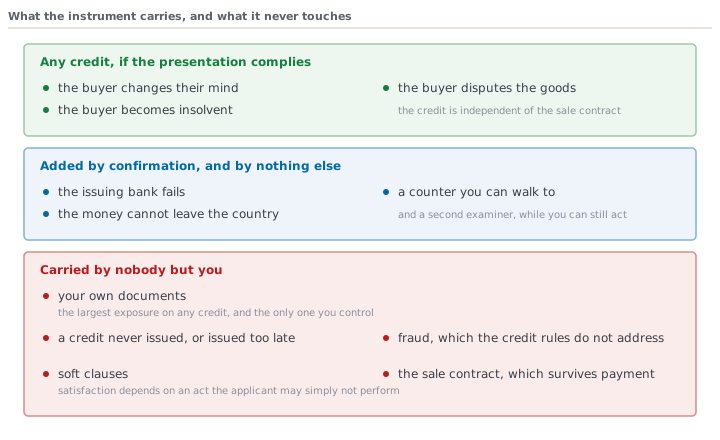
Carried by any credit, provided you present complying documents. Your buyer changing their mind. Your buyer running out of money. Your buyer arguing about the goods. The bank pays anyway, because the credit is separate from the sale contract, and that separation is the single most valuable thing you have bought. A buyer who is unhappy about a shade cannot tell their bank to hold your money.
Added by confirmation. The issuing bank failing. The money being unable to leave the country. And, in practice, a counter in your own city where the clock stops, and where somebody examines your documents while you can still do something about them.
Carried by nobody but you. This band is longer than the other two, and it is where every story in this course happens.
The band nobody prices
Your own documents. By a distance the largest exposure on any credit, and the only one entirely within your control. USD 8,328.29 on QG-2140, on a shipment nobody complained about.
A credit that is never issued, or issued late. A payment term written into a PO is not a credit. Until it has arrived, been read and can be satisfied, you have an intention. Qaitbay's rule after this order is short: no fabric is cut against a documentary credit until the credit has arrived and the day-one read is signed off. On this order the gap between the PO and the advice was six days. It is routinely six weeks.
Soft clauses, which are the next section.
Fraud. UCP 600 governs documents. It says nothing about a beneficiary who presents perfect papers for goods that do not exist. The fraud exception comes from national law, and the standard of proof, the procedure and the speed with which a court will stop a bank paying vary a great deal between countries. This matters to you in the direction people do not expect. As an honest exporter, you are exposed to a buyer who alleges fraud in their own courts in order to stop a payment they simply do not want to make.
The sale contract afterwards. Being paid is not being right. The separation works in both directions. The credit paid you against paper, and your buyer's claim about the goods survives it completely. A refusal to pay is not a rejection of the goods, and a payment is not an acceptance of them.
Soft clauses, and the test that actually works
A soft clause is a term of a credit whose satisfaction depends on an act the applicant is free not to perform. That is the whole test, and it is better than any list, because it identifies clauses no list has thought of yet.
Run it across the ones you will actually meet.
- A certificate of inspection or quality issued or signed by the applicant, or by a representative they name. Qaitbay's original credit, and the worst version, because the credit added that the signature must be verified by the issuing bank against a specimen. Two people can now stop your payment, and neither owes you anything.
- The credit becomes operative only on the issuing bank's further advice, or on receipt of the applicant's shipping instructions. You hold a document that is not yet a promise.
- Shipment only on a vessel nominated by the applicant, or only on a named vessel and voyage. Their nomination, your latest shipment date.
- One original bill of lading to be sent directly to the applicant. You have handed over the means of collecting the goods and kept an incomplete set, which is also a discrepancy waiting to happen.
- A document in a form or wording acceptable to the applicant. There is no wording you can prove is acceptable in advance.
Go or no-go, on the day it arrives
The day-one read from lesson 1 ends in a decision, and there are only four.
| Decision | When |
|---|---|
| Accept as advised | Every document has a named producer inside a party you instruct; every date has float against your own measured lead times; no clause depends on the applicant's free act |
| Accept subject to amendment, and do not cut until it is in hand | Anything in the credit is not satisfiable as written. Production started against an unamended soft clause is the most expensive habit in this course |
| Accept with confirmation | The confirmation quotes tell you the issuing bank or the country carries risk you are not willing to hold, and the fee is in the price |
| Refuse and renegotiate the payment term | The credit cannot be made satisfiable, or banks decline to confirm it. A term you cannot satisfy is worse than a term you did not want |
The second row is the one that gets broken. A credit arrives with a soft clause. The amendment is requested. The factory starts cutting, because the ship date is fixed and everyone is sure the amendment will come. Sometimes it does not, and by then the fabric is a garment that fits one buyer.
What the order cost, all in
| USD | |
|---|---|
| Advising commission | 85.00 |
| Confirmation, 1.10% of the credit amount | 2,178.00 |
| Two amendments advised, at 60.00 each | 120.00 |
| Handling commission on the drawing, 0.15% | 297.00 |
| Courier of the presentation | 68.00 |
| The refused presentation, from lesson 4 | 8,328.29 |
| Total | 11,076.29 |
USD 11,076.29 on an order of USD 198,000.00. That is 5.59% of it, or USD 0.769 a coverall. And 75.2% of that total is the last line: the cost of a specification that arrived on 4 March and was owned by nobody until 23 March.
The credit itself did its job. It paid, in a first transaction with a buyer whose credit insurer would not cover an open-account sale, and the machinery for doing that cost USD 2,748.00. That is what the instrument is worth, and it is cheap.
The checklist this course leaves you with
On the morning a credit arrives, before the file leaves your desk:
- A person's name against every numbered field and every required document.
- Every document's producer named, and marked as inside or outside your control.
- Every date checked backwards against your own measured lead times, per document, per issuer.
- The earliest of the three dates identified, and it is usually the presentation period.
- Every clause tested for whether it depends on an act the applicant is free not to perform.
- Every worrying condition checked for whether a document is attached to it.
- One amendment request, containing everything, in priority order, sent the same day.
- A confirmation quote asked of three banks, and the shape of the three answers recorded.
Check yourselfYour buyer says the goods were the wrong shade and instructs their bank not to pay. Your documents comply. What happens?Show the answer
You are paid. The credit is separate from the sale contract, and a complying presentation is paid whatever the applicant says about the goods. That separation is the main thing the instrument exists to give you. What does not happen is the end of the argument. Your buyer's claim about the shade survives the payment completely, and they may pursue it under the contract. Being paid and being right are separate questions, and a credit answers only the first.