Lessons · Lesson 3 of 7
- 01 · The credit arrives, and it is a specification
- 02 · The amendment is the only fix, and three parties must agree
- 03 · What a discrepancy actually is
- 04 · Refusal, waiver, and the discrepancy you cannot cure
- 05 · Three dates, one calendar, and the document with the longest tail
- 06 · Confirmation is a product, and it has a price
- 07 · What a credit protects you against, honestly
What a discrepancy actually is
Check one real presentation against one real credit, find the four things that will refuse it, and separate what you control from what you no longer do.
Lesson 3 of 7 · 23 min
A property of the paper, not of the goods
4 July. Yusra Rifaat walks a folder into Bahari Bank's trade services desk in Alexandria. Inside are three original invoices, three original bills of lading, three packing lists, a certificate of origin, an inspection certificate and a beneficiary's certificate. The coveralls have been on the water for three weeks. They were made correctly, they were inspected and passed, and nobody anywhere has complained about them.
None of that matters to what happens next.
A discrepancy is a document, or a set of documents, that does not match on its face three things at once: the terms of the credit, the UCP rules the credit follows, and international standard banking practice. Three yardsticks, not one. That is why "but the buyer is happy" is never an answer, and why a document can be a perfectly good document and still be discrepant.
Two parts of that definition do most of the work.
It is decided on the face of the documents. The examiner does not investigate. They do not telephone the mill, look at the goods, or ask what you meant. If the paper does not say it, it is not there.
Documents must not contradict each other. They do not have to be identical. A certificate of origin may describe the goods in general terms while the invoice is specific. But data in one document may not contradict data in another, or in the credit. One document is the exception: the invoice's description of the goods must correspond with the description in the credit. That is the one field where "close enough" is not a standard.
Course 12.1 teaches this same stack of documents as a customs and carriage matter: what each one is for, and how to catch an error before somebody else does. This lesson checks the identical folder against a different reader. That reader does not care whether the goods clear customs. He cares only whether the paper matches the credit.
The presentation, document by document
| Document | Credit calls for | As presented |
|---|---|---|
| Invoice | Signed, in three originals, goods as in the credit | Signed, three originals, 240 gsm, applicant named Brackenbury Safety Supplies LLC |
| Bill of lading | Full set 3/3, clean, on board, to order of issuing bank, notify applicant, freight prepaid | Full set 3/3, clean, on board 13 June, to order of Batinah Commercial Bank, notify applicant, freight collect |
| Packing list | Three originals, cartons, net and gross weight | Three originals, 1,440 cartons of 10, net 11,952 kg, gross 12,816 kg |
| Certificate of origin | Issued and certified by the chamber of commerce | Chamber of commerce, dated 2 July, origin Egypt |
| Inspection certificate | Argosy Inspection Services | Argosy, inspected 10 June, issued 16 June |
| Beneficiary's certificate | One non-negotiable set couriered to applicant within 3 days of shipment | Certifies despatch on 19 June |
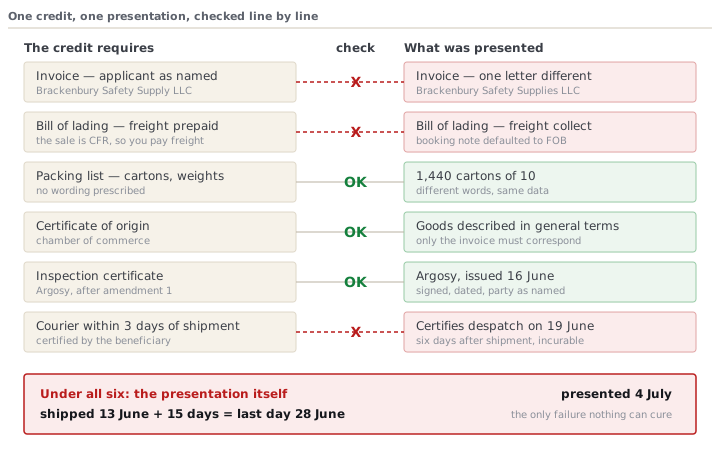
Batinah Commercial Bank refused on four discrepancies.
One. Presented after the presentation period. The credit gives 15 days after the shipment date. The on-board date on the bill of lading is 13 June, so the last day was 28 June. The presentation was made on 4 July.
Two. Bill of lading marked freight collect. The sale is CFR Sohar, so Qaitbay pays the ocean freight, and the credit says the bill must be marked freight prepaid. It says collect.
Three. Applicant's name on the invoice. The credit says Brackenbury Safety Supply LLC. The invoice says Brackenbury Safety Supplies LLC. One letter.
Four. Beneficiary's certificate contradicts the credit. It certifies despatch on 19 June, which is six days after the shipment date, against a credit requiring 3 days.
The two that passed, and why that surprises people
The packing list says 1,440 ctns @ 10 pcs. The invoice says 1,440 cartons of ten pieces each. Different words, same data, no conflict. So both stand. Wording that differs is not a discrepancy. Data that contradicts is.
The certificate of origin describes the goods as men's industrial coveralls and nothing more, while the credit's field 45A runs to a fabric composition and a weight. That is fine too. Only the invoice has to correspond with the credit's description. Every other document may carry a general description, as long as it does not conflict. People routinely put too much detail on their certificates, believing that more detail is safer. It is the opposite. Every extra word is another chance to contradict something.
Where each of the four came from
Number three is a typing error in a template. It is the only one of the four that anybody would call a mistake.
Number two is the interesting one. Qaitbay's forwarder raised the booking on Qaitbay's own standard booking note. That note is set to FOB Alexandria, because almost all their business is FOB. Under FOB the buyer pays the freight and the bill is correctly marked collect. The forwarder did exactly what the booking note told them to do, promptly and without error. The instruction was wrong. The action was right. There is no individual to correct here, only a template with one field that changes with the Incoterm, which nobody had connected to the credit.
Number four is a shipping department doing its job in the order that made sense to it. The courier set went out once the bills of lading were physically in hand on 17 June, plus two days to assemble a full set of copies. Perfectly reasonable, and two days later than a clause nobody had read to them.
Number one is not a mistake by anyone at all, and lesson 5 takes it apart.
Curable and incurable
The whole of lesson 4 turns on this split, so make it now.
| Discrepancy | Fixable? | What it would take |
|---|---|---|
| Presented after the period | No | Nothing can move a date that has passed |
| Freight collect | In principle | The line re-issues a corrected bill, USD 250.00 and three working days |
| Applicant's name | Yes | Re-type the invoice, one hour |
| Certificate says 19 June | No | It records an act already performed; a certificate saying otherwise is a false document, not a cure |
Two of the four were free to fix, and were fixed within a day of being named. Two of them could not be fixed at any price, and both of those are about time. Paper you control is cheap to correct, and time cannot be corrected at all. That is the argument for checking the credit's dates in March rather than its documents in July.
Check yourselfYour invoice describes the goods exactly as the credit does. Your packing list calls them simply garments. Is the packing list discrepant?Show the answer
No. Only the invoice's description has to correspond with the credit's. The other documents may describe the goods in general terms, as long as nothing they say conflicts with the credit or with each other. The risk runs the other way. A packing list that repeats the credit's full description gives you six more chances to mistype a composition or a weight, and any one of those becomes a conflict. Say less on every document except the invoice.