Lessons · Lesson 1 of 7
- 01 · The bank does not check whether you failed
- 02 · Four instruments on one contract, and what each one secures
- 03 · The demand: what it must say, and how fast the money goes
- 04 · Standby credits, and choosing between the two shapes
- 05 · The call nobody was wrong to make
- 06 · Expiry is the only thing that reliably protects you
- 07 · The drafting that costs nothing at the time
The bank does not check whether you failed
Tell an independent undertaking from a surety, and see why that difference decides whether a bank pays before anybody has proved anything.
Lesson 1 of 7 · 18 min
The email that is not a question
14 April 2027, 15:40. The finance director of Zawya Uniforms, in Fayoum, opens a message from Corniche Commercial Bank in Cairo. It is four lines long.
A demand has today been received under our guarantee CCB/G/27-0114 in favour of Kerrund State Railways for the full amount, USD 248,000. The demand appears to conform on its face. In accordance with the guarantee we shall pay on the fifth banking day and debit your account.
Read it again for what it does not say. It does not ask whether Zawya agrees. It does not ask whether Zawya failed. It does not ask for Zawya's side of the story. It reports what the bank is about to do with Zawya's money. All it offers is notice.
This is not a bank behaving badly. The bank is doing exactly what the instrument tells it to do. And Zawya is the one who asked for that instrument. Everything else in this course follows from that. So go slowly here.
The order this course runs on
Kerrund State Railways is a state rail operator. Kerrund is invented, and so is every rate, fee and margin in this course. In 2026 it ran a tender to re-equip its platform and train crews. Zawya Uniforms, Fayoum, won it.
- Contract KSR/UNI/271, signed 15 December 2026.
- 62,000 uniform jackets, style UJ-410, wool-rich suiting, one colour, men's and women's blocks.
- USD 40.00 a jacket, delivered. Contract value USD 2,480,000.
- Three tranches: 20,000 pieces due 15 March 2027, 22,000 due 15 June, 20,000 due 15 September.
Zawya's merchandising team costed the order, planned it, and shipped most of it well. Nobody costed the four bank instruments the tender obliged Zawya to provide. And nobody read the wording of any of them closely.
Two families, and almost everything you meet is the first
There are two very different ways a third party can stand behind an obligation. The difference is not a matter of degree. It decides who has to prove what before money moves.
An independent undertaking. The bank promises to pay a stated sum against a stated document. Usually that document is a written demand. Sometimes it is a demand plus one or two named documents. The promise is independent of the underlying contract. The bank is not a party to the sale. It has not read the tech pack. It has no view on whether the goods were late. Its whole duty is to look at what has been presented and ask one question: does this match what my own instrument says I must be given? If it does, it pays. Demand guarantees and standby letters of credit are both this shape.
An accessory undertaking. This is a surety, or a conditional bond. Here the guarantor's liability is tied to the underlying contract. The beneficiary has to establish default before anything is payable. And the guarantor can raise the defences the principal could have raised. This is closer to what most people picture when they hear the word "guarantee". In international apparel supply it is much rarer.
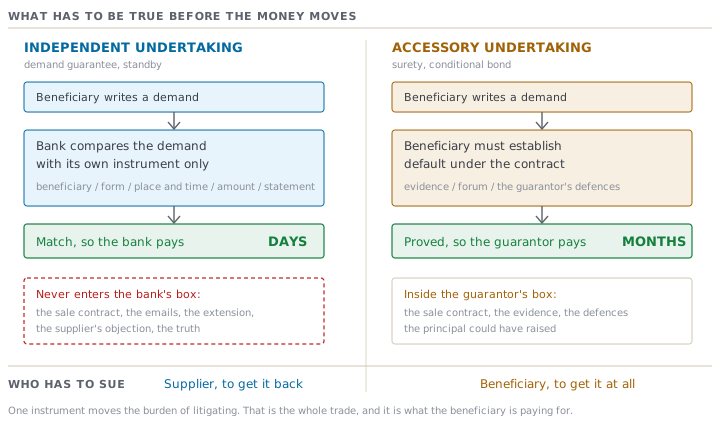
The trap is that the family is decided by the wording, not by the title. A document headed "Performance Bond" can be an independent undertaking. A document headed "Bank Guarantee" can be accessory. The words that give it away are ordinary and easy to skim past: on first written demand, without proof or conditions, notwithstanding any objection by the applicant, your demand shall be conclusive evidence. Any of those, and you are in the first family. The bank will not investigate.
What independence actually buys, and who it is for
It is tempting to read all this as a bank protecting itself. It is not. Independence is a feature the beneficiary is paying for. It is worth understanding why it exists, because one day you will be a beneficiary too.
A buyer who takes a conditional bond has bought a lawsuit. To get money out of it, the buyer must prove default somewhere, against a supplier in another country, under a law that is probably not the buyer's own. That takes months. It costs money the buyer may never recover. A buyer who takes an independent undertaking has bought liquidity. The buyer writes a demand and has the cash. Any argument about who was right happens afterwards, with the money already on the buyer's side of the table.
That is the whole trade. The independent undertaking moves the burden of litigating from the beneficiary to you. Before the call, the buyer would have had to sue you. After the call, you have to sue the buyer, in the buyer's country, to get it back.
Three parties, and you are not one of them
One last thing to fix before the mechanics. An independent undertaking has three roles, and they are not equal.
- The applicant, or instructing party — Zawya. Asks for the instrument, indemnifies the bank, pays for it.
- The guarantor, or issuer — Corniche Commercial Bank. Owes a duty to the beneficiary under the instrument, and a separate duty to Zawya under the facility agreement.
- The beneficiary — Kerrund State Railways. Holds a promise from a bank.
The instrument runs between the guarantor and the beneficiary. Zawya is not a party to it. Zawya's objection to a demand has no standing under it at all. That is exactly why the email on 14 April was a notification and not a question. Zawya does have rights against KSR under contract KSR/UNI/271. But those are rights under a different agreement, enforced somewhere else, on a different timescale.
Hold that shape in your head. Course 13.2 does the same job for documentary credits, where the bank also examines documents rather than goods. The difference is that a credit is meant to be drawn every time, and one of these is meant never to be drawn at all.
Check yourselfA bond is headed Conditional Performance Bond, and its operative sentence reads: we undertake to pay you on receipt of your first written demand, without proof or conditions. Which family is it in?Show the answer
The first: an independent undertaking. The heading is decoration. "On receipt of your first written demand, without proof or conditions" tells the bank it may not look behind the demand. So the word "Conditional" in the title describes nothing the bank will ever act on. Read the operative sentence, always.