Lessons · Lesson 5 of 7
- 01 · The bank does not check whether you failed
- 02 · Four instruments on one contract, and what each one secures
- 03 · The demand: what it must say, and how fast the money goes
- 04 · Standby credits, and choosing between the two shapes
- 05 · The call nobody was wrong to make
- 06 · Expiry is the only thing that reliably protects you
- 07 · The drafting that costs nothing at the time
The call nobody was wrong to make
Follow ten individually correct decisions to a demand under a performance bond, price what the call cost against what was actually owed, and find the one act that would have stopped it.
Lesson 5 of 7 · 18 min
Nobody made a mistake
This is the lesson the rest of the course exists for. Its point is not that somebody at Kerrund State Railways behaved badly. Nobody did. Every decision in the chain below was correct, defensible, and made by a person doing their job properly. At the end of the chain, USD 248,000 left Zawya's account.
8 January 2027. Zawya submits lab dips and a bulk shade for the KSR corporate blue. The contract gives KSR's technical office ten working days to respond.
8 January to 26 February. The technical office does the job thoroughly. It compares the submission against the physical reference in daylight. Then, and this is the part that took the time, it compares it against a jacket from the previous uniform generation, recovered from a regional depot, so the new jackets will not sit badly beside the thousands still in service. That comparison is exactly right. It is the sort of care a supplier normally wishes buyers took. It takes 49 days instead of ten working days.
26 February. Approval returned. Zawya could not have cut earlier. The mill would not dye 37,000 metres for Tranche 1 against an unapproved shade, and no factory should ask it to.
3 March. Zawya's project manager agrees an extension of the Tranche 1 delivery date, by email, with the head of KSR's technical office. That is the person who caused the delay, who has every reason to agree, and who does agree, in writing, unambiguously.
6 April. Zawya recovers hard and delivers Tranche 1. It is 22 days late against 15 March, rather than the 49 the approval cost. That recovery was genuinely good work.
9 April. KSR's contract administrator applies liquidated damages under the contract: 0.5% of the value of the late tranche for each completed week, capped at 5%. Three completed weeks on a tranche worth USD 800,000 is USD 12,000. Correct arithmetic, correct clause.
9 April. KSR's procurement manual requires that where liquidated damages on any tranche exceed USD 10,000, the contract administrator refers the file to the Guarantees Committee. The manual was written after an audit found officers quietly absorbing supplier failures. He refers it. Not referring it would have been the disciplinary offence.
13 April. The Guarantees Committee applies its standing instruction: where a referred file shows no approved extension of time in the contract register, demand under the performance bond. The register shows none. An extension of time is a contractual variation, and only the contract administrator may enter one. A register that accepted amendments by email from any department would not be a register.
14 April. The demand is presented. It complies, as lesson 3 showed.
21 April. Corniche pays. USD 173,600 is debited from Zawya's current account.
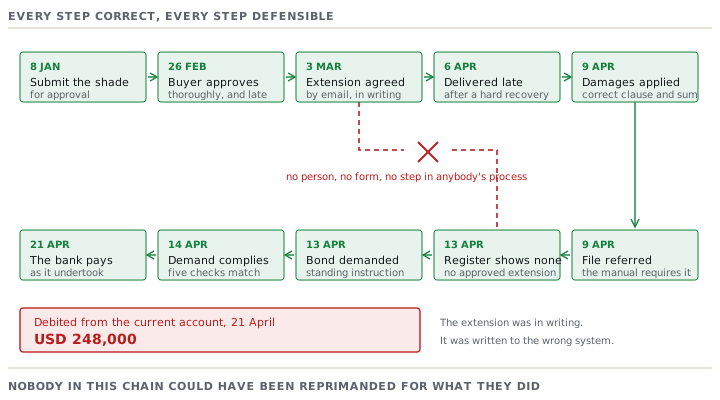
The extension was in writing. It was written to the wrong system.
Zawya's internal review produced two lessons: chase buyer approvals harder, and always get extensions in writing. Both are sensible. Neither would have changed anything. Zawya had chased the approval, and the file is full of it. And the extension was in writing.
The extension was agreed with the department that owed it, and recorded in that department's email. The instrument lives in a different world entirely. It answers to the contract register, and the contract register answers to the contract administrator. Between the email of 3 March and the register there was no person, no form, and no step in anybody's process.
That is the whole failure, and it is the shape this course wants you to recognise. Every contractual variation that moves a date, a quantity or a value must produce a matching change in two places: the beneficiary's authoritative record, and the instrument itself. The second one has a price list. Corniche amends a guarantee for USD 120.
What the call cost, separated from what was owed
Be precise about this. The two get muddled, and only one of them is the instrument's doing.
Owed anyway. The USD 12,000 of liquidated damages was payable under the contract whether or not any bond existed. It is not a cost of the call.
Caused by the call. Zawya claimed against KSR under the contract and settled on 12 March 2028. KSR returned USD 236,000, keeping the USD 12,000 it was genuinely entitled to. So the money was gone for eleven months.
- Financing that hole at Corniche's 11.5% working-capital rate: 248,000 for eleven months, USD 26,143.33.
- Legal fees, an expert on the approval correspondence, and eleven months of a finance director's attention, invoiced at USD 18,500.
- Total caused by the call: USD 44,643.33.
That is 3.7 times the amount actually owed. It is 372 times the amount Corniche would have charged to amend the guarantee on 3 March.
And it understates the damage, because the second-order cost has no clean number on it. With USD 173,600 gone from the current account in April, Zawya's headroom on its facility fell. The letter of credit for the Tranche 3 fabric had to be opened later and smaller than planned. Course 13.4 is where that kind of cost is properly modelled. The point here is simpler: a bond call does not arrive as a single line in the accounts. It arrives as a squeeze on everything the facility was also holding up.
What defences actually exist, and how narrow they are
Almost none. It is worth understanding why, rather than being disappointed.
Courts will stop payment under an independent undertaking only in narrow circumstances. Essentially, where a required document is forged, or the demand is materially fraudulent. That means a beneficiary claiming what it knows it has no right to claim. In the United States that ground sits in the letter-of-credit article of the Uniform Commercial Code. Other systems reach a similar place by other routes. The bar is deliberately high. The exception is the only thing that can undermine independence, and independence is the entire value of the instrument to the beneficiary who paid for it.
Zawya had an email showing that a department had agreed an extension. That is evidence of a dispute. The Guarantees Committee was not claiming something it knew to be false. It was acting on the only record it was entitled to act on. No court was going to call that fraud, and Zawya's counsel said so on 18 April. He was right.
Check yourselfIf you could add only one item to a merchandiser's process to prevent this, what would it be?Show the answer
A rule that no agreed change to a delivery date, quantity or value counts as agreed until two things happen. First, the buyer's contract owner confirms it — the person whose entry the buyer's own system accepts. Second, where an instrument depends on that date, the instrument is amended. Chasing approvals harder and getting things in writing are both good habits, and neither would have helped here. The writing existed and went to the wrong place.