Lessons · Lesson 2 of 7
- 01 · The bank does not check whether you failed
- 02 · Four instruments on one contract, and what each one secures
- 03 · The demand: what it must say, and how fast the money goes
- 04 · Standby credits, and choosing between the two shapes
- 05 · The call nobody was wrong to make
- 06 · Expiry is the only thing that reliably protects you
- 07 · The drafting that costs nothing at the time
Four instruments on one contract, and what each one secures
Match each bond on a real tender to the exposure it exists for, and price the retention guarantee against the cash retention it replaces.
Lesson 2 of 7 · 18 min
The four lines nobody costed
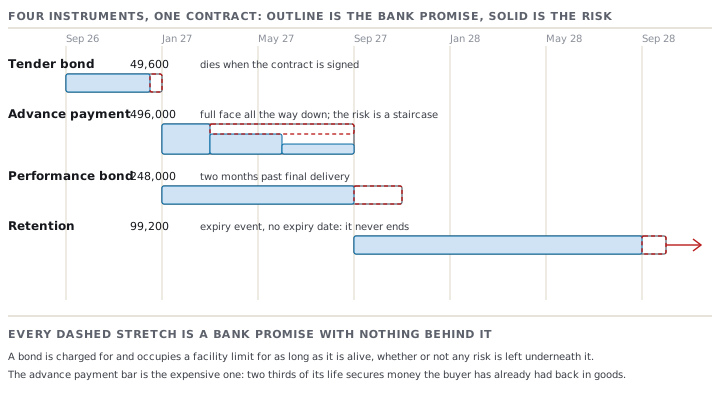
Section 9 of the KSR tender pack is one page long. It obliges Zawya to provide four separate bank instruments at four separate moments. Zawya's tender team read it as an administrative annexe. It is a financing schedule.
| Instrument | Percentage | Face | Issued | Should die |
|---|---|---|---|---|
| Tender bond | 2% of tendered value | 49,600 | 1 Sep 2026, with the bid | 31 Dec 2026 |
| Advance payment guarantee | 100% of the advance | 496,000 | 1 Jan 2027 | When the advance is worked off |
| Performance bond | 10% of contract value | 248,000 | 1 Jan 2027 | 30 Nov 2027 |
| Retention guarantee | 4% of contract value | 99,200 | 1 Oct 2027 | 30 Sep 2028 |
Total face issued across the life of the contract is USD 892,800. At the busiest moment, the first quarter of 2027, Zawya has USD 744,000 of bank promises outstanding at once. Every one of those dollars is charged for. And every one of them takes up room on a facility Zawya also needs for buying fabric. Lesson 6 puts a price on that. This lesson is about what each instrument is actually for. An instrument aimed at the wrong exposure is the commonest drafting error in the set, and the most expensive.
Each one answers a different question
The tender bond answers: if we award this to you, will you actually sign? A public buyer runs a tender at real cost: evaluation, committee time, a schedule built around an award date. A bidder who wins and then withdraws makes the buyer start again. So does a bidder who wins and then refuses to provide the performance bond. The tender bond is small because the loss it covers is small. It covers the cost of re-running a tender, not the value of the contract. It should expire the moment the risk does, which is when the contract is signed and the performance bond is in place.
The advance payment guarantee answers a completely different question: if we hand you our money before we have any goods, what brings it back? KSR paid Zawya USD 496,000 on 8 January 2027, twelve weeks before the first jacket existed. That is not a comment on Zawya's performance. It is unsecured cash sitting in a supplier's account. So the guarantee is for the full amount of the advance. It is the one instrument in the set that is not a percentage of anything. It tracks the money.
That has a consequence people miss. The advance is worked off delivery by delivery. Once 20,000 jackets are delivered and certified, roughly a third of the advance has been earned. The exposure the guarantee exists for is a third smaller. A guarantee that does not shrink with it is securing money that has already been repaid, and you are paying for the privilege. Lesson 7 costs exactly that.
The performance bond answers: if you do not deliver, what compensates us for the mess? Re-tendering, buying elsewhere at a worse price, running a rail network in last season's uniforms. It is a percentage of contract value because the loss is proportional to the contract. It is also the one a buyer is most likely to call, because it is live during the part of the job where things go wrong.
The retention guarantee answers: if the garments fail after we have paid, what pays for putting it right? Seams, colour fastness after industrial laundering, a zip supply that turns out to be wrong. That risk starts at delivery and runs through the warranty period. This is why it is the only instrument in the set that is issued after the work finishes.
The one that is a real decision: retention
Three of the four are take-it-or-leave-it. The fourth is a genuine choice, and it is worth money.
KSR's conditions of contract allow either route. Cash retention: KSR deducts 4% from every invoice and holds it for twelve months after final delivery. A retention guarantee: KSR pays every invoice in full, and Zawya provides a bank instrument for the same 4%.
Both leave KSR equally protected. They are not equally expensive for Zawya. And the comparison is the sort a merchandiser can do on the back of a delivery note.
Under cash retention, Zawya is without USD 99,200 for the twelve months. Corniche charges Zawya 11.5% a year on its working-capital line. That is Corniche's rate, on Zawya's facility, in 2027. So being without that money costs USD 11,408.00.
Under the guarantee, Zawya keeps the cash and pays two other things instead. First, an issuance commission of 1.6% a year on the face. On USD 99,200 for a year that is USD 1,587.20. Second, a 30% cash margin the bank blocks. That is USD 29,760 tied up for the year, costing USD 3,422.40 at the same 11.5%. Total USD 5,009.60.
| Cash retention | Retention guarantee | |
|---|---|---|
| Cash Zawya is without | 99,200 for 12 months | 29,760 for 12 months |
| Financing cost at 11.5% | 11,408.00 | 3,422.40 |
| Bank commission at 1.6% | nil | 1,587.20 |
| Total cost to Zawya | 11,408.00 | 5,009.60 |
The guarantee is cheaper by USD 6,398.40. That is about ten US cents a jacket on a USD 40.00 garment. It is cheaper for one reason: the margin is less than a third of the face rather than all of it. Reverse the margin and the answer reverses with it. That is why this is a calculation and not a rule. Ask your bank for its margin before you choose, not after.
The other family does exist, and it changes the price
Everything above assumes independent undertakings. That is what KSR's template produced. It is worth knowing the alternative exists. In some markets and some industries the same four instruments are written as conditional bonds. They are often issued by an insurer rather than a bank, and the beneficiary must establish default before anything is payable.
The ICC publishes rules for both shapes. The fact that it needs two sets is the clearest signal that they are different animals. A surety bond is usually cheaper in bank limit terms, because an insurer is underwriting your performance rather than your balance sheet. It is also much harder for a beneficiary to convert into cash. Buyers know this. That is why a buyer with the bargaining power asks for the first family.
Check yourselfZawya delivers the last 20,000 jackets on 15 September 2027 and KSR certifies them on 30 September. Which of the four instruments should still be live on 1 October, and which should be dead?Show the answer
Live: the retention guarantee, which starts here and runs through the warranty period, and the performance bond, which KSR's template holds until 30 November. Dead: the tender bond, which expired the previous December, and the advance payment guarantee, because the last certification finishes working off the advance. The advance payment guarantee is the one to chase. Nothing releases it automatically, and every quarter it stays open is charged for.