Lessons · Lesson 4 of 6
What a two-fifths buyer prices
Put a number on the orders you did not take, the terms you did not negotiate and the price you did not ask for, and turn the resignation question into a break-even probability.
Lesson 4 of 6 · 19 min
Concentration is not a risk statistic. It is a price list.
Ravnsborg is 40.79% of Lomnitsa's revenue and 44.44% of the capacity it sold. Everybody in the building knows the first number and treats it as a fact about exposure: something a bank asks about, something to mention to an auditor, something to worry about in general.
It is not a general worry. It is a set of real prices that Lomnitsa paid this year, in three places, and none of the three appears on any report the sales meeting reads. Course 14.6 owns concentration as a risk across the whole order book. This lesson owns it as an operating cost in one year.
The first price: the orders you did not take
In April 2026 Norbeck asked for a second programme: twelve line-weeks of workwear jackets, starting in September. Lomnitsa said no, because September and October had to stay clear for a Ravnsborg autumn drop that had been discussed since February and was never confirmed. The drop did not happen. The weeks were eventually filled with ordinary Ravnsborg repeats.
| How you value the weeks | Working | Amount |
|---|---|---|
| The overhead they must carry, at minimum | twelve line-weeks at the hurdle rate | 31,200.00 |
| The contribution the declined programme would have earned | twelve line-weeks at Norbeck's rate | 89,250.00 |
Ravnsborg held an option on twelve weeks of a factory it does not own, for seven months, and paid nothing for it. Nobody asked it to, and it never occurred to anyone to ask, because holding capacity for your biggest account does not feel like a transaction. It is one. The honest range on what it was worth is between USD 31,200.00 and USD 89,250.00, and where you sit in that range depends on whether you can name the work you turned away. Here you can.
Take the smaller of the two numbers into a conversation, for the reason lesson 2 gives: the number you can defend is worth more than the number that is bigger.
Course 14.6 values held capacity a third way, at the rate at which holds have historically turned into orders across the whole book. That is the right method when the question is how much of your loading is real. The question here is narrower: what one account's free option cost, so it can be entered on that account's ledger.
The second price: the terms you did not negotiate
In November 2025 Ravnsborg sent every supplier a letter moving payment from 60 days to 90 days from the bill of lading, effective February. There was no negotiation, because there was no offer. Lomnitsa's answer was a filing decision rather than a commercial one.
Those thirty days cost the factory USD 28,110.77 a year at its overdraft rate. That is USD 0.0450 a piece, which is 5.70% of Ravnsborg's whole contribution per piece.
Course 13.5 works the same arithmetic from the other direction and finds something worth carrying here. When a factory asks a buyer to shorten its terms, the buyer prices the request accurately and charges almost exactly what the shortening is worth. Buyers know what days cost. The only difference in this case is that nobody was asked.
The third price: the price you did not ask for
Lesson 2 left Ravnsborg USD 68,984.86 short of the overhead sitting on its capacity. Closing that gap on price alone means USD 0.1106 a piece: an FOB of USD 4.96 instead of USD 4.85, an increase of 2.28%.
Should Lomnitsa ask? The instinctive question is will they accept, which cannot be answered. The answerable question is how likely would losing them have to be before asking is the wrong move, and that has an exact answer.
If the ask succeeds, Lomnitsa gains the shortfall: USD 68,984.86. If it fails and the account leaves, Lomnitsa loses what the account currently puts towards overhead, which is its contribution after concessions and finance: USD 243,015.14. Asking is worth it as long as the chance of losing the account is below the ratio between the two.
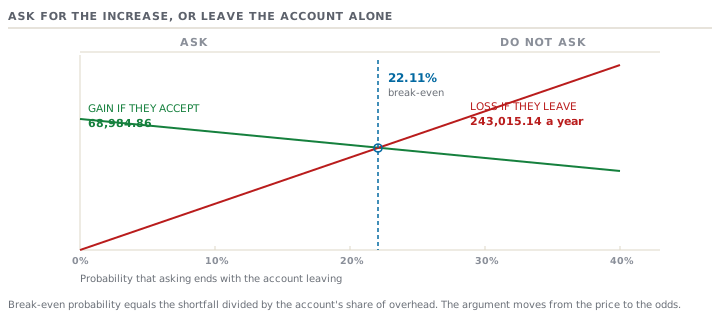
That probability is 22.11%, and the arithmetic behind it is worth remembering: the break-even probability is the shortfall divided by the account's share of overhead. The two figures above add up to USD 312,000.00, which is exactly the 120 line-weeks at the hurdle rate, because the shortfall is by definition the part of the overhead share the account does not cover.
So the question at the review is not are they going to say yes. It is: would more than one in five of these conversations end with us losing the account? For a two per cent increase, from a supplier holding twelve of the buyer's styles, the honest answer is almost always no. And now it is a number instead of a nerve.
The resignation question, answered properly
The obvious conclusion from lessons 1 and 2 is that Lomnitsa should resign the account. Work it through.
| Amount | |
|---|---|
| Profit for the year as it stands | 160,215.88 |
| Remove the account's shortfall | 68,984.86 |
| Lose its contribution to the overhead on 120 line-weeks | 312,000.00 |
| Profit for the year without the account | -82,799.26 |
An account that loses USD 68,984.86 a year is worth USD 243,015.14 a year to the factory, and both sentences are true at once. That is the whole of concentration in one line. The decision is not is this account profitable. It is can I fill 120 line-weeks with anything better before I let it go, which is a sales question with a deadline, not an accounting question.
That gives two thresholds rather than one, and mixing them up is the commonest error in this whole subject:
- Replacement work above USD 2,025.13 a line-week makes the factory better off than keeping Ravnsborg.
- Replacement work above USD 2,600.00 a line-week actually covers the overhead on the capacity it uses.
Work that falls between those two figures improves the factory and still loses money on paper. Take it, and keep taking it, while you look for better.
The uncomfortable part
Lomnitsa left 18 line-weeks unsold this year, which cost it USD 46,800.00 in overhead nobody carried. That is two thirds of the shortfall on its largest account, produced by nothing at all. Concentration and idle capacity are the same disease read at two temperatures: a factory with four accounts cannot fill its lines and cannot refuse its biggest buyer, and the second follows from the first.
The cure is a fifth account, which is course 14.5. Nothing in this lesson gets better by squeezing Ravnsborg harder.
Check yourselfLomnitsa's owner says a break-even probability is a spreadsheet game, and that losing this account would end the factory. Is he wrong?Show the answer
He is right about the consequence and wrong about the conclusion, and the two can be separated. Losing the account without a replacement turns a profit of USD 160,215.88 into a loss of USD 82,799.26. That is a threat to the factory's existence, not merely unpleasant, and it is entirely reasonable to weigh it more heavily than the arithmetic alone. What the break-even probability does is stop the fear working invisibly. It says the ask is right unless you genuinely believe more than one in five such conversations would end the relationship. So the argument moves from how frightened everyone is to how the buyer has behaved on the four most recent occasions something was asked of it. That is a question the account file from lesson 6 can actually answer.
What you should be able to do now
- Measure your largest account against sold capacity, not only against revenue. They are usually different numbers, and the capacity one is the real constraint.
- Price every block of capacity you hold for a buyer at the hurdle rate, and treat an unconfirmed hold as an option they have not paid for.
- Work out the break-even probability before any price ask: the shortfall divided by the account's share of overhead. Argue about the probability, not about the price.
- Keep the two replacement thresholds apart — better than the account you have, and good enough to cover its capacity. They are far apart, and work in between is worth taking.