Lessons · Lesson 2 of 6
The concessions ledger
Price every free sample, absorbed air freight, accepted chargeback and held line-week on the day it happens, and read the FOB you actually got rather than the one you agreed.
Lesson 2 of 6 · 18 min
The third book
Lomnitsa keeps two books that everyone trusts. The cost sheet says what a piece costs to make. The bank statement says when the money moved. Between them sits a third book that nobody keeps, and it is the one that decides whether an account is worth having.
A concession is anything of value that leaves the factory and goes to an account outside the agreed price. It is not charity and it is not weakness. Most of the entries below were the right call on the day. The problem is not that they were given. The problem is that they were given one at a time, by different people, over ten months, and were never added up. So when the annual price review came round, the factory argued from memory and the buyer argued from a system.
Every one of these payments is already in Lomnitsa's accounts. Not one of them carries the buyer's name. The air freight sits in freight. The samples sit in sample-room labour. The replacement pieces sit in production waste. The chargebacks are a credit note against revenue. Course 14.4 builds the profit and loss account those lines belong to. The job here is narrower and harder: put an account code on money that has already been spent.
Ravnsborg's year, line by line
| What was given | How it was priced | Amount |
|---|---|---|
| Extra development samples beyond the agreed three per style | sample-room cost of 96.00 each | 3,936.00 |
| Air freight absorbed on three late deliveries | 2,180 kg at the 4.35 differential over sea | 9,483.00 |
| Chargebacks accepted without challenge, seven debit notes | face value on the day accepted | 21,640.00 |
| Line-weeks held at the buyer's request and then released | see the note below | 48,376.00 |
| A yarn increase absorbed rather than passed on | 214,000 pieces at 0.07 | 14,980.00 |
| Re-inspections paid for by the factory | nine visits at 385.00 | 3,465.00 |
| Replacement pieces shipped free of charge | 1,850 pieces at the direct cost of 4.06 | 7,511.00 |
| Total | 109,391.00 |
A chargeback is money the buyer takes back from your invoice, usually for a late delivery or a packing fault, and tells you about afterwards. It arrives as a debit note.
Divide the total by the year's 624,000 pieces and it is USD 0.1753 a piece.
Now put that next to the price on the front of the contract. Lomnitsa agreed USD 4.85. Lomnitsa received USD 4.6747. The difference is not a discount anybody negotiated, and it does not appear on any order confirmation. It is a year of small yeses, each of which was reasonable.
Against a contribution of USD 0.79 a piece, the concessions ledger is 22.19% of everything the account earns.
The staircase
Lesson 1 left Ravnsborg at USD 2,936.72 a line-week after the cost of the money it holds, comfortably above the USD 2,600.00 hurdle. Add this ledger and the account crosses the line.
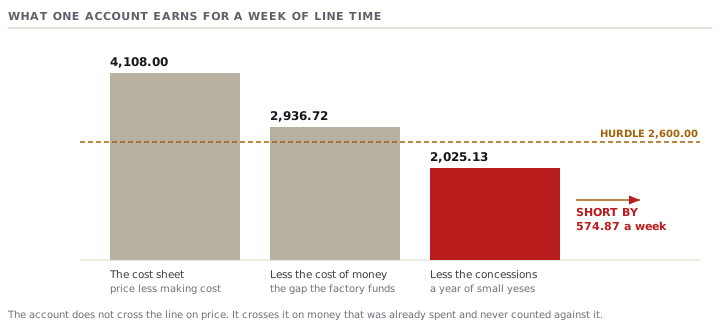
At USD 2,025.13 a line-week, Ravnsborg is USD 574.87 a week short of the overhead sitting on the capacity it occupies. Across 120 line-weeks that is USD 68,984.86 for the year. The factory's whole profit for the same year is USD 160,215.88.
Read that pair of numbers slowly, because they are the reason this course exists. The largest account in the building, on a price everyone in the building has defended for three years, used 44.44% of the sold capacity and did not cover the overhead sitting on it. And every figure that proves it was already in the accounts, filed under a name that does not mention the buyer.
Concession intensity is not proportional to size
Run the same exercise across all four accounts and a second surprise appears.
| Account | Concessions | Per piece | Share of its own contribution |
|---|---|---|---|
| Ravnsborg | 109,391.00 | 0.1753 | 22.19% |
| Verhulst | 26,860.00 | 0.3893 | 17.30% |
| Ottelin | 18,420.00 | 0.0707 | 4.21% |
| Norbeck | 4,275.00 | 0.0679 | 1.60% |
Verhulst is the smallest account in the building and the most expensive one to serve per piece, by more than five times over Norbeck. It buys short runs, it changes its mind late, and it eats the sample room. Ravnsborg is worst by the second measure, because its contribution per piece is so thin that a small concession swallows a large share of it.
Neither ranking is the right one on its own. Per piece tells you what serving this buyer costs. Share of contribution tells you how much of the account's value that service eats. A buyer can be cheap to serve and still not be worth serving.
Prompt · Build one buyer's concessions ledger for the year, and give me the price I actually received
Before an annual review, when you know you have given things away and cannot say how much.
Act as a commercial controller in an export garment factory. Build me a concessions ledger for ONE buyer covering one financial year, and turn it into the price I actually received. Account facts: buyer [BUYER], year ended [DATE], pieces shipped [QTY], agreed price [PRICE] per piece [INCOTERM AND NAMED PLACE], my direct cost per piece [AMOUNT] covering materials, trims and making. Capacity: my factory has [NUMBER] production lines running [NUMBER] weeks a year; this account used [NUMBER] line-weeks; my annual fixed overhead is [AMOUNT]. Money: my working capital facility costs [RATE] a year; cash goes out on average [DAYS] before the on-board date and arrives on average [DAYS] after it. Now the ledger. For each category below, give me a row with the amount and the basis you priced it on. If I have not given you the input, leave the row BLANK with a note, never a zero. The categories: development samples given beyond the agreed number [NUMBER AND UNIT COST]; air freight or expedite costs absorbed [WEIGHT AND DIFFERENTIAL PER UNIT]; chargebacks and debit notes accepted [LIST WITH DATES AND AMOUNTS, AND SAY WHICH ARRIVED WITH EVIDENCE]; line-weeks held at the buyer's request and released [NUMBER, MY WEEKLY WAGE COST FOR AN IDLE LINE, AND WHETHER I REFUSED NAMED WORK IN THOSE WEEKS]; price increases I absorbed rather than passed on [PIECES AND AMOUNT PER PIECE]; re-inspections, testing or third-party visits I paid for [NUMBER AND UNIT COST]; replacement or top-up pieces shipped free [PIECES AND DIRECT COST]; anything else of value that left the building for this account. Price a held line-week TWICE: at the wages actually paid, and at the contribution forgone. Use the wages figure in the total unless I have named the order I turned away, because a number I cannot defend weakens the ones I can. Then give me the ledger total; the total per piece; the realised price per piece against the agreed price; the total as a share of the account's contribution; contribution per line-week before the ledger, after it, and after the cost of money; and whether the account clears my overhead per line-week at each stage. Finally, list separately any STANDING TERM that is not an event — a payment-term change, a discount structure, a returns allowance — with its annual cost and a warning that it may already be inside my finance cost and must not be added twice. End with the three entries a buyer's analyst would most likely challenge, and what evidence I would need for each.
AI can make mistakes — check anything you act on.
Five rules that make the ledger worth keeping
- Enter it in the week it happens. A concession rebuilt eleven months later is an argument. One entered on the day, with the name of the person who authorised it, is evidence.
- The account code is compulsory. This is the single mechanical change that makes the whole thing work. If your chart of accounts cannot carry a buyer code on a freight line, add a memo column outside the accounts. Never let money leave without a name attached.
- Price it with the cost you can defend, not the biggest one available. The rule in the callout above holds everywhere: wages actually paid, freight actually charged, face value actually credited.
- Never set a concession off against goodwill. We gave them the air freight but they gave us the repeat is not an entry. Record the cost. Record the repeat separately in revenue. Let the year decide.
- Do not count twice what is already in the finance line. Lesson 4 has a concession worth more than any line in the table above, and it must not be added to this total, for a reason worth its own page.
Check yourselfA buyer's chargeback for a late delivery was genuinely the factory's fault. Does it belong in the concessions ledger?Show the answer
Yes, and this is the entry people argue about most. The ledger is not a list of things the buyer took unfairly. It is a list of what the account cost outside its price, whoever was to blame. A deserved chargeback still tells you that this account's true realised price is lower than its contract price, which is the number you need when you decide whether to keep it. Blame belongs in a different conversation, with your own production manager, and the fix for a deserved chargeback is on the floor rather than at the negotiating table. Keeping the two apart is what stops the ledger becoming a grievance file, which is the fastest way to make a buyer stop reading it.
What you should be able to do now
- List every way value leaves your factory outside the price, and find where each one currently lands in your accounts.
- Price a held line-week both ways — wages paid, and contribution forgone if and only if you refused real work — and use the smaller one unless you can name the order you turned down.
- Convert the total to a realised price per piece. That number, not the contract price, is what your account is being sold at.
- Compare concession per piece against concession as a share of contribution. They rank your accounts differently, and both are worth knowing before a review.