Lessons · Lesson 1 of 6
What an account is worth in a year
Rank four buyers three ways from one ledger, and find the account that is biggest by revenue and last by the one measure that decides which order you take.
Lesson 1 of 6 · 19 min
Four accounts, one year, one ledger
Lomnitsa Apparel makes knitted tops and light workwear in Ruse, on the Bulgarian Danube. It has six sewing lines and works forty-eight weeks a year. It also has a cutting room and a small sample room. It sells FOB — free on board, which means the price covers the goods loaded onto the ship, and the buyer pays the freight from there. It has four accounts.
This course does not follow one order. It follows those four accounts through one financial year, the year to 31 January 2027. Every number in the six lessons comes out of the same ledger. An order is the wrong unit for the question this course asks. You cannot decide whether to keep a buyer by looking at one of its orders, any more than you can judge a mill by one roll.
Here is the year as the sales director shows it to the board.
| Account | Pieces | FOB | Revenue | Share |
|---|---|---|---|---|
| Ravnsborg Stores, Odense | 624,000 | 4.85 | 3,026,400.00 | 40.79% |
| Ottelin Sport, Turku | 260,400 | 9.40 | 2,447,760.00 | 32.99% |
| Norbeck Workwear, Kassel | 63,000 | 18.60 | 1,171,800.00 | 15.80% |
| Verhulst Kleding, Ghent | 69,000 | 11.20 | 772,800.00 | 10.42% |
Every figure there is true, and the table answers a question nobody asked. Revenue tells you how busy you were. It does not tell you which of these four you would take again if only one line were free.
The second ranking, and it changes nothing
The obvious correction is to take out what each piece costs to make — cloth, trims, cutting, sewing, finishing, packing — and rank on what is left. What is left has a name. It is the contribution: the money a piece brings in after the cost of making it.
| Account | Cost per piece | Contribution per piece | Contribution |
|---|---|---|---|
| Ravnsborg | 4.06 | 0.79 | 492,960.00 |
| Ottelin | 7.72 | 1.68 | 437,472.00 |
| Norbeck | 14.35 | 4.25 | 267,750.00 |
| Verhulst | 8.95 | 2.25 | 155,250.00 |
This is a better table and it gives the same order. Ravnsborg is still first. Stop here and you conclude that the biggest account is also the most valuable one. That is what everybody in the room already believed, so the meeting ends early.
The third ranking, which turns it upside down
Lomnitsa cannot sell pieces. It can only sell line-weeks — one sewing line running for one week. It has 288 of them a year and cannot buy more before next January. Course 7.4 treats the line-week as a planning unit: the thing a planner marks committed, held or free. Here it is a costing unit. It is the scarce resource, so the whole commercial argument has to be divided by it.
Divide each account's contribution by the line-weeks it used, and the year reads differently.
| Account | Line-weeks | Pieces per line-week | Contribution per line-week |
|---|---|---|---|
| Norbeck | 36 | 1,750 | 7,437.50 |
| Ottelin | 84 | 3,100 | 5,208.00 |
| Verhulst | 30 | 2,300 | 5,175.00 |
| Ravnsborg | 120 | 5,200 | 4,108.00 |
The account that was first on both earlier tables is last on this one. The account that was third is now first, by a wide margin. Norbeck earns Lomnitsa USD 7,437.50 for a week of line time. Ravnsborg earns USD 4,108.00 for the same week. The same seven days in the same building are worth 1.81 times as much to one buyer as to the other.
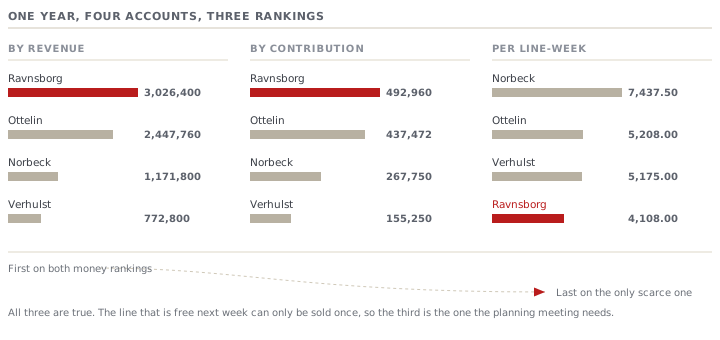
All three tables are true. Only the third one answers the question the planning meeting really asks every Monday. That question is never who is our biggest customer. It is always this line is free in week 31 — whose work goes on it?
The hurdle: what a line-week has to earn before it earns anything
Lomnitsa's fixed overhead for the year is USD 748,800.00. Overhead is the cost of being open: the building, the machines, the office, the sample room, the compliance audits, the managers. Spread it across all 288 line-weeks and it is USD 2,600.00 a line-week. Any week of line time that returns less than that is a week the factory paid to work.
Measured against that hurdle, all four accounts pass. Ravnsborg clears it by USD 1,508.00 a line-week. That sounds comfortable, and it is the last comfortable number in this course.
The fourth cut: the money that is not in the building
A contribution is not cash. Lomnitsa pays its knitter for the cloth long before the buyer pays for the garment. The gap is funded by an overdraft, and that overdraft costs the factory 13.5% a year. That is this factory, this bank, this year. Do not quote it as a market rate anywhere else.
| Account | Days out before shipment | Days from shipment to cash | Average money held | Finance cost |
|---|---|---|---|---|
| Ravnsborg | 46 | 104 | 1,041,139.73 | 140,553.86 |
| Ottelin | 52 | 63 | 633,378.41 | 85,506.09 |
| Norbeck | 61 | 47 | 267,499.73 | 36,112.46 |
| Verhulst | 44 | 58 | 172,575.62 | 23,297.71 |
Course 13.4 builds a cash cycle properly, one dated outflow at a time. Course 14.4 owns the factory profit and loss account that these figures roll up into. Both are worth having. What matters here is only what the finance column does to the third ranking.
Charge each account for the money it holds. Ravnsborg's line-week falls from USD 4,108.00 to USD 2,936.72. It still clears the hurdle. It clears it by USD 336.72 instead of by USD 1,508.00. It has just lost more than three quarters of the margin the board thought it had, and not one thing went wrong.
Nothing in lesson 1 is a criticism of Ravnsborg. Every figure so far comes off the cost sheet and the bank statement. Lesson 2 adds the third book, the one nobody keeps.
Check yourselfRavnsborg is 40.79% of revenue and last on contribution per line-week. Should Lomnitsa resign the account?Show the answer
Not on this evidence, and the reason is worth stating exactly. Contribution per line-week ranks work when the line is FULL. It tells you whose order to take when two buyers want the same week. Lomnitsa left 18 line-weeks unsold this year, so its lines were not full, and an account that clears the overhead hurdle at all adds to profit rather than subtracting from it. The ranking says something narrower and more useful. Every line-week Ravnsborg uses is a line-week Norbeck cannot have. If Norbeck ever asks for more, the answer is arithmetic rather than loyalty. Lesson 4 puts the resignation question properly, and finds the answer is not the one this table suggests.
Where this course sits
Track 14 divides the commercial job. The boundaries are worth naming before you go further, because three of the six courses touch these same numbers from a different chair.
- 14.1 owns the quotation: how an enquiry becomes a price you can defend.
- 14.2 owns the contract and the liability — the clause that costs you. Lesson 3 here prices a habit that was never written into any clause at all, which 14.2 cannot reach.
- 14.4 owns order profitability and the factory profit and loss account. It works in orders; this course works in accounts and in years.
- 14.6 owns risk across the order book. Lesson 4 here treats concentration as a pricing fact — what a large buyer costs you on every other decision — and leaves the risk of losing it to 14.6.
- 16.4 owns negotiation. Lesson 5 here builds the evidence you walk in with, not the way you argue it.
What you should be able to do now
- Name the resource your factory cannot make more of — line-weeks, machine-hours, a single bottleneck — and divide every account's contribution by it.
- Work out your own hurdle: annual fixed overhead divided by the total units of that resource, sold or not.
- Charge each account for the money it holds, then rank again. An account that clears the hurdle on the cost sheet and fails it at the bank is common, and it is invisible in every report the sales meeting normally sees.