Lessons · Lesson 5 of 6
- 01 · Six profitable orders and a factory that lost money
- 02 · The rate, the base, and the volume nobody sold
- 03 · What a factory has to sell before it earns anything
- 04 · Full cost or contribution: which decision is in front of you
- 05 · The contribution trap, and where it flips
- 06 · Correctly costed, correctly made, and wrong
The contribution trap, and where it flips
Calculate the exact spillover at which a fill-in order below full cost stops paying, and price the concession before you grant it.
Lesson 5 of 6 · 18 min
The bill arrives in November
Tanwir accepted Corvin's 28,000 hoodies at USD 3.92 in March 2027 and gained USD 26,040.00. Everything in lesson 4 was correct.
On 9 November 2027 Corvin's sourcing manager sends the autumn 2028 placement. The annual programme is 190,000 pieces of CVB-5507 a year at a list price of USD 4.72. The email asks for USD 4.28 across the whole programme. The reason it gives is neither aggressive nor dishonest.
We have your April price of 3.92 on file. We understand there were particular circumstances, and we are not asking you to hold that number. 4.28 sits between the two and reflects what we now believe your cost base to be.
That is a request for USD 0.44 a piece across 190,000 pieces. It is USD 83,600.00 a year, every year, for as long as the programme runs.
The one-off gain was USD 26,040.00. The recurring cost is 3.21 times it.
Nobody did anything wrong. Corvin's sourcing manager is doing her job with the only evidence she has, and Tanwir gave her that evidence. A price is a claim about your cost. Once you have made it, you have made it.
The arithmetic of the flip, in one line
You can work this out before you answer the email, and it takes two minutes. Two things decide it.
- d — how far the price falls on the volume that follows it down
- s — the share of that volume which follows
The fill-in gain is lost when
s × exposed volume × d > gain
so the flip point is
s* = gain ÷ (exposed volume × d)
For Corvin: the gain is USD 26,040.00, the exposed volume is 190,000 pieces a year, and the full gap is USD 4.72 − 3.92 = USD 0.80.
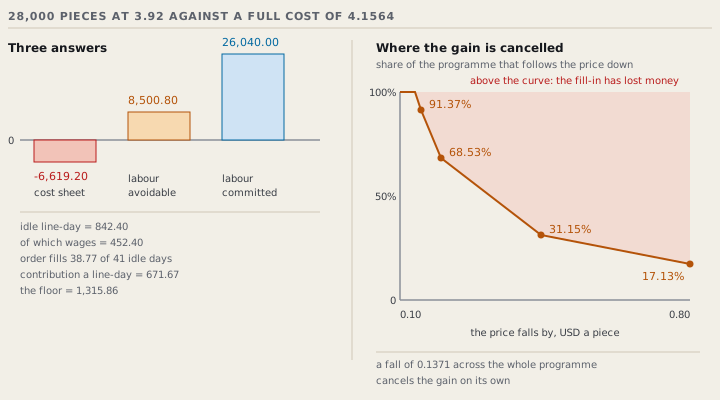
s = 26,040 ÷ (190,000 × 0.80) = 17.13%*
If more than 17.13% of next year's full-price volume follows the fill-in price all the way down, the fill-in order destroyed value. Not "was risky". Destroyed value, with a number.
The half that is genuinely surprising
Now read the flip the other way. Hold the share at everything and solve for the price instead.
d = gain ÷ exposed volume = 26,040 ÷ 190,000 = USD 0.1371*
A concession of 13.71 cents across the programme wipes out the entire gain. Thirteen cents. Against a discount of eighty cents granted once, on a quantity that is 14.7% of a year.
That gap is the whole trap, and it is worth saying plainly. The gain is a one-off on a small quantity. The loss is permanent on a large one. You do not need a catastrophe for a fill-in order to be the wrong decision. You need a rounding error on the annual programme.
| Price falls by | Cost on 190,000 pieces a year | Share that must follow before the gain is gone |
|---|---|---|
| 0.10 | 19,000.00 | 100% and it still just survives |
| 0.15 | 28,500.00 | 91.37% |
| 0.20 | 38,000.00 | 68.53% |
| 0.44 | 83,600.00 | 31.15% |
| 0.80 | 152,000.00 | 17.13% |
Read the top row and the bottom row together. A ten-cent drift across the entire programme is survivable. A full transfer of the fill-in price to a sixth of the programme is not. The danger is not proportional to the size of the discount you gave. It is proportional to the volume that hears about it.
Why it travels, and it is not because buyers cheat
Four mechanisms. None of them needs bad faith, and three of them are invisible from the factory.
- The buyer's own costing. A sourcing team builds a should-cost model from the prices it has actually paid. Your 3.92 goes into it as a data point. Nobody decides to use it against you. The model simply contains it.
- Benchmarking across a supplier base. Corvin buys the same garment from three factories. The lowest price any of them has quoted becomes the internal reference, and the other two are asked to explain the difference.
- The buyer's own staff turnover. The merchandiser who agreed the circumstances leaves in September. Her successor inherits a price file and no context. Your one-off is a row in a spreadsheet with no footnote.
- The rest of your own sales team. The second-worst way a fill-in price travels is inside your own building, when another merchandiser sees that CVB-5507 has been sold at 3.92 and stops defending 4.72.
What actually makes a concession non-referenceable
You cannot stop a price being remembered. You can make it hard to compare, and that is a different goal, and an achievable one. In order of how well they work:
- Change the product. A different style, a different fabric weight, a different pack. Anything that means the two prices are not prices for the same thing. This is the only one that works completely, because it removes the comparison instead of arguing about it.
- Give something other than price. Free freight to the port, a longer payment term, absorbed development cost, a free colour, a shorter lead time. Every one of those is worth money to the buyer, and none of them appears in a price file. This is the single most under-used move in factory selling.
- Attach a condition that expires. Made in the window 12 April to 6 May 2027 and priced for that window. A price with a date on it is defensible in a way that a price with an explanation is not.
- Say it once, in writing, at the time. Tanwir did this, and it was worth having in November. It is the weakest of the four, and it is still much better than nothing.
- Code it separately in your own system, so your own team does not quote from it.
Notice what is not on that list: hoping. And notice that Tanwir did three, four and five, and still received the November email. The measures that work are the ones that change what is being priced, not the ones that explain why the price was low.
What Tanwir should have asked for on 20 March
The fill-in was worth USD 26,040.00 to Tanwir, and it was worth something to Corvin too. A cancelled programme was placed at three weeks' notice, by a factory that already had the fabric approved and the pattern in the system. That is a favour. A favour is negotiable while it is being asked for, and worthless afterwards.
A single sentence in the acceptance email would have done it. We can take this at 3.92 for this window, against confirmation of the autumn 2028 programme at 4.72. Corvin might have refused. If they had, the order was still worth accepting on lesson 4's arithmetic. If they had agreed, the November email would not exist.
The moment to buy protection against the trap is the moment you are granting the concession. It is the only moment you have something to trade.
Check yourselfA buyer wants 9,000 pieces at USD 3.92 to fill a hole, and buys nothing else from you at all — this is your entire relationship with them. How does the flip arithmetic read?Show the answer
Exposed volume is zero, so there is no s* to calculate and the trap does not apply to this buyer. The decision is lesson 4's alone: is the contribution positive, and is the line genuinely idle. But run the calculation for the buyers you already have, not for this one, because the exposed volume is not only theirs. If this buyer sells into the same market as Corvin, or uses the same agent, or is quoted by the same three factories, the price can reach your existing programme without ever passing through this buyer's hands. Ask who else could come to hold this number, not who you gave it to.
What to take away
- A fill-in order below full cost is right when the line is idle and the price does not travel. Lesson 4 settles the first. Nothing settles the second by itself.
- The flip point is one line: *s\ = gain ÷ (exposed volume × the price gap)**. Corvin's is 17.13%. Work it out before you reply, not afterwards.
- Solve it the other way and the number is alarming. USD 0.1371 across the programme cancels a USD 26,040.00 gain. The gain is one-off and small. The exposure is annual and large.
- Prices travel through the buyer's cost model, their benchmarking, their staff turnover and your own sales team. None of that needs anyone to act in bad faith.
- Explaining a low price protects you least. Changing what is being priced protects you most, and conceding something that is not price protects you completely.
- Ask for something in return on the day. It is the only day you have anything to trade.