Lessons · Lesson 6 of 6
- 01 · Six profitable orders and a factory that lost money
- 02 · The rate, the base, and the volume nobody sold
- 03 · What a factory has to sell before it earns anything
- 04 · Full cost or contribution: which decision is in front of you
- 05 · The contribution trap, and where it flips
- 06 · Correctly costed, correctly made, and wrong
Correctly costed, correctly made, and wrong
Rank an order book by the resource that is actually scarce, and see why the best margin in the book lost the month.
Lesson 6 of 6 · 16 min
Two people who are both right
Back in the meeting room on 14 April. The sales director says March was the best margin performance in three years. The controller says the factory lost USD 18,628.80. Neither is exaggerating, and neither can explain the other. They are measuring with different denominators, and nobody has said so out loud.
There is one order underneath both statements.
PVL-7742
Peverell Stores, 60,000 children's cotton pyjama sets, confirmed 6 October 2026 for a March make and a 4 April ship.
Everything about it went right. It was costed at 18.65%, the best margin in the March book. It ran at standard efficiency. Cutting hit its yield. It shipped complete, on the contracted date, with no claim and no allowance. Audit the order against its own cost sheet and you would find nothing to say.
It occupied 126.92 of March's 273 sold line-days. That is 46.5% of everything the factory made that month.
And it contributed USD 1,181.82 a line-day, against a contribution floor of USD 1,315.86.
- Shortfall: USD 134.04 a line-day
- What the order actually contributed: 60,000 × 2.50 = USD 150,000.00
- What 126.92 line-days had to contribute to carry their share of the factory: USD 167,012.54
- Gap: USD 17,012.54
The month's loss was USD 18,628.80. One order, the best-margin order in the book, made perfectly, accounts for 91.32% of it.
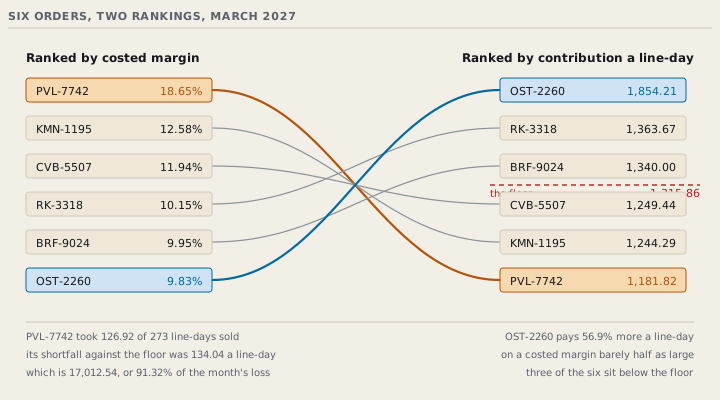
Why the percentage lied
The arithmetic is not hard once you look at it, and it is the single most useful thing in this course.
Margin percentage divides by FOB. FOB includes materials, and materials are largely other people's cloth moving through your building. So a garment with cheap fabric shows a big percentage on a small number.
| PVL-7742 pyjama set | OST-2260 technical shell | |
|---|---|---|
| FOB | 3.85 | 15.05 |
| Materials as a share of FOB | 32.21% | 80.40% |
| Costed margin | 18.65% | 9.83% |
| Margin a piece | 0.7180 | 1.4788 |
| Standard minutes | 27.5 | 19.0 |
| Contribution a line-day | 1,181.82 | 1,854.21 |
The shell earns Tanwir 56.9% more for every day of factory it uses up, on a costed margin barely half the pyjama set's.
Say why in one sentence and it becomes obvious. The factory does not sell garments and it does not sell percentages. It sells 4,056,000 minutes a month, and the only question about an order is how many dollars it leaves behind for every minute it takes. A percentage cannot answer that, because it has no minutes in it.
The order that was refused
Here is where it stops being a costing lesson.
On 14 December 2026, Ostrander asked Tanwir for a second drop: 26,000 more technical shells, same style, same price, made in March for an 8 April ship. It needed 494,000 minutes, which is 38.00 line-days.
Tanwir declined. The reason was written down, applied consistently, and entirely reasonable. The sales policy said do not sell a month below 12% margin once the month is 85% booked, and the shell costs out at 9.83%.
In March the factory ran 39 line-days empty.
- Contribution Ostrander's second drop would have added: 26,000 × 2.71 = USD 70,460.00
- Extra fixed cost of making it: nothing. The wages, the rent and the overhead were already committed, and already spent on empty lines.
- March's result had it been accepted: −18,628.80 + 70,460.00 = +USD 51,831.20
The mistake nobody made
Read the chain again. Every step is defensible.
- Costing costed PVL-7742 correctly, using the factory's own standard rates.
- Sales accepted it in October because it carried the best margin percentage available that week, which is exactly what the policy asked for.
- Planning booked it correctly, and the board showed the month 87.50% full.
- The December policy correctly refused a 9.83% order.
- Production made it at standard efficiency and shipped on time.
Five correct decisions, one policy applied consistently, and a loss. The defect is not in any of the steps. It is in the number the policy was written around. A margin threshold expressed as a percentage of FOB rewards garments that eat the scarce resource and passes over garments that pay for it. And it does so silently, because everybody involved can show that they followed the rule.
The switch, which is this whole course in three lines
Lessons 4 and 5 said: when a line is idle, judge an order against zero. This lesson says: when a line can be sold, judge it against the alternative. Both are the same rule with a switch, and the switch is not a property of the order.
- The line cannot be sold. Anything above avoidable cost is a gain. PVL-7742 in a month with sixty empty line-days is a good order.
- The line can be sold. Rank by contribution a line-day and cut at the floor. PVL-7742 in March is not.
An order is not good or bad. A month is, and the same order changes sign when the month does. That is why this decision has to be taken by whoever can see the board, not by whoever can see the cost sheet.
Prompt · Rank my order book by the thing I am actually short of
Before you accept anything into a month that is already filling up.
Act as a factory planner and commercial analyst. I want my order book ranked by the resource that is actually scarce, not by margin percentage. My factory: [NUMBER] lines, [NUMBER] working days, [NUMBER] earned standard minutes per line-day. My fixed cost a month, including committed wages if my operators are permanent: [AMOUNT]. Line-days I realistically expect to sell in the month: [NUMBER]. Orders and live enquiries, one row each: PO or enquiry reference, buyer, pieces, standard minutes per piece, FOB price, material cost per piece, other direct cost per piece, required make window. Do the following. First, compute my contribution floor as fixed cost divided by expected line-days, and express it three ways: per line-day, per line-hour and per standard minute. Second, for every row give me contribution per piece, line-days consumed, and contribution per line-day. Third, produce two rankings side by side, one by costed margin percentage and one by contribution per line-day. Tell me every row whose position moves by more than two places between them. Fourth, mark every row below the floor and tell me what each one costs me over the line-days it occupies, in money. Fifth, tell me the weighted average contribution per line-day of the accepted book so far, and what the remaining line-days must average for the month to break even. Sixth, where two orders compete for the same window, tell me which to take and by how much, and say what my answer would be instead if those line-days could not be sold at all. Give me a table I can paste into a spreadsheet.
AI can make mistakes — check anything you act on.
Check yourselfApplying this rule, Tanwir refuses PVL-7742 in October 2026 and nothing arrives to replace it. What has the rule cost?Show the answer
USD 150,000.00 of contribution. On March's numbers that is the difference between a loss of USD 18,628.80 and a loss of USD 168,628.80. That is the honest answer, and it is why this is a ranking rule and not a refusal rule. Contribution a line-day tells you which order to take when you must choose. The floor tells you what a full month needs to average. Neither says refuse an order into an empty month. The right use of the number in October is to accept PVL-7742 and know, on the day, that the month it fills now needs its other orders to average above USD 1,432.32 a line-day to break even. That is a plan, and it is what nobody had.
What to take away
- Margin percentage divides by FOB, and FOB is mostly somebody else's fabric. It rewards cheap-material garments and tells you nothing about the resource you are short of.
- Rank by contribution a line-day: (FOB − materials − other direct) ÷ SAM × the minutes in a line-day. Put it on the quotation sheet next to the percentage.
- Set the floor from your own fixed cost and expected volume, and know which orders in your book sit under it. Three of Tanwir's six did.
- A margin-percentage policy will refuse the orders that pay best per line-day, and it will do so consistently and defensibly. Check what units your rules are written in.
- Judge against zero for a day you cannot sell, and against the best alternative for a day you can. The order does not decide which. The month does.