Lessons · Lesson 1 of 6
- 01 · Six profitable orders and a factory that lost money
- 02 · The rate, the base, and the volume nobody sold
- 03 · What a factory has to sell before it earns anything
- 04 · Full cost or contribution: which decision is in front of you
- 05 · The contribution trap, and where it flips
- 06 · Correctly costed, correctly made, and wrong
Six profitable orders and a factory that lost money
Build the bridge from six cost sheets to one profit and loss account. Name the three places the money goes missing.
Lesson 1 of 6 · 20 min
The meeting
14 April 2027, 08:15. A meeting room above the cutting floor at Tanwir Apparel in Shibin El Kom. Twelve sewing lines. Twenty-six working days a month. Four hundred and ten people on the payroll.
The sales director has brought the March order book. Six orders shipped. Every one of them hit or beat its costed margin, and three of them beat 12%. It is the best book the factory has produced in three years.
The financial controller has brought the March management accounts. The factory lost USD 18,628.80.
Nobody in the room made a mistake. The cost sheets are right. The accounts are right. This lesson builds the third document, the one that shows how both can be true at once. The rest of the course is what you do about it.
The March book
Every order is quoted the same way: materials, other direct costs, direct labour, and factory overhead. The last two are charged by the minute. The minute here is the SAM, the standard minute value, which is the time one garment should take to sew. Tanwir charges USD 0.0348 a minute for direct labour and USD 0.030 a minute for overhead. Together that is USD 0.0648 a standard minute, and the trade calls that the conversion rate. Lesson 2 takes those two rates apart.
| PO | Buyer | Garment | Pieces | SAM | FOB | Costed cost | Margin a piece | Margin |
|---|---|---|---|---|---|---|---|---|
| PVL-7742 | Peverell Stores | children's pyjama set | 60,000 | 27.5 | 3.85 | 3.1320 | 0.7180 | 18.65% |
| RK-3318 | Ryde & Kvamme | men's twill overshirt | 36,000 | 24.5 | 9.68 | 8.6976 | 0.9824 | 10.15% |
| KMN-1195 | Kilmaine Outfitters | canvas work trouser | 15,000 | 28.0 | 6.88 | 6.0144 | 0.8656 | 12.58% |
| OST-2260 | Ostrander | men's technical shell | 12,000 | 19.0 | 15.05 | 13.5712 | 1.4788 | 9.83% |
| CVB-5507 | Corvin Brands | boy's fleece hoodie | 14,000 | 18.0 | 4.72 | 4.1564 | 0.5636 | 11.94% |
| BRF-9024 | Barrowfield | women's linen shirt | 6,000 | 19.5 | 7.50 | 6.7536 | 0.7464 | 9.95% |
Add the margins up. Peverell USD 43,080.00, Ryde and Kvamme USD 35,366.40, Kilmaine USD 12,984.00, Ostrander USD 17,745.60, Corvin USD 7,890.40, Barrowfield USD 4,478.40. Total USD 121,544.80 on revenue of USD 974,360.00. That is a costed gross margin of 12.47%.
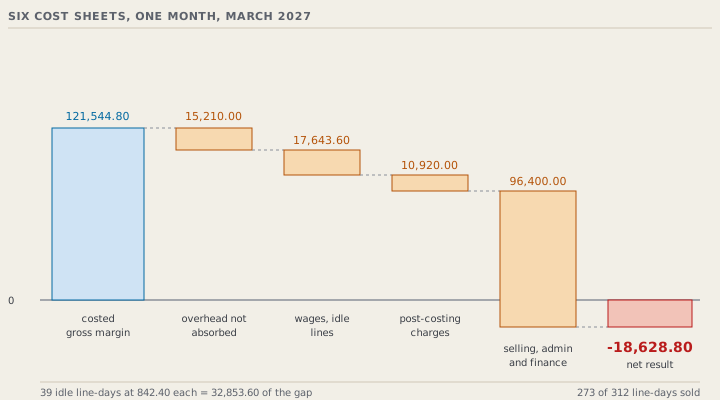
And the factory lost money. The gap is USD 140,173.60, and it sits in three places.
The first place: overhead the sheets never charged anybody
Tanwir's fixed factory overhead is USD 121,680.00 a month. That is rent, power, maintenance, the mechanics, the merchandising department, the compliance and audit budget, and depreciation on the machines. The rate of USD 0.030 a standard minute came from dividing that pool by the factory's full capacity: twelve lines, twenty-six days, and 13,000 earned standard minutes a line-day. That is 4,056,000 minutes a month.
March sold 3,549,000 of those minutes. That is 273 line-days out of 312, or 87.50%.
- Overhead the cost sheets charged out: 3,549,000 × 0.030 = USD 106,470.00
- Overhead the landlord, the utility and the payroll actually took: USD 121,680.00
- Missing: USD 15,210.00
That is 39 idle line-days at USD 390.00 each, and USD 390.00 is what one line-day of Tanwir's fixed overhead costs. Nobody was billed for it. There was no order on those days to bill.
The second place: wages for minutes nobody bought
This one is bigger, and almost nobody tracks it. It hides inside a line that looks like a direct cost.
Direct labour is charged to a cost sheet per earned standard minute. That is the right way to cost it, and course 8.1 shows why the efficiency assumption belongs in the rate. But Tanwir's operators are permanent employees, and replacing a trained machinist takes eleven weeks. So the factory kept all twelve lines staffed through March. The wage bill did not shrink when the order book did.
- Wages the factory owed for twelve staffed lines: 4,056,000 × 0.0348 = USD 141,148.80
- Wages the six cost sheets absorbed: 3,549,000 × 0.0348 = USD 123,505.20
- Missing: USD 17,643.60
That is the same 39 idle line-days, at USD 452.40 each. Put the two halves together. An idle line-day at Tanwir costs USD 842.40, which is the whole conversion rate: 13,000 minutes at USD 0.0648. Thirty-nine of them cost USD 32,853.60.
The third place: everything below the gross margin line
A cost sheet stops at the factory gate, and that is correct. It is a pricing tool, not a set of accounts. Two kinds of money live below it.
Costs no order ever carried. Directors, finance, human resources, the sales team and their travel, the ERP subscription, bank charges and interest, audit fees, bad debt. At Tanwir that is USD 96,400.00 a month. It is not factory overhead and it is not in the USD 121,680.00 pool. It is the cost of being a company rather than a building.
Costs that arrived after the sheet was signed. March had two. USD 6,800.00 of airfreight, which the factory paid into when a late trim delivery threatened Barrowfield's shipping window. And USD 4,120.00 of quality allowance, credited to Ryde and Kvamme for a shade variation the buyer accepted instead of sending back. USD 10,920.00 in total. Both belong to named orders. Neither will ever appear on those orders' cost sheets, because the sheets were printed in November.
The bridge
| USD | Of revenue | |
|---|---|---|
| Revenue, six orders shipped | 974,360.00 | 100% |
| Materials | 602,970.00 | 61.88% |
| Direct labour absorbed | 123,505.20 | 12.68% |
| Factory overhead absorbed | 106,470.00 | 10.93% |
| Other direct costs | 19,870.00 | 2.04% |
| Costed gross margin | 121,544.80 | 12.47% |
| Overhead not absorbed, 39 idle line-days | 15,210.00 | 1.56% |
| Wages for idle lines, 39 line-days | 17,643.60 | 1.81% |
| Post-costing charges | 10,920.00 | 1.12% |
| Selling, administration and finance | 96,400.00 | 9.89% |
| Net result | -18,628.80 | -1.91% |
Read the bridge in the direction that matters. Nothing in it is a costing error. Every order made what it said it would make. The factory lost money because it sold 87.50% of a machine sized for 100%, and because a cost sheet has no way of saying so.
Why this is the merchandiser's problem and not the accountant's
You will be tempted to file this under finance and go back to the order book. Do not. Of the four lines below the costed gross margin, the two largest are decided entirely by which orders were accepted, and when. The controller cannot change them in April. The person who books March's capacity in December can.
That is what the rest of this course is about. Lesson 2 rebuilds the rate on the volume the factory actually sells, not the volume it owns. Lesson 3 turns the whole cost base into one number: how many line-days must be sold before anything is earned. Lessons 4 and 5 take the decision that follows, which is whether to sell a line-day below full cost, and the exact point where doing so stops paying. Lesson 6 is the order that caused all of this, and nobody who touched it did anything wrong.
Prompt · Reconcile my cost sheets to last month's result
At the month-end review, when the order book looks healthy and the accounts do not.
Act as the financial controller of a garment export factory and build the bridge from my cost sheets to my profit and loss account for one month. My factory: [NUMBER] sewing lines, [NUMBER] working days in the month, [NUMBER] earned standard minutes per line-day, so state my capacity in line-days and in standard minutes. My rates as they appear on the cost sheet: direct labour [RATE] per earned standard minute, factory overhead [RATE] per earned standard minute, and tell me what total volume that overhead rate was set on. My actual fixed factory overhead for the month [AMOUNT]. My committed wage bill for the month [AMOUNT] and whether my operators are permanent or hired to the order book. My selling, administration and finance costs [AMOUNT]. Orders shipped, one row each: PO, buyer, pieces, standard minutes per piece, FOB price, material cost per piece, other direct cost per piece. Any charge that arrived after the sheet was signed [DESCRIBE AND AMOUNT]. Do the following. First, restate each order as a costed margin per piece, in total, and as a percentage of FOB, and give me the sum. Second, tell me the line-days sold, the line-days idle, and the loading percentage. Third, split the idle cost into overhead not absorbed and wages paid on idle lines, give me each per idle line-day, and say which is larger. Fourth, build the bridge as a single column from costed gross margin down to net result, with every step named and signed. Fifth, tell me which steps are decided by which orders were accepted, rather than by anything finance controls. Do not give me a range where a number is possible, and list every assumption at the end.
AI can make mistakes — check anything you act on.
Check yourselfTanwir's controller proposes fixing this by raising the overhead rate until the pool is fully recovered on the volume the factory sells. What does that fix and what does it not?Show the answer
It fixes the quotation and not the month. Charging out the true cost of a minute means new prices carry the factory's real overhead. That is right, and it is exactly what lesson 2 does. It changes nothing about March, because the under-recovery comes from minutes that were never sold, and no rate applied to zero minutes recovers anything. There is a worse risk too. If the higher rate makes the factory uncompetitive, it sells fewer minutes, under-recovers more, and the next rate is higher again. That loop has a name and a way out, and both run through lessons 3 and 4.
What to take away
- A cost sheet is a pricing document. A profit and loss account is a period document. The sum of the first is not the second and never will be.
- Three things separate them: fixed production cost that no order absorbed, costs that live below the gross margin line, and charges that arrived after the sheet was signed. Build the bridge with those three headings and it will reconcile.
- In a factory with permanent operators, the idle-line wage gap is bigger than the idle-line overhead gap. Measure both. At Tanwir it is USD 452.40 against USD 390.00 a line-day.
- Express the whole thing per line-day, not per piece. A piece is a unit of output. A line-day is a unit of the thing you are actually short of.