Lessons · Lesson 1 of 3
The architecture comes before the products
Give every line a role, a price rung and a floor under its depth, then find the option count that nobody in the building owned.
Lesson 1 of 3 · 48 min
The situation
A season of clothes is not chosen the way a wardrobe is. Before anyone looks at a garment, somebody decides how many different products the shops will carry. Somebody decides what job each one does, and how far apart their prices sit. This lesson makes those decisions on purpose, instead of letting them happen. A fixed budget split across too many products buys too little of each. A product bought too thinly never gets a fair trial.
3 February 2026, a buying office on the south side of Dublin. Tullamere is a womenswear multiple: 152 stores across Ireland, the Netherlands and Belgium, plus a website that trades as its 153rd and largest shop. The category is Womenswear Tops, Autumn/Winter 26 — jersey, blouses, light knits, everything worn above the waist and under a coat. The buyer is Aoife Bannon. The merchandiser is Tomas Vrieze.
There are two documents on the table, and a third thing that does not exist yet.
The first is the merchandiser's plan. Sales of EUR 4,750,000 at achieved prices, 162,000 units, intake margin not below 62.0%. How that plan is built is Retail Planning's subject, in track 17: the open-to-buy (the money released to spend), the phasing, the markdown assumption inside it. Here it is an input. You may not renegotiate it by writing a nicer range.
The second is last season. Autumn/Winter 25: 74 options, 148,000 units, and a set of results everybody in the room has already read.
The third thing, the one that does not exist, is a sentence saying what the range is for. Without it, a range is assembled the way it was assembled last year. One product at a time, each one approved on its own merits, in a Monday meeting where the only question ever asked is do we like it.
One word, settled before it causes trouble
In this track, merchandiser means the numbers role: open-to-buy, allocation, phasing, markdown. Buyer means the person who chooses the product. On the supply side the same word means the person who runs an order through a factory, which is what tracks 7 and 27 are about. Two jobs, one word. Say which one you mean the first time it matters, and never again.
A line does not exist because it is good. It exists because it does a job.
The single move that turns a list of products into a range is this: every line is bought into a role, and it is reviewed against that role and nothing else.
| Role | What it is for | Judged on | Must NOT be judged on |
|---|---|---|---|
| Opening price | Making the range feel affordable at the door | Transactions it appears in | Its own margin percentage |
| Volume | Delivering the units and the bulk of the cash | Units and realised price | Being interesting |
| Margin | Funding the range | Margin points delivered | Unit volume |
| Statement | Making the range credible and photographable | Whether it earns its cap | Anything financial, beyond the cap |
| Test | Finding next year's volume lines | How many it promotes and how many it kills | Its performance this season |
Read the fourth column. It is where ranges are destroyed. An opening-price line judged on margin percentage will always look like the worst line in the range, because it is designed to be. Cut it, and the customer who walks in and sees nothing under EUR 20.00 stops walking in. A statement line judged on sell-through will always fail. A test line judged on this season's margin is not a test. It is a small, badly bought volume line.
The fifth row is not a role in the same sense. Test is a ring-fence: a declared, capped sum of money whose job is to be spent on things that might not work. Tullamere did not have one last season. It had something worse, and the second half of this lesson is about it.
The price ladder, and the two gaps that matter
A range's prices are not a list. They are a ladder: a small number of rungs the customer learns, with deliberate distances between them.
| Rung | Options | Units | Step up from the rung below |
|---|---|---|---|
| EUR 18.00 | 9 | 22,200 | — |
| EUR 25.00 | 16 | 41,440 | 38.9% |
| EUR 32.00 | 26 | 55,500 | 28.0% |
| EUR 39.00 | 15 | 20,720 | 21.9% |
| EUR 55.00 | 8 | 8,140 | 41.0% |
The weighted average full price is EUR 30.19. That is the number the merchandiser cares about, and it tells you nothing at all about whether the ladder works. The steps do.
Tullamere has two rules of thumb, and they are its own, taken from its own eight seasons of data. They are not laws, and no textbook can give them to you. The useful thing is not the numbers. It is that a retailer should be able to state them.
- A step above about 35% is a cliff. The customer does not climb it. The rung above sells only to the customer who was always going to spend that much. That is not a trade-up. It is a separate small business.
- A step below about 15% is invisible. The customer cannot tell the two rungs apart without reading the ticket. So the dearer option adds cost, occupies fixture space, and buys no extra sale.
AW25's ladder hides one of each problem. The 41.0% step from EUR 39.00 to EUR 55.00 is the cliff. The top rung took 5.5% of the units and 10.0% of the season's markdown, and just under half of it was still on the fixture in week 14. The ladder also has a hole, which is the same defect seen from underneath. There is nothing between EUR 39.00 and EUR 55.00 for a customer who wants to spend a little more than she planned.
One nuance stops this becoming a superstition. A cliff above the top rung is fine. The statement option is not there to be traded up into. It is there so the rung below it looks like a sensible decision. A cliff between two working rungs is a lost sale. A cliff above the last one is the point.
How many options is a cash question, not a taste question
Here is the arithmetic that decides option count. It has nothing to do with how many good products exist.
The estate needs a minimum viable presentation: the smallest quantity of an option in a shop that reads as a choice rather than as a leftover. At Tullamere that is 8 units, a five-size run doubled on the two middle sizes. Across 152 stores that is 1,216 units just to face the estate once, before a single garment is sold, plus roughly 400 to launch it online. An option intended for every shop cannot honestly be bought below about 1,600 units. (How those units are then split between shops, replenished and re-cut by size is Allocation and Inventory's subject, in track 18. What it gives you here is a floor.)
Under that sits a second floor, and it comes from the supply side. It is the supplier's minimum per colour. For Tullamere's two tops suppliers that is 800 pieces, and below it a short-run surcharge of EUR 0.55 a unit applies. Why a dye lot has a minimum at all, and how it is costed, is course 8.2 and course 8.6. Do not re-derive it. Respect it.
So the range equation is:
options × average depth = units
162,000 units at the 1,600 floor gives an arithmetic ceiling of 101 options. That is a ceiling, not a target, because the lines that actually work take four and five times the floor. Every option you add past the point where the money runs out is bought below the floor. And an option below the floor is not a small option. It is a different product: one that reaches only part of the estate, pays a surcharge, cannot be replenished, and gets reviewed at the end of the season against lines that had every advantage it did not.
The mistake nobody made
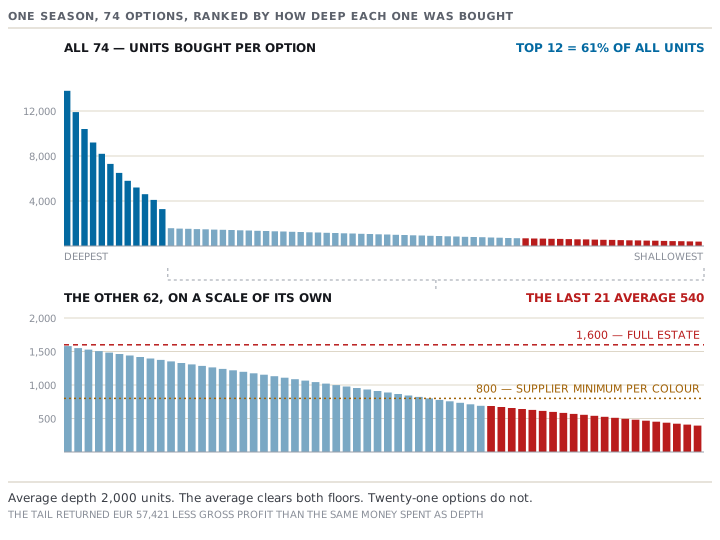
AW25 had 74 options and 148,000 units. The average buy is 2,000 units an option, comfortably over the floor. That average was the number quoted in every meeting.
The distribution was not the average.
| Options | Units | Average depth | |
|---|---|---|---|
| The top twelve | 12 | 90,280 | 7,523 |
| The next forty-one | 41 | 46,380 | 1,131 |
| The tail | 21 | 11,340 | 540 |
| Range | 74 | 148,000 | 2,000 |
The top twelve options took 61.0% of the units. The 21 options in the tail were each bought at an average of 540 units. That is below the supplier's minimum and below the estate floor, in about a third of the shops, and unreplenishable.
Now price the tail. Those 21 options carried an average retail of EUR 31.00 against a cost of EUR 11.50. They sold through at 58% at full price where the category ran at 78%, and the residue went at 45% off.
| As 21 new options | As depth behind lines already working | |
|---|---|---|
| Units | 11,340 | 11,340 |
| Cost of goods | EUR 130,410 | EUR 130,410 |
| Sold at full price | 58% | 86% |
| Cash taken | EUR 285,099 | EUR 336,283 |
| Gross profit | EUR 154,689 | EUR 205,873 |
| Kept margin | 54.3% | 61.2% |
The gap is EUR 51,184. The short-run surcharge on 11,340 units adds EUR 6,237. So the tail cost EUR 57,421 of gross profit against the same money spent as depth.
And here is the part that matters. Nobody made a bad decision. Every one of those 21 options was presented, argued and approved on its own, and most of them were genuinely good products. There was no meeting at which somebody said let us buy twenty-one options at half the floor. The count was not decided by anyone. It emerged, one perfectly reasonable yes at a time, because no single person in the building owned the total.
The honest argument on the other side
The tail is not simply waste, and a course that pretended otherwise would be lying to you.
Three of those 21 options became AW26 volume lines. Newness is what brings a customer back into a shop she was in three weeks ago. A range of twelve options is not a range. It is a uniform. The problem with AW25's tail is not that it existed. It is that it was unlabelled. It was a test budget that had never been called one, so it was not capped, not measured against a test's success criterion, and never killed on purpose. An unlabelled test budget is the most expensive kind, because it pays the full price of experimenting and collects none of the learning.
That is why the role table above has a fifth row.
The range charter
Before a single product is looked at, one page, agreed and signed:
- The unit plan and the retail value the buy must carry — enough full-price retail that the sales plan survives the markdown assumption.
- The margin floor, as a percentage and as a cash ceiling on the cost of the buy.
- The ladder: the rungs, with every step measured and any step above 35% or below 15% justified out loud.
- The role table: for each role, a maximum number of options, a share of units, and a margin floor.
- The depth floor, derived from the estate, and the rule for what happens to an option that cannot reach it. It is either graded to fewer shops on purpose, or it is not bought.
- The test ring-fence: options, units, cash, and what counts as a pass.
- A name against the option count.
Check yourselfA buyer shows you a range of 96 options with an average buy of 1,690 units, above the 1,600 floor. What is the first thing you ask for?Show the answer
The distribution, not the average. An average sits above the floor very comfortably while a third of the range sits below it, because a handful of big lines carry the mean. Ask for the options sorted by depth, and count how many fall under the floor and under the supplier's per-colour minimum. That count — not the option count and not the average — is the number that predicts next season's markdown.
Prompt · Write the charter before you look at a single product
The week before a range build, when you have a sales plan and a margin target and no statement of what the range is for.
Act as a senior range planner for a retail buying office. I am about to build a range and I want the architecture agreed before any product is chosen. My inputs: category [CATEGORY], season [SEASON], sales plan [AMOUNT] at achieved prices, unit plan [UNITS], intake margin floor [PERCENT], and the markdown assumption my planner uses is [PERCENT] of units at an average [PERCENT] off. My estate is [NUMBER] shops plus [ONLINE OR NOT], my minimum viable presentation in a shop is [UNITS], and my supplier's minimum per colour is [UNITS] with a short-run surcharge of [AMOUNT] a unit below it. Last season's range was [OPTIONS] options and [UNITS] units, and here is its price ladder with the option count and units on each rung: [PASTE IT]. Do the following. First, work out the retail value the buy must carry, from the sales plan and the markdown assumption, and show the division. Second, derive the depth floor from my estate and state the arithmetic ceiling on option count that follows, and say plainly that it is a ceiling and not a target. Third, read last season's ladder. Give me every step as a percentage. Name any step above a third as a cliff, and any step under a sixth as invisible. For each one, say whether it sits between two working rungs or above the top one. Fourth, propose a role table with five roles - opening price, volume, margin, statement and a ring-fenced test budget - giving each a maximum option count, a share of units, a margin floor and one sentence saying what it must NOT be judged on. Fifth, tell me what I have not given you that the charter needs. Do not propose products. If a number is missing, ask for it rather than assuming one.
AI can make mistakes — check anything you act on.