Lessons · Lesson 2 of 3
Building one range to a margin and a quantity
Build the same category three times against one plan, watch a range miss a margin that no single line missed, and price the option that cannot be defended.
Lesson 2 of 3 · 46 min
Two numbers, and only one of them gets checked
Buying cheaper feels safe. When money is tight it is everybody's instinct, and in a range plan it is a trap. It cuts what the stock costs. It cuts what that stock is worth on the rail faster. This lesson builds one season's products against a plan that fixes both numbers at once. It asks how garments that each clear their own profit target can add up to a range that misses.
A range has to deliver two things. Almost every buyer checks the second and forgets the first.
The retail value of the buy is what the range is worth at full price on day one. It has to be big enough that the sales plan survives the markdown assumption. Tullamere's plan assumes 22% of units sell at a markdown averaging 31% off. Why a plan assumes markdown at all, instead of treating it as failure, is course 16.1's subject. Here it is arithmetic. The plan will realise:
0.78 + (0.22 × 0.69) = 0.9318 of full-price retail value
So to take EUR 4,750,000, the buy must be worth EUR 5,097,660 at full price. The charter rounds that up and writes EUR 5,100,000.
The cost of the buy is the second number. Intake margin is the margin built into the buy, before anything is marked down. At a 62.0% intake margin floor, the cost may not exceed 38.0% of whatever retail value the range turns out to have. Note what that means. The cost ceiling is not a fixed sum of money. It moves with the range. A cheaper range has a lower ceiling, which is why a buyer cannot save a margin by buying down.
Retail margin here is stated on the selling price, not as a mark-up on cost, because that is how a retailer's stock and accounts are kept. Course 16.1 settles the convention. Do not convert it back into a factory's mark-up in the middle of a range build.
The first pass
17 February. Aoife Bannon has a role table, a ladder and a floor. For the first time she has a range that was designed before it was chosen.
| Role | Options | Units | Average full price | Intake margin | Role floor | Retail value | Cost |
|---|---|---|---|---|---|---|---|
| Opening price | 6 | 24,000 | EUR 20.00 | 51.0% | 50.0% | EUR 480,000 | EUR 235,200 |
| Volume | 20 | 88,000 | EUR 29.00 | 62.0% | 62.0% | EUR 2,552,000 | EUR 969,760 |
| Margin | 16 | 34,000 | EUR 42.00 | 67.0% | 66.0% | EUR 1,428,000 | EUR 471,240 |
| Statement | 5 | 3,600 | EUR 65.00 | 66.0% | 64.0% | EUR 234,000 | EUR 79,560 |
| Test | 10 | 12,400 | EUR 33.00 | 60.0% | 58.0% | EUR 409,200 | EUR 163,680 |
| Range | 57 | 162,000 | 62.39% | 62.0% | EUR 5,103,200 | EUR 1,919,440 |
Retail value EUR 5,103,200 against a requirement of EUR 5,097,660. Intake margin 62.39% against a floor of 62.0%. Both numbers clear, and neither of them by much. That is what a correctly built range looks like. A range that clears its margin by four points has bought the wrong products.
What changed, and why the change was right
On 17 February the customer work landed. Course 16.5 owns how it is produced. Here it is an input, and it says two things. 31.0% of Tullamere's tops customers bought nothing above EUR 25.00 last season, against 24.0% the season before. And the nearest competitor has opened its tops offer at EUR 15.99, a rung below anything Tullamere sells.
The opening-price role exists precisely to answer that. So Aoife moves units into it. The role goes from 6 options and 24,000 units to 8 options and 44,000 units. The 20,000 units come out of the margin role and the test ring-fence, which are the two places with any slack.
Every step in that reasoning is correct. The customer read is real. The role is the right one. The units have to come from somewhere. And the two places she took them from are the two places a buyer under pressure always takes them from.
Every line passed. The range failed.
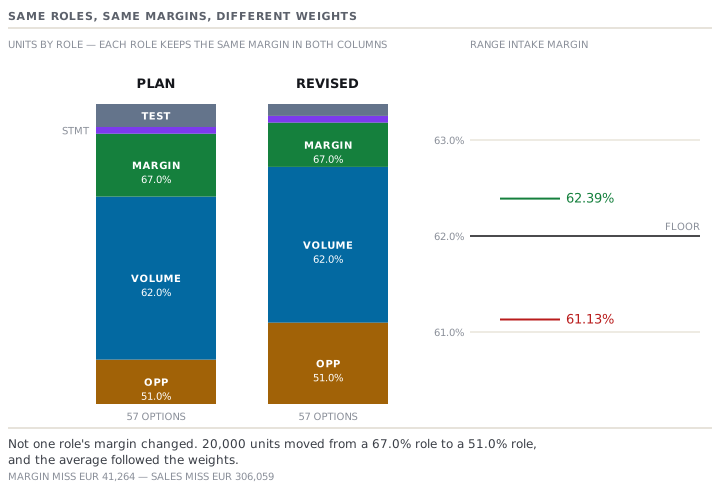
| Role | Options | Units | Average full price | Intake margin | Role floor | Retail value | Cost |
|---|---|---|---|---|---|---|---|
| Opening price | 8 | 44,000 | EUR 20.00 | 51.0% | 50.0% | EUR 880,000 | EUR 431,200 |
| Volume | 20 | 84,000 | EUR 29.00 | 62.0% | 62.0% | EUR 2,436,000 | EUR 925,680 |
| Margin | 16 | 24,000 | EUR 42.00 | 67.0% | 66.0% | EUR 1,008,000 | EUR 332,640 |
| Statement | 5 | 3,600 | EUR 65.00 | 66.0% | 64.0% | EUR 234,000 | EUR 79,560 |
| Test | 8 | 6,400 | EUR 33.00 | 60.0% | 58.0% | EUR 211,200 | EUR 84,480 |
| Range | 57 | 162,000 | 61.13% | 62.0% | EUR 4,769,200 | EUR 1,853,560 |
Read the margin column and the floor column beside it. Not one line's margin changed, and not one line is under its floor. The opening-price role is at 51.0% against a 50.0% floor, exactly as it was in the first pass. The volume role is on 62.0%. The margin role is a point above its floor. Every product in this range would pass a line-by-line review.
The range is at 61.13% against a floor of 62.0%. It misses by 0.87 points.
Nothing was mismanaged. A range margin is a weighted average, and an average moves with its weights whether or not any of the things being averaged moves. Twenty thousand units walked from a role earning 67.0% to a role earning 51.0%. That is the whole explanation.
Now price both misses. There are two, and only one of them is visible.
- The margin miss. At 62.0%, the cost of a buy worth EUR 4,769,200 may not exceed EUR 1,812,296. It is EUR 1,853,560. The range is EUR 41,264 over.
- The sales miss. The buy is worth EUR 4,769,200 at full price against a requirement of EUR 5,097,660. Multiply by the 0.9318 markdown factor and this range will take EUR 4,443,941 against a plan of EUR 4,750,000. That is EUR 306,059 short, and short at 100% sell-through as well. There is not enough retail value in the range to reach the plan even if the customer buys every single garment.
The sales miss is more than seven times the margin miss. It is also the one that does not appear on a margin report. A buyer who checks the margin line and signs is signing a range that cannot deliver the plan under any behaviour of the customer.
What to cut when the numbers do not work
Four moves were on the table. Three of them are the wrong answer, for reasons worth knowing.
- Put the units back. Cheapest, and it throws away a real customer finding. Rejected in full, accepted in part: half the move stands.
- Raise the opening price from EUR 20.00 to EUR 24.00. It fixes both numbers instantly and destroys the role, which exists to answer a competitor at EUR 15.99. A role you can price your way out of was never a role.
- Negotiate the opening-price cost down. Taking the role from 51.0% to 55.0% is worth EUR 27,200 on the signed buy. That is most of the margin miss and none of the sales miss. This is Sourcing and Negotiating's subject, in course 16.4. It is real money, and it is not a substitute for a shape.
- Rebuild the shape. Fewer test options, one fewer statement option, and the margin role rebuilt across two rungs instead of one, so that its average price rises without inventing a price the ladder does not have.
The signed range does 1 at half strength, 3, and 4. Move 2 was refused, and refusing it is the decision the whole lesson is about.
The signed range
| Role | Options | Units | Average full price | Intake margin | Retail value | Cost |
|---|---|---|---|---|---|---|
| Opening price | 7 | 36,000 | EUR 18.89 | 55.0% | EUR 680,000 | EUR 306,000 |
| Volume | 20 | 82,000 | EUR 29.15 | 62.0% | EUR 2,390,000 | EUR 908,200 |
| Margin | 18 | 36,000 | EUR 45.50 | 67.0% | EUR 1,638,000 | EUR 540,540 |
| Statement | 4 | 3,200 | EUR 72.75 | 65.7% | EUR 232,800 | EUR 79,962 |
| Test | 6 | 4,800 | EUR 37.63 | 60.0% | EUR 180,600 | EUR 72,240 |
| Range | 55 | 162,000 | EUR 31.61 | 62.77% | EUR 5,121,400 | EUR 1,906,942 |
The role averages are not prices. Every unit sits on a rung of the ladder, and the average is what falls out:
| Rung | Opening | Volume | Margin | Statement | Test |
|---|---|---|---|---|---|
| EUR 16.00 | 10,000 | ||||
| EUR 20.00 | 26,000 | ||||
| EUR 25.00 | 24,000 | ||||
| EUR 29.00 | 40,000 | ||||
| EUR 35.00 | 18,000 | 3,000 | |||
| EUR 42.00 | 18,000 | 1,800 | |||
| EUR 49.00 | 18,000 | ||||
| EUR 69.00 | 2,600 | ||||
| EUR 89.00 | 600 |
Retail value EUR 5,121,400 against a requirement of EUR 5,097,660. Expected take EUR 4,772,121, which is EUR 22,121 over the plan. Intake margin 62.77%, leaving EUR 39,190 of headroom under the cost ceiling. That headroom will be spent, because a fabric price moves between a range sign-off and a purchase order.
The option that cannot be defended
There is one line in that table that fails on every number a range is judged by. It is in the range on purpose.
TP-2691 is a hand-embroidered blouse at EUR 89.00, a rung above anything else Tullamere sells, bought at 600 units. Cost EUR 34.60, which is an intake margin of 61.1%, below the statement role's own floor of 64.0%. It is expected to sell 55% at full price and the rest at 40% off.
| TP-2691 | The same cost as volume depth | |
|---|---|---|
| Cost of goods | EUR 20,760 | EUR 20,760 |
| Retail value | EUR 53,400 | EUR 54,632 |
| Cash taken | EUR 43,788 | EUR 51,922 |
| Gross profit | EUR 23,028 | EUR 31,162 |
| Kept margin | 52.6% | 60.0% |
The blouse returns EUR 8,134 less gross profit than the same cash spent behind a line that already works. That is what it costs, and no version of the arithmetic makes it look clever.
It is still the right buy. Here is the honest defence, rather than the flattering one. It is on the cover of the autumn book, in eleven windows and at the top of the home page. It is the reason the EUR 49.00 rung reads as a sensible decision rather than as the most expensive thing in the shop. Tullamere is buying a photograph and a halo, and EUR 8,134 is the price of both.
What makes that a decision rather than an indulgence is the cap. The statement role may not forgo more than 0.5% of the range's intake gross profit, which on EUR 3,214,458 is EUR 16,072. One blouse fits inside the cap. Two do not. That is the whole mechanism: the cap is what stops a defensible exception becoming an undefended habit.
Two more disciplines make it honest. The blouse is signed as a graded option, not a failed full-estate one. Its 600 units are 19 stores at 20 each and 220 online, chosen at sign-off rather than discovered in week 12. And the statement role still clears its own floor at 65.7%, because the other three options in it carry the blouse. A cap works by being absorbed, not by being excused.
Check yourselfYour range comes in at 62.4% intake margin against a 62.0% floor, and the retail value of the buy is 6% below what the plan needs. Which do you fix first?Show the answer
The retail value, and it is not close. The margin is a percentage of whatever you buy, so it is satisfied by a smaller range as easily as by a right-sized one. The retail value is the only number that says whether the range can physically deliver the sales plan. A range 6% short on retail value will miss the plan even at full-price sell-through, and the miss will be several times any margin gap. Fix the shape, then re-read the margin. It will have moved on its own.
Prompt · Make me defend one option, with a number attached
The moment somebody says a line has to be in the range and cannot say which role it plays or what it displaces.
Act as a retail merchandiser who has no attachment to any product and is paid to protect the range's numbers. I want one option argued for or against, honestly. The option: [STYLE], [DESCRIPTION], retail [PRICE], cost [AMOUNT], proposed buy [UNITS], proposed role [OPENING PRICE, VOLUME, MARGIN, STATEMENT OR TEST]. The range around it: unit plan [UNITS], retail value requirement [AMOUNT], intake margin floor [PERCENT], the role's own margin floor [PERCENT], the depth floor from my estate [UNITS], and my supplier's minimum per colour [UNITS]. The price ladder is [PASTE THE RUNGS]. My best-performing comparable line sells [PERCENT] at full price; a line of this type usually sells [PERCENT], and the residue goes at [PERCENT] off. Do the following. First, place the option on the ladder and tell me whether its price is a rung or an invention, and what the steps either side of it are as percentages. Second, test it against the depth floor and the supplier minimum. If it is below either, tell me whether that is a deliberate graded buy or an accident, and what a graded buy would look like in shops and units. Third, compute its expected cash taken, gross profit and kept margin, and then compute the same figures for spending its COST as depth behind my best comparable line. Give me the difference in gross profit as a single number. Fourth, if the option loses that comparison, tell me what it buys that the depth does not, in terms I could put on a sign-off sheet - and give me a cap for that, as a percentage of the range's gross profit. Fifth, tell me plainly whether you would sign it. Do not tell me it is a lovely product. If it should be killed, say so in the first line.
AI can make mistakes — check anything you act on.