Lessons · Lesson 2 of 3
Preparing the ask, and the trade that makes money
Separate what you can verify in a supplier's cost from what you can only bound and what you can never see, find the difference between your target and your walk-away, and build a concession that costs you less than it is worth to them.
Lesson 2 of 3 · 38 min
Tuesday 14 April 2026
Preparing for a negotiation is usually imagined as rehearsing arguments. It is better understood as three sums, all done before anyone sits down. Which lines of the other side's price can you check? Which can you only estimate? Which can you never see? What would it really cost you to take the work elsewhere? And what is a thing you can give away cheaply worth to the person opposite? This lesson does all three sums on one order, and the money turns up somewhere unexpected.
A year on. Same style, same factory, same buyer, a different preparation.
Duncan Aird's autumn plan holds LM-6274 at a retail price of USD 25.00 and an intake margin target of 68%. So the landed cost, which is the cost of the goods once freight and duty are paid, has to come in at USD 8.00. Freight, duty and handling on this lane run USD 1.42 a piece. The target FOB is therefore USD 6.58.
Talpitiya opens at USD 7.18. That is USD 0.60 a piece over the plan, which is USD 27,600 on 46,000 pieces.
Last April Imogen would have started arguing. This April she spends two days before the meeting doing three pieces of arithmetic, and only one of them is about price.
The cost sheet has three columns, and only one of them is negotiable
Take the sheet from lesson 1 and sort every line by what you can actually know about it.
| Line | Per piece | What you can know |
|---|---|---|
| Body jersey | USD 2.81 | Verifiable. You nominate the yarn count and the weight; you hold two mill quotations. |
| Collar cloth and cuffs | USD 0.41 | Verifiable. It is a specification you wrote. |
| Trims | USD 0.33 | Verifiable. Nominated suppliers, published prices. |
| Cut, make and trim | USD 1.48 | Boundable. Not verifiable, but you can build it from the outside and see whether it is plausible. |
| Factory overhead | USD 0.79 | Unknowable. It depends on their whole order book, which you will never see. |
| Margin | — | Unknowable, and none of your business as a line. |
The rule that comes out of that table is the most useful thing in the lesson. Negotiate on the lines you can verify. Test the lines you can bound. Never ask for a cut on a line you cannot see. A request to "take twenty cents off overhead" cannot be answered with a change, only with a number. So the supplier moves the number, protects the total somewhere else, and both of you have had a conversation about nothing.
The bound that came out within two cents
Cut, make and trim, usually shortened to CMT, is the making charge: the factory's own labour and running cost for turning the cloth into a garment. It is the line buyers push hardest and understand least. It can be bounded from outside the factory using four facts Talpitiya has already published in its own bulletin.
The style runs at 18.4 standard minutes. A standard minute is the time one operator needs for one minute of work at a normal pace, so 18.4 of them is the work in one shirt. A Talpitiya line is 34 operators working 8.5 productive hours at a stated efficiency of 61%. That is 34 times 8.5 times 60, which is 17,340 operator-minutes. At 61% it earns 10,577.4 minutes. Divided by 18.4, that makes 574.86 pieces a line-day.
Talpitiya's declared line cost, meaning operators fully loaded plus supervision and mechanics, is USD 862 a line-day. Divide: USD 1.50 a piece, against the USD 1.48 in the sheet.
Two cents. That is the answer to the question the whole meeting was going to be about, and it arrives before the meeting starts. The making cost is not padded. How a standard minute value is established, and what efficiency means when a line is new to a style, is course 8.1 and course 7.1. What matters here is what the bound tells a buyer to do. Stop pushing CMT, because there is nothing in it. Spend the ninety minutes on the two lines where there genuinely is something.
The same arithmetic gives a second number for free. The order is 46,000 pieces at 574.86 a line-day, which is 80 line-days: four lines for four weeks. Hold on to that. It is the currency in the second half of this lesson.
Your walk-away is not your target
Ask a buyer what their walk-away is and most will say the plan number. On this order that answer is wrong by USD 0.59 a piece, and it is wrong in the expensive direction.
A walk-away is not a price you would like. It is the point at which the alternative becomes cheaper than the deal. Larkmead's vendor base holds one other qualified supplier for this construction, Hettipola Apparels, quoting USD 6.92. That is cheaper than Talpitiya's opening number. But moving a live style is not free.
| Fit and grading on a new block | USD 1,900 |
| Three sample rounds with couriers | USD 2,400 |
| Fabric and colour approvals | USD 1,150 |
| First-order quality visit and inspection | USD 2,800 |
| Buyer and technologist time | USD 3,150 |
| Total | USD 11,400 |
| Across 46,000 pieces | USD 0.248 a piece |
So the alternative delivers at USD 6.92 plus USD 0.248, which is USD 7.168. That, not USD 6.58, is the walk-away. Larkmead's first-order risk with a supplier new to a style sits on top of it, and is priced in course 27.1.
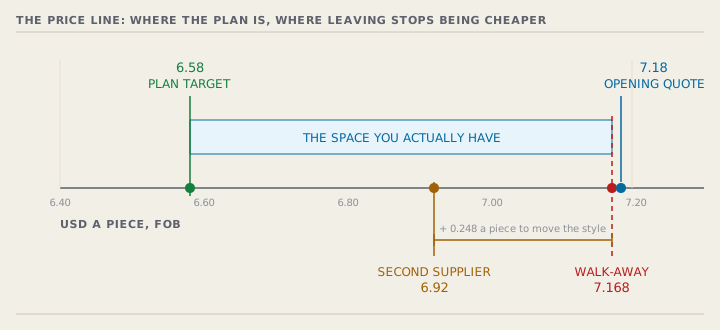
Read the drawing before you read the next sentence, because the conclusion is uncomfortable. The opening quote of USD 7.18 is one cent above the walk-away. Larkmead has no credible threat to leave. The space Imogen actually has is between USD 6.58 and USD 7.168: USD 0.588 a piece, USD 27,040. It is not space she can win by pressure. Pressure only works when leaving is a real option, and here it is not.
A buyer who believes the target is the walk-away does one of two damaging things. Either they threaten to move the order and get called on it, which costs the account its credibility for two seasons. Or they push until the supplier's answer stops being a price and starts being a behaviour, which is lesson 3.
The way out is not to push harder into a gap of USD 0.588. It is to make the gap smaller from outside it.
What a quantity commitment is worth to the other side
Imogen offers something she has never offered before: three drops committed together. Autumn 2026 at 46,000, spring 2027 at 22,000, autumn 2027 at 46,000. That is 114,000 pieces, confirmed by 30 April, with the last drop held to a band of plus or minus 15%.
Then she asks the question that most buyers do not: show me what that is worth to you. Nuwan does, because a supplier asked for a commitment has usually already costed it.
| Where the saving comes from | Per piece |
|---|---|
| Yarn: 61,560 kg clears the mill's contract band, USD 4.86 a kg against USD 5.20 spot, on 0.54 kg | USD 0.18 |
| Set-up: one fit, one marker, one bulletin across three drops instead of three of each | USD 0.05 |
| Overhead: 198 line-days booked a year ahead rather than won order by order | USD 0.06 |
| What Talpitiya can give | USD 0.29 |
Now price it on Larkmead's side, honestly. A commitment costs a buyer flexibility, and flexibility has a price. Of the 22 committed multi-drop programmes Larkmead ran in the four years to 2025, 5 were cut beyond their band at the second or third drop. The cancellation charge it paid on the cut quantity averaged 40% of the FOB. Run those figures against this programme and the expected cost is about USD 0.04 a piece.
So the commitment creates USD 0.25 a piece of value that did not exist before the meeting. Neither side had it before. It is made out of a mill's contract band and a factory's planning horizon. They settle at USD 0.25 off, which is Talpitiya handing over the whole of the created value and keeping the certainty. FOB USD 6.93.
The calendar is the cheapest thing a buyer owns
Second trade. Talpitiya's autumn peak is weeks 29 to 38, and its 14 lines are full. Weeks 22 to 28 are 41% loaded.
The order is 80 line-days. Placed in the peak, those line-days push out other paying work. Placed in weeks 22 to 28, 59% of them, which is 47.2 line-days, sit on capacity that currently earns nothing, at USD 862 a day of fixed cost that is not being recovered: USD 40,686.40.
Imogen offers to take the goods six weeks earlier. Then she costs what that does to Larkmead, because a concession you have not costed is a concession you are about to regret.
| Stock value at landed cost, 46,000 pieces at USD 8.35 | USD 384,100 |
| Six weeks of working capital at 9.5% a year | USD 4,210.33 |
| Distribution-centre storage, 1,150 cases at USD 0.42 a case a week | USD 2,898.00 |
| Cost to Larkmead | USD 7,108.33 |
| Per piece | USD 0.155 |
Talpitiya gives USD 0.16 a piece, which is USD 7,360, against a cost of USD 7,108.33. FOB USD 6.77.
The cash gain is USD 251.67, and it would be dishonest to dress that up. Six weeks of negotiation preparation produced two hundred and fifty dollars. But cash is not what the trade bought. It bought six weeks of buffer in front of a week-40 launch, on a style whose predecessor went partly by air two years ago at a cost of USD 5,002. And it turned USD 40,686.40 of a supplier's dead fixed cost into something both sides could stand on.
That is what a positive-sum trade actually looks like: small in cash, large in risk, and completely invisible in the price file. Anyone who tells you these trades are where the money is has not costed one. They are where the safety is, and safety is what lets you stop pushing on price.
The last nineteen cents did not come from the supplier
FOB is USD 6.77. The target is USD 6.58. Still USD 0.19 short, which is USD 8,740.
Imogen does not go back to Nuwan. She goes to design.
LM-6274 carries a woven twill collar and placket at USD 0.41 a piece. A knitted rib collar in the same yarn as the body costs USD 0.22. The fit session had already flagged that the twill collar was the harder of the two to keep square through wash. The change saves exactly USD 0.19, and it comes out of the garment rather than out of Talpitiya's margin.
FOB USD 6.58. The plan is met.
Say that plainly, because it is the sentence most likely to change how a reader works. Of the USD 0.60 that had to be found, USD 0.41 came from trades with the supplier and USD 0.19 came from the specification. None of it came from pressure.
The settlement, read from both sides
| Per piece | |
|---|---|
| Opening quote | USD 7.18 |
| Less the three-drop commitment | USD 0.25 |
| Less the six-week calendar move | USD 0.16 |
| Less the collar specification change | USD 0.19 |
| Settled FOB | USD 6.58 |
| Talpitiya's cost to make, after the commitment and the collar | USD 5.76 |
| Talpitiya's margin | USD 0.82 |
USD 0.82 is 12.46% of the FOB. Had Talpitiya not made the calendar concession, the FOB would be USD 6.74 and the margin USD 0.98, or 14.54%. So the calendar cost them 0.16 and bought them 47.2 line-days they were not going to sell. The order is USD 302,680, and both parties can explain their own number to their own director.
Prompt · Build the walk-away, and find the trade that makes money
Two days before a price negotiation, when you know your target and have never worked out the price at which leaving would actually be cheaper than staying.
Act as a retail sourcing director preparing me for one price negotiation. Do not give me tactics or phrases. Give me arithmetic. Order facts: style [CODE], [GARMENT], quantity [PIECES], colours [NUMBER], ex-factory [DATE], supplier [SUPPLIER], their opening FOB [PRICE]. My plan: retail [PRICE], intake margin target [PERCENT], landed cost allowance [AMOUNT] a piece, target FOB [AMOUNT]. The supplier's cost sheet, if I have it: fabric [AMOUNT], trims [AMOUNT], cut make and trim [AMOUNT], finishing and packing [AMOUNT], overhead [AMOUNT]. What I know about their production: standard minutes [NUMBER], operators on a line [NUMBER], productive hours [NUMBER], stated efficiency [PERCENT], line cost a day [AMOUNT] if known. My alternative: the next qualified supplier is [NAME] quoting [PRICE]. What it costs me to move a live style is fit and grading [AMOUNT], sample rounds [AMOUNT], approvals [AMOUNT], first-order quality visit [AMOUNT], my own time [AMOUNT]. Do the following. First, sort every line of their cost sheet into verifiable, boundable and unknowable, and say for each verifiable line exactly what document would verify it. Second, build the making cost from the outside using the production facts, and tell me whether the sheet is plausible, giving the arithmetic. Third, compute my true walk-away as the alternative quote plus my switching cost per piece, and draw the space between my target and that walk-away in dollars a piece and on the order. Say plainly whether I have a credible threat to leave. Fourth, list every non-price thing I could give that costs me little: a quantity or multi-drop commitment, a production window in the supplier's low season, a shipment consolidation, a simpler specification, an earlier confirmation date. For each, tell me what to ask THEM to show me, so that the value is their arithmetic and not my guess, and estimate what it costs ME with the arithmetic shown. Fifth, tell me which single trade has the best ratio of their gain to my cost, and what must be in writing from a third party before I offer it. Sixth, tell me what part of my gap cannot be closed by the supplier at all and must come from the specification or the plan. Name every assumption in a list at the end.
AI can make mistakes — check anything you act on.
Check yourselfYour supplier's CMT line is USD 1.48. You build it from outside — 18.4 standard minutes, 34 operators, 8.5 hours, 61% efficiency, USD 862 a line-day — and get USD 1.50. What do you do with that?Show the answer
Stop negotiating CMT and say so out loud. The bound says the line is honest, and a buyer who keeps pushing an honest line teaches the supplier that evidence does not change your behaviour. That is exactly the lesson you do not want them to learn. Move the ninety minutes to the lines where something can actually change. The fabric, which is a specification you own. And the overhead, which only moves if their order book moves, so the lever there is a commitment or a calendar, not a request.
Check yourselfA supplier offers USD 0.29 a piece for a three-drop commitment. Why ask for their arithmetic rather than simply taking it?Show the answer
Because the arithmetic tells you what to ask for next. Talpitiya's USD 0.29 splits into yarn, set-up and overhead. So the value is created by a mill contract band, a shared marker and a booked line. And every one of those is a thing you can give more of or less of. A number with no arithmetic behind it is a number you can only accept or refuse. A number with arithmetic behind it is a menu. It also tells you whether the offer is real: a saving built on a mill band can be checked with the mill, and a saving that cannot be explained usually is not one.
What to take away
Preparation is not rehearsing arguments. It is three pieces of arithmetic done before the meeting. Which lines of their cost you can verify. What your real walk-away is. And what a thing you can give cheaply is worth to the person opposite.
Do those three and the meeting changes shape. Imogen found USD 0.60 a piece without once raising her voice, and the largest single piece of it was not a concession at all. It was a collar.