Lessons · Lesson 1 of 3
What you are buying besides the price
Take one buying meeting apart and put a price on every term agreed in it, so that a concession on price and a concession on terms can be read in the same currency.
Lesson 1 of 3 · 38 min
Thursday 10 April 2025, 14:00
Nobody prepares for the last part of a buying meeting. The price is settled, everyone is tired, and the rest is read off a list. Payment days. A tolerance on the quantity. A minimum per colour. Who owns the cloth if the order dies. All of it is money, and this lesson prices it in the same money as the price. Only one of those items ever shows up in a report.
The place is Larkmead's buying office in Macclesfield. Larkmead is a mid-market clothing retailer with 184 stores and a website. It buys and plans in US dollars, so every figure in this course is a dollar figure.
Imogen Threlfall, buyer for men's tops, has ninety minutes with Nuwan Amarakoon, commercial director of Talpitiya Knit Mills. The style is LM-6274, a men's heavyweight cotton jersey rugby shirt for autumn: 46,000 pieces in four colours. Juniper 15,000, Navy 14,000, Claret 11,000, Ochre 6,000. Ex-factory 22 August, into the national distribution centre in the week commencing 15 September, on sale in week 40.
Talpitiya was chosen months ago. How a supplier gets picked in the first place, and how you end up with too much work in one factory without noticing, is course 27.1. None of that is reopened today. Today there is one factory, one style and a list of terms. Imogen has to come out of the room with a number her merchandiser can put in a plan.
Two words that mean opposite things across this table
In a buying office, merchandiser is the numbers role. Open-to-buy (the money the buyer is allowed to spend in a season), phasing, intake, markdown. The buyer selects the product and places the order. On the supply side both words point at the same person: the one who runs the order through the factory. In this course the buyer is Imogen Threlfall and the merchandiser is Duncan Aird. Where a factory-side merchandiser appears, they are named as such.
How Duncan's plan is built, including the open-to-buy, the phasing and the intake margin, is track 17. This course uses his numbers as given and does not rebuild them.
The quote, and what sits behind it
Talpitiya opens at FOB USD 7.05. FOB means free on board: the price of the goods loaded onto the ship, before freight and duty. Nuwan then does something not every supplier does. He puts the cost sheet on the table.
| Line | Per piece |
|---|---|
| Body jersey, 0.54 kg at USD 5.20 a kg | USD 2.81 |
| Twill collar cloth and rib cuffs | USD 0.41 |
| Trims: buttons, placket tape, labels, polybag | USD 0.33 |
| Cut, make and trim | USD 1.48 |
| Finishing, packing, testing | USD 0.19 |
| Factory overhead | USD 0.79 |
| Cost to make | USD 6.01 |
| FOB quoted | USD 7.05 |
| Margin | USD 1.04 |
How a sheet like that is built, line by line, is course 8.1. Here it is given data. The only figure to hold on to is the last one: USD 1.04 a piece, 14.75% of the FOB.
What Imogen won
She works for fifty minutes and she wins USD 0.11 a piece. FOB USD 6.94.
That is a real result. It is not a rounding. It takes Talpitiya's margin from USD 1.04 to USD 0.93, from 14.75% of the FOB to 13.40%, and it is USD 5,060 on the order. It came from work. She had the previous season's settled price. She had the yarn index. And she knew that Talpitiya's production window was not full. Nothing in this lesson is about a buyer being lazy.
The three sentences that cost more than the win
The last twenty minutes of a buying meeting is the part nobody prepares. The price is agreed, the room relaxes, and the remaining items are read off a list as though they were paperwork.
"Thirty days from bill of lading is fine." Talpitiya asked to be paid at 30 days instead of 60. It felt like nothing. The same money, slightly earlier, and it plainly helps a supplier who is buying yarn. But Larkmead's finance director prices working capital at 9.5% a year. Thirty days of USD 319,240 at 9.5% is USD 2,492.70, which is USD 0.054 a piece.
"Three per cent either way is standard." The AW24 contract said the shipped quantity had to be the ordered quantity. The AW25 contract lets the factory over-ship by 3% and invoice it. Talpitiya over-shipped to the full tolerance on the three colours whose fabric allowed it: Juniper, Navy and Claret, 40,000 pieces between them. Three per cent of 40,000 is 1,200 pieces at USD 6.94, which is USD 8,328, or USD 0.181 a piece.
Read that one twice. Those 1,200 shirts are not a loss. They are a purchase Larkmead did not make. Nobody chose them and nobody planned them, and they used up open-to-buy that had already been committed elsewhere. How many of them eventually sell at full price is a range-planning question, and track 17 owns it. What is certain today is that a buyer bought 1,200 units without deciding to.
"Six thousand a colour, then." Talpitiya's minimum per colour went from 4,000 to 6,000, because the dye house had changed and the new one runs a bigger vessel. Duncan's plan wanted 4,600 pieces of Ochre. The minimum made it 6,000. So Larkmead bought 1,400 pieces it had not planned, at USD 6.94: USD 9,716, or USD 0.211 a piece. Why a colour has a minimum at all, and how a dye lot sets it, is course 8.2.
The ladder
Put the four items in one column and the arithmetic is not arguable.
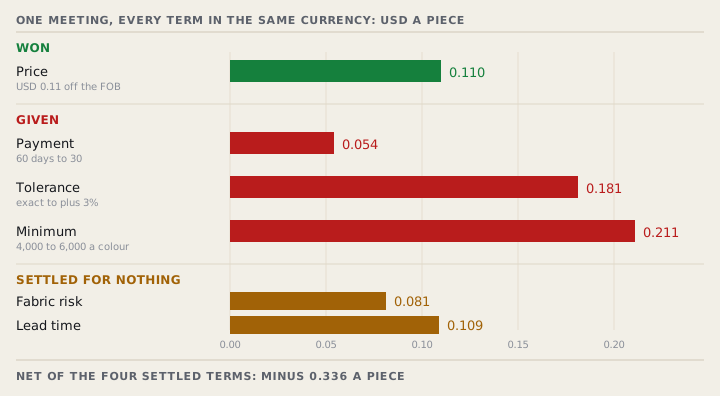
| Term | Which way it moved | Per piece | On the order |
|---|---|---|---|
| FOB price | won, USD 0.11 down | +USD 0.110 | +USD 5,060.00 |
| Payment, 60 days to 30 | given | −USD 0.054 | −USD 2,492.70 |
| Quantity tolerance, exact to +3% | given | −USD 0.181 | −USD 8,328.00 |
| Minimum per colour, 4,000 to 6,000 | given | −USD 0.211 | −USD 9,716.00 |
| Net | −USD 0.336 | −USD 15,476.70 |
Imogen won USD 5,060 and spent USD 20,536.70 in the same room, on the same afternoon, with the same person. The order is USD 15,476.70 worse than it was when she sat down. That is 4.85% of its own value.
Nobody did anything wrong, and the reporting says it went well
This is the shape worth studying, because there is no villain in it. Every one of the three concessions is normal trade. A 3% tolerance is normal. A dye-house minimum is a fact about a dye house. Paying at 30 days is not generous, it is ordinary.
What made it expensive is that only one of the four items was priced in the room. Nuwan knew the value of all four, because a supplier is asked for terms every week and has been made to cost them. Imogen knew the value of one, because a buying system reports one.
That is the mechanism, and it is worth stating flatly. A price concession is visible in every report you have. A terms concession is visible in none of them. The FOB is a field. It sits on the purchase order, in the landed-cost model, in the intake margin, in the supplier ledger and on the range plan. Payment days sit in the finance system with no dollar sign attached. A tolerance sits in a contract clause nobody totals. A colour minimum turns into an intake number that looks like a buying decision, because it arrived as one.
The two terms that were sold for nothing
Two more items were settled that afternoon. Neither cost a cent on the day, which is why neither was discussed.
Fabric liability from the day the yarn is booked. Talpitiya asked that Larkmead own the yarn once it is committed at the spinning mill, rather than at fabric delivery. Imogen agreed, and she was right that it was not a price. It is not a price. It is an option, and Larkmead sold it for nothing. The exposure is 46,000 pieces at 0.54 kg at USD 5.20, which is USD 129,168.
Put a number on that option using Larkmead's own record rather than a general claim. Of the 27 autumn knit programmes it booked yarn against in the three years to 2025, 3 were cut after the yarn was committed, by an average of 26%. So the expected cost of the clause is USD 129,168 times 0.26 times 3 in 27, which is USD 3,731.52, or USD 0.081 a piece. Larkmead gave that away without a sentence being spoken about it.
Seventeen days of lead time, declined. Talpitiya offered to cut the lead time from 95 days to 78 by booking greige cloth (fabric knitted but not yet dyed) before the purchase order, for USD 0.05 a piece, which is USD 2,300. Imogen declined, because USD 2,300 was a cost and there was no budget line for it.
The previous autumn, the style before LM-6274 missed its week-40 launch by nine days. 8,200 pieces went by air at USD 0.61 a piece over sea: USD 5,002, paid by Larkmead. Seventeen days of lead time is the buffer that removes that event. She declined a USD 2,300 option against a USD 5,002 event that had happened twelve months earlier. She declined it because the option had a price and the event did not have a line.
A third term was on that list and is deliberately not priced here: who carries the ship date when the buyer approves late. What an approval transfers the moment you give it, and what a day of your own silence costs, is course 27.4. The clause in your own terms that makes the supplier's date conditional on your approvals is course 27.2. Take both into the meeting, because they are terms and they have prices. But the arithmetic belongs to those courses.
How to price a term before you agree to it
Every term reduces to one of four questions, and each has an arithmetic you can do in a meeting.
- Does it move money in time? Payment days, deposits, retentions. Multiply the sum by your own cost of capital and by the days. Ask your finance director for that percentage once. It will not change this year.
- Does it make you buy units you did not choose? Tolerances, colour minimums, style minimums, pack ratios. Multiply the units by the cost. Do not net it against anything. Those units are a purchase, and you are the one who authorised it.
- Does it move risk across the table? Fabric liability, cancellation terms, who owns the goods when. You cannot price risk exactly, so price it from your own history. How often has this happened to us, and what did it cost when it did? Three events in twenty-seven programmes is a better number than any general rule, because it is yours.
- Does it buy or sell time? Lead time, approval windows, shipping mode. Time is priced by the thing it prevents. Your air-freight ledger from last year is the price list.
Anything that fits none of those four is genuinely paperwork, and there is less of that than a meeting agenda suggests.
Prompt · Put a price on every term before you agree to it
The night before a buying meeting. Or the moment a supplier's list of terms arrives with the quotation and you are about to read it as paperwork.
Act as a senior retail sourcing manager who prices commercial terms for a living and has no interest in whether I like the answer. I am about to negotiate one order. I want every term on the table converted into dollars a piece before I walk in. Order facts: retailer [RETAILER], buyer [NAME], supplier [SUPPLIER], style [CODE], description [GARMENT], quantity [PIECES] in [NUMBER] colours with the split [LIST IT], quoted FOB [PRICE], ex-factory [DATE], into the distribution centre [DATE], on sale [WEEK]. My plan numbers: retail [PRICE], intake margin target [PERCENT], freight duty and handling [AMOUNT] a piece, so my target FOB is [AMOUNT]. My company's cost of capital is [PERCENT] a year. The terms proposed are: payment [DAYS] from [TRIGGER], quantity tolerance [PERCENT AND DIRECTION], minimum per style [NUMBER], minimum per colour [NUMBER], lead time [DAYS], who owns the fabric from [POINT], price validity [DAYS] and what happens after it, packing and presentation [DESCRIBE], approval turnaround expected of me [DAYS]. Do the following. First, sort every term into one of four kinds: it moves money in time, it makes me buy units I did not choose, it moves risk across the table, or it buys or sells time. Second, price each one in dollars a piece and in dollars on the order, showing the arithmetic line by line, and say which figures you had to assume. Third, for the risk terms, ask me for my own history rather than using a general rule, and if I cannot give it, tell me what record I should start keeping. Fourth, rank the terms by value to me, and tell me which three I should be trading and which are genuinely paperwork. Fifth, tell me for each term what it plausibly costs or is worth to the SUPPLIER, and mark clearly where you are guessing rather than knowing. Sixth, write the four sentences I should say in the meeting, in the order I should say them, with the terms settled before the price. Do not give me a range where a number is possible.
AI can make mistakes — check anything you act on.
Check yourselfYour supplier asks to move from 60-day to 30-day payment on an order worth USD 319,240 and offers nothing for it. What is your answer?Show the answer
Not no. The answer is a price: thirty days of that sum at your own cost of capital, which at 9.5% is USD 2,492.70, or USD 0.054 a piece. Say the number out loud and then trade it. Trade it for the tolerance, for a colour minimum, for lead time, or for USD 0.054 off the FOB, which is the same money in the currency your reporting understands. What you must not do is give it away. A term given for nothing is not a saving you failed to make. It is a purchase you made without a purchase order.
Check yourselfWhy is a quantity tolerance the most expensive clause most buyers never read?Show the answer
Because it turns directly into stock nobody selected. A tolerance of 3% on 40,000 pieces is 1,200 units bought at full cost, and a supplier with a tolerance uses it. The fabric is already cut, and shipping to the top of the band is free money for them. It never appears as a negotiation outcome, because it arrives as an intake quantity, and that looks like a buying decision. If you want a tolerance at all, take it in one direction: under-delivery only, or nil either way with a stated tolerance on weight rather than pieces.
What to take away
A price is one term among seven or eight, and it is the only one your systems will ever total for you. That gap is the whole lesson. It is why buyers work hard on the number that is measured and hand over the ones that are not. And it is why a meeting can be won on every report Larkmead runs and lost by USD 15,476.70 on the order itself.
The fix is not to be tougher. It is to arrive with every term already converted into dollars a piece. Then, when the last twenty minutes come around, you are not being asked for housekeeping. You are being asked for money, in a currency you can see.