Lessons · Lesson 2 of 3
Trend is a quantity, a price and a date
Turn a trend call into a sized commitment: what the information costs, what it can and cannot prove, and what the right to change your mind in June is worth in cash.
Lesson 2 of 3 · 36 min
The situation
Deciding that a colour is coming is the easy half. At some point the business has to commit money to it. That moment usually falls the better part of a year early, when nothing can be tested. This lesson weighs where the information behind such a decision comes from, and what each source can honestly prove. It then puts a price on the right to change your mind later in the year.
14 March. Vestrey, the forecasting service Halgarth subscribes to, has delivered its autumn direction. Two calls matter to knitwear. A warm mid-brown is named as a key colour. The half-zip funnel neck is named as a key shape.
The buyer's meeting the next morning spends forty minutes on whether brown is a trend. That is the wrong argument. Everybody in the room leaves it holding the same opinion they walked in with.
The buyer's question is never "is this a trend". It is: how many, at what price, arriving when — and what does it cost me to be wrong. All four have numbers. This lesson produces them.
Where trend information comes from, and what it costs
| Source | Cost a year | What it can establish | What it cannot |
|---|---|---|---|
| Vestrey subscription | GBP 18,400 | Direction, colour and shape, far enough ahead to act on | Quantity, price point, or anything about your customer |
| Comparative shopping to a method | GBP 7,280 | What competitors put in, at what price, in what specification | Whether any of it sold, or what it cost them |
| Your own trading history | The sales file you already have | Whether your customer takes it from you | Anything about what you did not buy |
| Mill and supplier sell-in | Nothing | What other buyers have ordered for the season | Demand. This is a supply signal wearing a demand costume |
| Catwalk and press | Nothing | The vocabulary, and roughly when it will reach the middle market | Nothing usable about GBP 55.00 in a market town |
| Search and resale panels | GBP 6,200 | Direction of interest, week by week | Interest is not purchase, and not purchase at your price |
Those costs cover the whole womenswear business, and knitwear takes about 14% of the womenswear buy. Its share of the whole apparatus is roughly GBP 4,463 a year, against a knitwear cash margin last autumn of GBP 482,693.75. That is under 1%. Information is not what makes trend calls expensive. What you do with the information is.
Two signals are worth more than one loud signal
Halgarth has three things pointing at brown, and they are not equally good. Sort them before you spend.
Vestrey's call. A view of direction, bought by hundreds of other buyers, most of whom are now also looking at brown. It is real information, and it is not private.
Halgarth's own spring range. One brown option, HG-4390, a cotton crew at GBP 35.00, finished at 88.0% full-price sell-through. Its three neighbours in the same price band finished at 71.0%, 64.0% and 59.0%.
Stop and check that against lesson 1 before using it. Lesson 1 says a high sell-through can be a measurement of a gap. Here it is not, and the reason is precisely that the neighbours existed. HG-4390 was not the only thing at its price. It beat three siblings that were on sale all season. That is what positive evidence looks like: a comparison inside a band that really was filled. It proves something narrow and genuinely useful. Halgarth's customer will buy brown from Halgarth. It does not prove that she will pay GBP 55.00 for it.
The mill's order book. Halgarth's supplier reports that its brown lambswool shade is the third most ordered of 34 this season, against eleventh last year. Read this carefully. It measures what other buyers have committed to, which is a fact about supply, not about demand. It tells you the shade will be available, that you will not be alone in the market, and that if the call is wrong a great many people will be discounting brown in November at the same time as you.
There is a fourth thing, from lesson 1: the hole in Halgarth's price ladder between GBP 46.00 and GBP 68.00. That has nothing to do with brown. A new option at GBP 55.00 has a reason to exist whether or not the colour call lands, and that is the strongest argument in the whole file. A trend you believe, plus a gap in your own range, is two separate reasons. A trend you believe in a band you already serve well is one.
The bet, and how to size it
The proposal is HG-5120, a lambswool half-zip funnel neck at GBP 55.00, in the brown, at 4,000 units. Intake margin below is the share of the selling price left after the landed cost, before any markdown.
| Retail | GBP 55.00 |
| Landed cost, committed in March, 22-week lead time | GBP 16.40 |
| Landed cost, called off in June from held yarn, 7-week lead time | GBP 19.10 |
| Non-refundable fee to reserve yarn in March, per unit reserved | GBP 0.85 |
| Intake margin at the March cost | 70.2% |
| In-season markdown price | GBP 27.50 |
| Cleared after the season to a wholesaler | GBP 4.00 |
Two outcomes to plan against. If the call lands, full-price demand runs to about 4,400 units. If it does not, it runs to about 1,700. Of what is then left, roughly a third goes at markdown and the rest to the clearance wholesaler. Those two demand figures are the merchandiser's. They are built with the phasing and the category plan that course 17 owns, so take them here as given.
Now the two ways to buy it.
| Commit 4,000 in March | Commit 1,800, reserve 2,200 | |
|---|---|---|
| Cash committed in March | GBP 65,600.00 | GBP 31,390.00 |
| Cost per unit if all 4,000 are taken | GBP 16.40 | GBP 18.35 |
| Intake margin if all 4,000 are taken | 70.2% | 66.6% |
| Cash margin if the call lands | GBP 154,400.00 | GBP 146,590.00 |
| Cash margin if it does not | GBP 56,017.50 | GBP 63,332.50 |
| Markdown value burned if it does not | GBP 98,382.50 | GBP 4,277.50 |
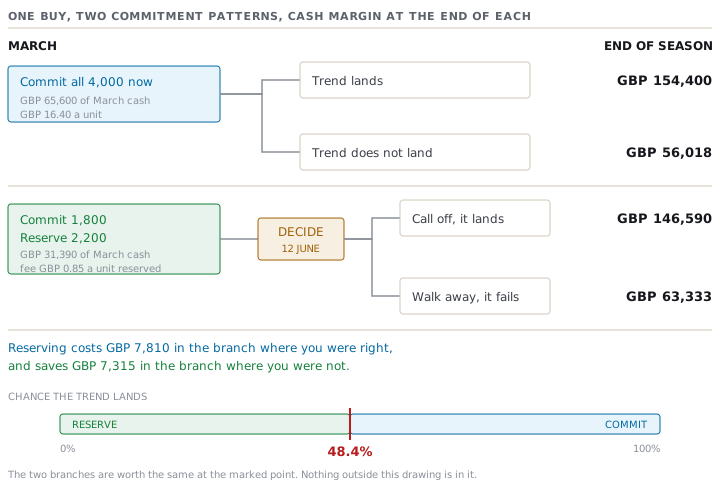
Read the last three rows together, because that is the whole decision.
Reserving costs GBP 7,810.00 when the call lands. That is a fee of GBP 1,870.00 on the reserved units, plus GBP 2.70 a unit more for the 2,200 called off late. It is 3.55 margin points, and it buys nothing at all in the branch where you were right.
Reserving saves GBP 7,315.00 when the call is wrong, because you never buy 2,200 units that would have brought in GBP 12.22 each against a cost of GBP 16.40.
Set those against each other. The reserve is worth taking whenever you think the call has less than a 48.4% chance of landing. Above that, on these numbers, full commitment wins.
That break-even surprises most buyers, and it is worth saying plainly why. At a 70.2% intake margin, over-buying is not very expensive per unit. The garment that fails still recovers most of its cost. The arithmetic really does favour commitment. A buyer who hedges everything is quietly paying a levy on every correct call they make.
What the arithmetic leaves out, which is the reason to hedge anyway
Two constraints sit outside that table, and both of them bite.
The markdown allowance. This is the money the category is allowed to give away in discounts across the season. Halgarth's knitwear category carries GBP 96,000.00 of it. If the full commitment fails, this one option burns GBP 98,382.50 of retail value in markdown and clearance. That is 102.5% of the entire category's allowance, spent on one option out of nine. Every other option then loses the ability to be marked down when it needs to be, and a range where nothing can be discounted at the right moment finishes worse everywhere. The reserved pattern's failure costs GBP 4,277.50, or 4.5% of the allowance.
The March cash. The full commitment ties up GBP 65,600.00 in March. The reserved pattern ties up GBP 31,390.00 and frees GBP 34,210.00 to buy something else. How that budget is built and defended is course 17's subject, because open-to-buy belongs to them and not to this course. The buyer feels it as a queue: the last option in the range is bought with whatever is left.
Neither of these appears in the payoff for a single option. Both belong to the category rather than to the garment. That is exactly why a buyer working alone, one option at a time, will reliably over-commit. The arithmetic does not make the decision. It tells you precisely what the decision costs, and hands the rest to a conversation with the merchandiser.
What June knows that March does not
If you take the reserve, you have bought one thing: the right to look again before spending. Be honest about what that look will contain, because it is easy to imagine it contains more than it does.
By mid-June you will have four things. The competitors' autumn ranges, visible in showrooms and on their sites, so you will know whether six other retailers are also buying brown. Your own spring season fully traded, so HG-4390's 88.0% is a finished number rather than a trend line. The mill's completed order book. And your own autumn range signed off, so you will know whether the GBP 55.00 option is arriving next to a strong neighbour or alone.
You will not have one customer's reaction to the garment. June information is about supply and about what other people intend to do. It is not demand data, and the season has not started. If you tell yourself you will "see how it goes", then call the reserve off anyway because the news was encouraging, look at what that cost. You have paid GBP 1,870.00 and GBP 2.70 a unit for a decision you were always going to make.
Most trend calls are wrong, and that is not the problem
The half of this that professionals get right and beginners do not is that being wrong is the normal case. A buyer who is right two seasons in three is unusually good. What separates them is not the hit rate. It is that their wrong calls are small and their right calls are properly sized. Both of those are decisions taken in March with a calculator, not judgements about brown.
So the file that leaves this meeting reads as follows. 4,000 units at GBP 55.00, of which 1,800 committed and 2,200 reserved at a cost of GBP 1,870.00. Call-off decision on 12 June against three written conditions. The option exists because of a gap in the ladder as much as because of the colour. And if the whole thing is wrong, the exposure is GBP 4,277.50 of markdown rather than GBP 98,382.50.
That is a trend call you can defend to a finance director, and none of it required anybody to be right about brown.
Prompt · Size the trend bet, and price the right to change your mind
Before a range meeting where somebody is about to argue whether a colour or a shape is a trend.
Act as a retail buyer and a retail merchandiser arguing opposite sides of the same commitment, and give me both arguments in full. The proposal: [OPTION, DESCRIPTION, RETAIL PRICE, PROPOSED UNITS, DELIVERY WEEK]. Costs: landed cost committed early [AMOUNT] at [WEEKS] lead time; landed cost called off late [AMOUNT] at [WEEKS] lead time; any reservation or holding fee [AMOUNT PER UNIT RESERVED, AND WHETHER IT IS REFUNDABLE]. Season economics: markdown price [AMOUNT], clearance realisation [AMOUNT], category markdown allowance [AMOUNT], category intake margin target [PERCENT]. Demand if the call lands [UNITS], demand if it does not [UNITS], and how the unsold units split between markdown and clearance [PERCENT AND PERCENT]. Evidence for the call: [LIST EVERY SOURCE — FORECASTER, YOUR OWN TRADING, SUPPLIER SELL-IN, COMPETITOR SIGHTINGS — AND SAY WHAT EACH ONE COST]. Do the following. First, sort my evidence into what is about DEMAND and what is only about SUPPLY OR OTHER BUYERS INTENTIONS, and tell me honestly how much of it is the second. Second, say whether any of my own trading evidence could be a measurement of a gap in my range rather than of the product, and how I would tell. Third, build the payoff for full commitment and for a part-commitment with a reserve, in both outcomes, and give me the break-even probability at which they are equal. Fourth, tell me what that break-even leaves out: what the failure branch does to the category's markdown allowance and to the cash committed at the early date. Fifth, write the exact exit conditions I should record NOW that would make me walk away from the reserve later, as observable facts with numbers, not as feelings. Sixth, state the decision as a single file entry a finance director could read. If a figure is missing, ask for it rather than assuming it.
AI can make mistakes — check anything you act on.
Check yourselfYour supplier tells you the shade you are considering is one of the three most-ordered in its book this season. How much should that move your buy?Show the answer
It should move your view of supply and your view of risk. It should not move your view of demand. It says the yarn will be available and the lead time will hold, which is worth knowing. It also says that if the call is wrong, a great many retailers will be discounting the same colour in the same weeks. That makes the failure branch worse than a private mistake would be, because your markdown has to be deeper to clear against everybody else's. What it cannot tell you is whether a customer will pay your price, because every order in that book was placed by somebody guessing exactly as you are. Treat a strong order book as a reason to check your exit conditions, not as a reason to raise the quantity.
Check yourselfReserving costs GBP 7,810.00 when the call lands and saves GBP 7,315.00 when it does not, so the break-even is 48.4%. Your merchandiser still wants the reserve although the team is confident. Is she wrong?Show the answer
No, and the reason is not in the option's own numbers. The break-even compares two outcomes for one garment on its own. It leaves out the two things the failure branch does to everything else. It burns 102.5% of the category's whole markdown allowance, which strips every other option of its ability to be discounted in the right week. And it locks up GBP 34,210.00 of March cash that could buy a second option into the same empty band. A buyer improving one option will commit. A merchandiser holding the category will hedge. Both are reading the arithmetic correctly. That disagreement is the system working, and it is why the decision is taken in the same room.