Lessons · Lesson 1 of 3
The margin was right and the money was wrong
Decide whether a category should go own-brand at all, using cash rather than margin, and know the three things a margin calculation cannot see.
Lesson 1 of 3 · 42 min
The situation
Take a supplier's badge off a product, put your own name on it, and it looks like free money. The badge costs something. Remove it, and that money should stay with you. This lesson is about three costs that appear the moment you do it. None of them shows up in the profit-per-garment sum that gets the proposal approved. The lesson also makes the case on the other side, for a shop that wants its own label.
14 January, the autumn range review at Ludgrove, a clothing and home retailer with 173 shops and a website. On the wall is the outdoor slot: one waterproof walking jacket, sold in 118 of the shops, forecast at 1,800 units for the season.
For four years that slot has held the Braemount Ridgeway. Ludgrove buys it from Braemount at GBP 62.00 and sells it at GBP 145.00. The buyer has a proposal on one page. Ludgrove can make the same kind of jacket itself, under a new own-brand label called Fellgate, land it at GBP 38.50 and sell it at GBP 129.00. Cheaper for the customer, and a much better margin for Ludgrove.
| Braemount Ridgeway | Fellgate FG-1140 | |
|---|---|---|
| Cost to Ludgrove | GBP 62.00 | GBP 38.50 |
| Retail | GBP 145.00 | GBP 129.00 |
| Cash margin a unit | GBP 83.00 | GBP 90.50 |
| Intake margin | 57.2% | 70.2% |
Every number in that table is correct. The proposal was approved. The jacket was developed. The season ran. And Ludgrove made GBP 5,936.00 less than it would have made by carrying on buying Braemount.
Nobody made a mistake. The arithmetic was right. It was answering the wrong question.
A note on words, because this track sits in a different chair from the rest of the academy. Here the buyer is the person who picks the product and commits the money. The merchandiser is the numbers role: open-to-buy (the money you are allowed to spend), phasing, markdown. On the supply side of this academy, "merchandiser" means the person who runs an order through a factory. Same word, two jobs. All retail prices in this course leave out VAT, the sales tax.
What an intake margin cannot see
An intake margin is the profit on one unit at the moment you buy it. It cannot see any of the three things that decided this season, because none of them is attached to a unit.
It cannot see the development. Braemount's GBP 62.00 already includes designing the jacket, cutting its pattern, sampling it, testing it, and registering the name and defending it. You never pay for those separately, because they sit inside the price. The moment Ludgrove makes its own jacket, those costs come back out of the price and land on Ludgrove as cash, before a single unit sells.
It cannot see the minimum. Ludgrove forecasts 1,800 units for the slot. Braemount will sell it 1,100 now and take a repeat of 400 in November. Ninh Giang Outerwear, the factory that will make the Fellgate jacket, has a minimum of 1,200 units a colourway, and the range needs three colours to fill the space. That is 3,600 units — twice the forecast — committed once, in March, and never again.
It cannot see who carries the markdown. When Braemount's jacket does not sell, Ludgrove marks down 260 units it chose to buy. When Fellgate's jacket does not sell, Ludgrove marks down everything the minimum forced it to buy, and there is nobody else in the chain to share it with.
The season, both ways
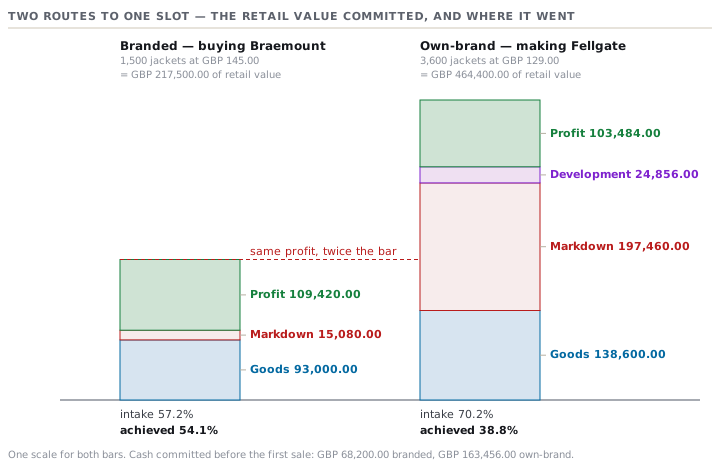
Here is what actually happened, on the same slot, in the same season.
| Units | Price | Value | |
|---|---|---|---|
| Bought in May | 1,100 | GBP 62.00 | |
| Repeat placed 11 November | 400 | GBP 62.00 | |
| Sold at full price | 1,240 | GBP 145.00 | GBP 179,800.00 |
| Sold at 40% off | 260 | GBP 87.00 | GBP 22,620.00 |
| Revenue | GBP 202,420.00 | ||
| Cost of goods | 1,500 | GBP 62.00 | GBP 93,000.00 |
| Gross profit | GBP 109,420.00 | ||
| Achieved margin | 54.1% |
| Units | Price | Value | |
|---|---|---|---|
| Committed 24 March | 3,600 | GBP 38.50 | |
| Sold at full price | 1,040 | GBP 129.00 | GBP 134,160.00 |
| Sold at 30% off | 700 | GBP 90.30 | GBP 63,210.00 |
| Sold at 50% off | 900 | GBP 64.50 | GBP 58,050.00 |
| Cleared to a jobber | 960 | GBP 12.00 | GBP 11,520.00 |
| Revenue | GBP 266,940.00 | ||
| Cost of goods | 3,600 | GBP 38.50 | GBP 138,600.00 |
| Development, one season | GBP 24,856.00 | ||
| Gross profit | GBP 103,484.00 | ||
| Achieved margin | 38.8% |
The intake margin was 13.0 points better. The achieved margin was 15.3 points worse. The direction flipped, and the reason is entirely in the three things the margin could not see.
Where the thirteen points went
Development came to GBP 24,856.00. Spread over all 3,600 units, that is GBP 6.90 a jacket, which still looks affordable. But 3,600 is not the number that carried it. Only 1,040 jackets sold at full price, and against those the development is GBP 23.90 a jacket.
Add that to the landed cost. The Fellgate jacket cost Ludgrove GBP 62.40 against the units that actually paid full price. The Braemount jacket cost GBP 62.00. The own-brand jacket, at a 13-point better margin, ended up costing forty pence more than the brand it replaced.
The minimum bought a tail that lost cash. Look at the bottom two rows of the Fellgate table. Those 1,860 jackets returned GBP 69,570.00 against a cost of GBP 71,610.00. They lost GBP 2,040.00 in cash. That is before development, before the warehouse space, before the shop space they held for eleven weeks, and before the markdown signs that told every customer in the shop what a Fellgate jacket is really worth.
The lower retail price gave away more than the lower cost saved. Dropping the price from GBP 145.00 to GBP 129.00 handed back GBP 16.00 on every full-price sale — GBP 16,640.00 across the season — and it did not buy sell-through. Fellgate sold 1,040 at full price. Braemount sold 1,240 at a higher one.
Why it did not sell: the question nobody asked in January
Fellgate sold worse at a lower price than Braemount sold at a higher one. A spreadsheet will never tell you that, and it is the real answer to when not.
Own-brand replaces a brand's margin. It cannot replace a brand's authority. Economics has a clean line for this. A search good is one a buyer can judge before paying. An experience good is one they can only judge after using it. In some categories the brand carries no information the customer needs: a plain white T-shirt, a bath towel, a school shirt, a pair of black socks. The customer can judge those by looking at them, and the name on the label is a tax. Own-brand in those categories is close to free money.
A waterproof jacket is the opposite. The customer cannot test it in the shop. They cannot see the membrane. They cannot see the seam tape. They will not find out whether it works until it rains on them in November. The brand is the customer's substitute for a test report they cannot run. Braemount had spent twenty years being that substitute. Fellgate had spent none.
There was a second cause, and it is the subject of lesson 3. By the time the jacket launched, it had lost the one piece of evidence it did have. The two causes cannot be separated in the sell-through number, and pretending otherwise would be dishonest. But they point the same way.
The number that made the decision look close, and was not the decision
Ludgrove committed GBP 163,456.00 to the Fellgate jacket before it sold one, goods and development together. It committed GBP 68,200.00 to Braemount before the season, and never more than GBP 93,000.00 in total. That is 2.4 times the cash, for less profit.
The return on the cash: Braemount returned 117.7% on the money spent on goods. Fellgate returned 63.3%.
And the timing is the whole difference. Ludgrove committed the last 400 Braemount jackets on 11 November, four weeks into trading, with real sales figures in front of it. It committed all 3,600 Fellgate jackets on 24 March — 203 days before the first sale and 341 days before the last, on a forecast written in January. Thirteen margin points do not buy back the right to decide in November.
The part the first season cannot tell you
Now the other side, honestly, because a retailer who reads only the above will never build an own-brand at all.
Development is a one-off. Year two of the Fellgate jacket carries no design, no tooling, no trade mark and no first test package. It carries a refresh only: lab dips for the new colours, which are small trial dyeings sent for approval, a re-test on the new fabric lot, and updated artwork. That is GBP 4,200.00. Ludgrove also knows which colours sold, so it commits 2,400 units instead of 3,600, and the label has a season of proof behind it.
| Units | Price | Value | |
|---|---|---|---|
| Sold at full price | 1,480 | GBP 129.00 | GBP 190,920.00 |
| Sold at 30% off | 480 | GBP 90.30 | GBP 43,344.00 |
| Sold at 50% off | 440 | GBP 64.50 | GBP 28,380.00 |
| Revenue | GBP 262,644.00 | ||
| Cost of goods | 2,400 | GBP 38.50 | GBP 92,400.00 |
| Development, refresh | GBP 4,200.00 | ||
| Gross profit | GBP 166,044.00 | ||
| Achieved margin | 63.2% |
Over two seasons the own-brand route earns GBP 269,528.00 against GBP 218,840.00 — ahead by GBP 50,688.00.
So both of these are true at once, and a buyer has to hold both: own-brand lost money in year one, and own-brand is the right decision — as long as the second year happens. That gives the two ways this goes wrong. They are opposite errors, and they come from the same failure to look past twelve months.
- The buyer who kills it in January because it lost GBP 5,936.00 has paid the whole development cost and collected none of the return. That is the most expensive possible outcome, and it looks like discipline.
- The buyer who launched it without a committed second season bought exactly that outcome in advance.
Check yourselfLudgrove's finance director asks why a product with a 70.2% intake margin delivered a 38.8% achieved margin. Give the three causes in the order of what they cost, and say which one is not a cost at all.Show the answer
Markdown, by a long way: GBP 197,460.00 of retail value was given away, against GBP 15,080.00 on the branded route. Then development, at GBP 24,856.00. Then the price cut, GBP 16,640.00 across the full-price units. The third is not a cost. It is a choice that was made in the same meeting as the margin and was never tested. A lower price was assumed to buy volume, and it bought less volume than the higher branded price did. The first is not really a markdown problem either. It is a minimum problem wearing a markdown's clothes. Ludgrove did not mark down 3,600 jackets because it priced badly. It marked them down because it bought twice its forecast in March and then had to be right.
Prompt · Cost the own-brand case in cash, not in margin
When somebody has put a margin comparison in front of you and you can feel that it is not the whole answer.
Act as a retail merchandise planner who has watched own-brand launches succeed and fail, and who has no stake in this one. I am deciding whether to take one category own-brand, and I want the case built in cash rather than in margin. Facts about the branded product I already sell: brand [NAME], cost price [AMOUNT], retail without sales tax [AMOUNT], units bought last season [NUMBER] split into the first buy and each in-season repeat with its date, units sold at full price [NUMBER], units sold at each markdown with the discount and the quantity, leftover stock and what it made. Facts about the own-brand alternative: quoted FOB, the price loaded onto the ship [AMOUNT], landed cost [AMOUNT] and how it is built up, intended retail [AMOUNT], minimum order quantity per colourway [NUMBER], colourways the range needs [NUMBER], lead time from order to my distribution centre [WEEKS], length of my selling season [WEEKS]. My forecast for the slot is [NUMBER] units. Development I can already name: [LIST EVERY LINE YOU HAVE, INCLUDING NONE]. Now do the following. First, tell me which development lines I have almost certainly forgotten, and put a rough figure on each, including my own team's hours. Second, build both routes to a cash gross profit for one season. Show units, prices and a markdown ladder for each, and state both the intake margin and the achieved margin. Third, run the counterfactual: the own-brand product on the branded product's real unit history, so I can see the effect of cost and price alone before any sell-through assumption. Fourth, divide development by the units that sell at FULL price, not by the units bought, and add it to my landed cost. Fifth, tell me the cash committed before the first sale on each route, and the date of the last commitment on each. Sixth, answer three questions in one line each. Does the brand I am replacing carry information the customer cannot get another way? Is the minimum below my forecast? Can I buy again inside the season? Seventh, build a second-season view with development removed. Then say plainly whether the case is a yes, a no, or a yes that depends on something I must commit to now. Name every assumption you had to make.
AI can make mistakes — check anything you act on.
What you do on Monday
Take the one category you have been told to "look at for own-brand" and build one page, in this order. The branded route's real unit history for last season. The same units at own-brand cost and price. The development bill as cash. And the minimum against your forecast. Do not work out an intake margin until all four are on the page. When you do, write it in the corner rather than at the top, because it is the least informative number there.
Then answer the second-season question in writing, and get it signed by whoever will still be in the chair next January. If nobody will sign it, you have your answer.