Lessons · Lesson 3 of 3
You are the producer now
Know which obligations moved onto your own company the day your name went on the label, and build the register that keeps every claim tied to a document.
Lesson 3 of 3 · 44 min
The situation
Put your own name on a garment and the law in most markets treats you as its maker. Every promise on the ticket, the care label and the web page is now your promise. Each one needs a document behind it, held by a named person. This lesson works through that list. It also follows the way such a promise most often comes apart, which is not by anybody lying.
26 September, 16:40. The Fellgate jackets landed at Ludgrove's distribution centre four days ago, 3,600 of them, ticketed and ready to send to shops. The launch is 13 October.
A test report on the bulk fabric arrives from Ludgrove's laboratory. It was ordered as routine.
| Ludgrove's standard | Bulk lot, 22 September | |
|---|---|---|
| Shell, hydrostatic head to ISO 811 | not less than 10,000 mm | 7,200 mm |
| Taped seam, same method, after five domestic washes | not less than 8,000 mm | 4,100 mm |
The swing ticket on all 3,600 jackets reads Waterproof — 10,000 mm.
That figure was true. It came from the laminator's certificate, and it was measured on the shell that was quoted in March. It stopped being true on 13 May, when a lighter face fabric was approved for hand-feel and nobody re-tested. There was no rule saying that a fabric change re-opens a claim.
The mistake nobody made
Trace it back and there is no bad decision anywhere in the chain.
- The buyer asked for a softer hand. Correct: hand is what a customer judges in the shop, and the sample was boardy.
- The laminator proposed a lighter face and a different finish. Correct: that is how you soften a laminate, and it cost nothing extra.
- The technologist approved the revised sample for colour, hand and construction. Correct on all three, and that is what a sample approval is for.
- The February test package — GBP 4,180.00 of physical and chemical testing — was correctly specified, correctly bought and correctly run.
And that last one is where it went. Ludgrove paid GBP 4,180.00 to test a garment that, by June, nobody was making. The test package described the March construction. The garments in the distribution centre are the May construction. Both facts are true, and nothing in the process ever put them next to each other.
The seam figure is the more serious of the two, and it shows the mechanism properly. Seam tape is bonded to the back of the shell, and that bond depends on the exact fabric it sticks to, at a set temperature and line speed. Change the face fabric and you have changed the fabric the tape sticks to. The factory ran the same tape at the same settings, because nobody told it the settings were now a variable. The seams looked perfect. They failed after five washes.
The test that would have caught it — a hydrostatic head on the bulk shell and a washed-seam check — costs GBP 340.00 and takes six working days. In May there was room for it three times over.
What actually changed on 24 March
Here is the part that makes this course different from a costing exercise. When Ludgrove bought the Braemount Ridgeway it was a distributor. It bought finished goods from a company established in its own market, sold them on, and if something was wrong it had a supplier to turn to. When Ludgrove put its own name on a jacket and imported it directly, it became the producer of that jacket and the importer of it. Those are not marketing words.
The rule is old, and it has the same shape across many markets. A person who puts their own name, trade mark or distinguishing mark on a product, in a way that holds them out as its producer, is treated as its producer. In the United Kingdom that sits in the Consumer Protection Act 1987, and similar own-brander rules exist in the product liability law of other markets. Check the one your product is actually sold in. The shape is common, the detail is not, and this course does not tell you what any particular market's version says.
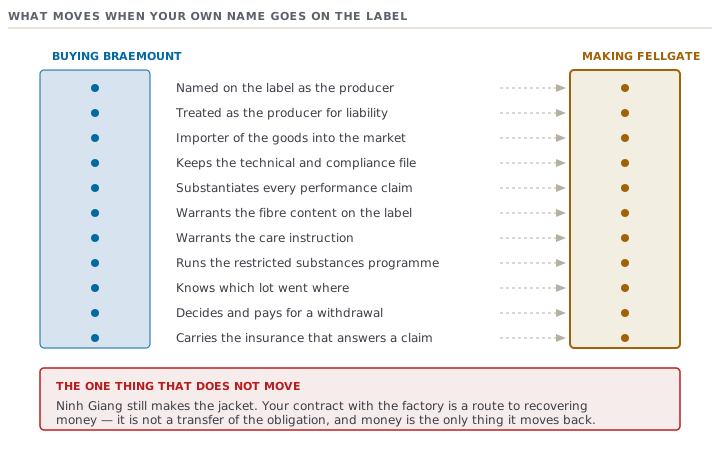
| Buying Braemount | Making Fellgate | |
|---|---|---|
| Named on the label as the producer | Braemount | Ludgrove |
| Treated as the producer for product liability | Braemount | Ludgrove |
| Importer of the goods into the market | Braemount | Ludgrove |
| Keeps the technical and compliance file | Braemount | Ludgrove |
| Substantiates every performance claim | Braemount | Ludgrove |
| Warrants the fibre content on the label | Braemount | Ludgrove |
| Warrants the care instruction | Braemount | Ludgrove |
| Runs the restricted substances programme | Braemount | Ludgrove |
| Can identify which production lot went where | Braemount | Ludgrove |
| Decides and pays for a withdrawal or recall | Braemount | Ludgrove |
| Carries the insurance that answers a claim | Braemount | Ludgrove |
One column, all the way down. And the thing that did not move is the one people assume did. The factory still makes the jacket, and your contract with the factory is a way of getting money back, not a way of handing over the obligation. If a market authority asks who put this product on the market, the answer is your company, and pointing at Ninh Giang is not an answer to that question. You may well recover the money afterwards. You will not recover the position.
Three of those rows are worth a sentence each, because they are the ones a retailer discovers late.
The technical file. This is the folder that proves the product: the specification, the test reports, the declarations from each component supplier, the approval records and who signed them. Braemount kept one, and Ludgrove never asked to see it. Ludgrove now needs its own for every own-brand style. Nobody at a retailer has ever had to keep this, which is why it usually turns up as a spreadsheet on a departed buyer's drive.
Product safety. The obligations that come with putting a product on the market — hazards, labelling, restricted substances, and the evidence programme behind all of it — are course 6.5's subject, in depth and from the supply side. It is the course to read next. What changes here is only who owes them. Every duty 6.5 describes as the supplier's is now also, and separately, yours.
Insurance. A retailer's products liability cover is often written for a business that sells other people's goods and can go back to the maker. Own-brand changes that risk in kind, not in degree. The policy is worth re-reading before the first own-brand style ships, and it is a five-minute question to ask the person who renews it.
Every claim needs an owner, and most claims have none
Ludgrove's Fellgate jacket makes seven claims. Four different departments wrote them over five months, and not one of them was written by the person holding the test file.
| Where it appears | The words | Who wrote them | The document that proves it | Held by |
|---|---|---|---|---|
| Swing ticket | Waterproof, 10,000 mm | Packaging studio, from the brief | Bulk-lot test to ISO 811 | nobody |
| Web page | Keeps you dry in sustained rain | E-commerce copy | nothing exists | nobody |
| Web bullets | Fully taped seams | Buying | Seam-seal validation record | Technologist |
| Care label | Wash at 30, do not tumble dry | Packaging studio, from the mill's card | A care trial on the made garment | nobody |
| Neck label | Fibre content by component | Packaging studio | Declarations, mill to laminator to factory | Technologist, shell only |
| Swing ticket | Made with recycled polyester | Marketing | A transaction certificate for this lot | nobody |
| Web page | Designed in Britain | Marketing | none needed, it is a fact about where the work was done | Design |
Five of the seven had no owner. Not "were wrong". They had nobody whose job it was to hold a document that made them true. That is the finding, and in a retailer it is built into the structure rather than careless. Buying writes the specification, marketing writes the story, e-commerce writes the copy, and the packaging studio turns all three into artwork. Only one of those four ever sees a laboratory report.
Two of the unowned rows deserve naming.
"Keeps you dry in sustained rain" is worse than the 10,000 mm figure, not better, because a number can at least be proved wrong. A sentence with nothing measurable in it cannot be proved and cannot be defended, and a customer will read it as a promise. A claim you cannot test is not a safe claim. It is an untestable one.
"Made with recycled polyester" may be perfectly true and still unusable. The evidence for a recycled claim is paperwork, not laboratory analysis: a transaction certificate that connects a certified quantity of recycled material to your shipment. Course 1.2 sets that out properly and this course will not repeat it. The retailer's problem is who holds it. The claim was written by a marketing team who have never seen one, for a garment whose certificate, if it exists, is in a folder at the factory. A claim you cannot evidence is a claim you cannot make, even when it is true.
Fibre content is a plain factual claim that you now warrant under your own name, and it is a chain. The yarn supplier declares to the mill, the mill to the laminator, the laminator to the factory, the factory to you. And you print it. The chain usually breaks at the component nobody thinks of as a fabric: the membrane, the seam tape, the wadding, the mesh, the drawcord. Course 6.5 follows one broken content declaration all the way to its cost. The addition here is that when the chain breaks under your own label, "our supplier told us" is a way of getting money back. It is not an answer to the market authority that asked.
The options, priced
Discovery is 26 September. Launch is 13 October. Here is what was on the table.
| Option | Cost | Working days | What is still wrong afterwards |
|---|---|---|---|
| Ship as ticketed | 0.00 | 0 | The ticket states a figure the goods do not meet, under Ludgrove's own name |
| Re-ticket to the tested figure | 2,628.00 | 9 | Honest, and the seam still fails Ludgrove's own standard |
| Re-ticket, drop the figure, keep the word | 2,628.00 | 9 | "Waterproof" needs a substantiated meaning of its own |
| Re-ticket and reposition as shower-resistant | 4,104.00 | 12 | The product is now a different product, sold into a slot planned for another one |
| Reject the delivery | nil at first | — | An empty slot, and a claim against the factory: course 27.6 owns that |
The re-ticket cost is GBP 0.11 a swing ticket and GBP 0.62 of handling a unit, across 3,600 units. The reposition adds GBP 980.00 of web and photography rework and GBP 496.00 of in-store signage.
Ludgrove repositioned. GBP 4,104.00 against the GBP 340.00 test in May: 12.1 times, and the money is the small half of it. The jacket launched into an outdoor slot without the claim the slot was planned around, and lesson 1's sell-through is where that ends up. It cannot be separated from the second cause — a new label with no authority in a category where the brand is the customer's evidence — and it would be dishonest to put a number on either half alone.
Traceability, in one paragraph, because it decides the size of everything above
If Ludgrove had needed to take these jackets off sale rather than re-ticket them, the only question that would have mattered is which lots went where. Own-brand makes that your question. The lot code has to be on the garment or its packaging. The goods-in record has to match the delivery note rather than the purchase order. And the allocation record has to show which shops received which lot — that last one being an allocation and inventory discipline, which track 18 owns when it is written. Course 6.5 prices what the absence of it costs. The retailer's version of the lesson is shorter. The difference between a recall and a withdrawal is a record you either kept in September or did not.
The fix, and what it costs
One person owns a claims register per style: the seven rows above, filled in before artwork is released, each row naming a document, and each document being about a lot rather than a style. No claim reaches artwork without a row. A specification change re-opens every row validated on the old specification.
Half a day of a technologist's time — GBP 149.80 a style at the rate in lesson 2 — against GBP 4,104.00 and a launch.
Check yourselfNinh Giang made the jacket, the laminator changed the fabric and both were paid. Ludgrove's supply agreement makes the factory responsible for goods that do not meet specification. Why is Ludgrove still the one with the problem?Show the answer
Because the contract and the obligation are different things, and they run to different people. The contract runs between Ludgrove and Ninh Giang. It is a way of getting money back: it is worth having, it will probably work, and Ludgrove should use it. The obligation runs between Ludgrove and everyone who bought a jacket, and to the authority that regulates products in the market Ludgrove sold into. It exists because Ludgrove's own name is on the label and Ludgrove imported the goods. Nothing Ludgrove agreed with a factory in Vietnam has any effect on that, because those people were not part of the agreement. The practical test is the one to remember: money can flow backwards along a supply chain, and responsibility cannot.
Prompt · Audit every claim on my own-brand product
Before artwork is released on an own-brand style, and on the day you discover a bulk specification changed after the test package was bought.
Act as a retail product compliance manager. I want a claims register for one own-brand style, and I want the gaps found rather than smoothed over. Style facts: [STYLE], category [CATEGORY], made by [FACTORY] in [COUNTRY], imported by my company into [MARKET], quantity [NUMBER], launch date [DATE]. Here is every word that appears on the product and around it: swing ticket, all sewn-in labels, packaging, the product page, and any in-store material: [PASTE THEM ALL]. Here are the documents I know exist: [LIST THEM, WITH THE DATE AND WHAT THEY WERE MEASURED ON]. Specification changes I know about since the test package was bought: [LIST THEM WITH DATES, OR SAY NONE KNOWN]. Now do the following. First, build the register: one row per claim, with the exact words, where they appear, which department almost certainly wrote them, the document that would prove the claim, and whether I have named that document. Second, mark every row where the proving document is about a STYLE rather than a production LOT, and explain for each why that matters. Third, sort the claims into three groups: measurable and evidenced, measurable and unevidenced, and not measurable at all. Then tell me why the third group is the most dangerous. Fourth, for each specification change I listed, name every claim it re-opens and the test that would close it, with a rough cost and duration. Fifth, tell me which obligations sit with my company because my name is on this product, and would have sat elsewhere if I had bought a branded equivalent. Be specific about the difference between a contractual claim against my supplier and my own obligation. Sixth, if anything here looks like a safety question rather than a claims question, say so first and separately, and tell me to stop and take it to someone qualified. Do not tell me what any market's law requires. Name the shape of the obligation and tell me who to ask.
AI can make mistakes — check anything you act on.
What you do on Monday
Take one own-brand style you already sell and write its claims register. Every word on the ticket, the labels, the packaging and the product page goes in one column. Who wrote it goes in the second. The document that proves it goes in the third. And the name of the person who holds that document goes in the fourth. Leave the blanks blank. The register is finished when the fourth column has a name in every row, and its value is entirely in how uncomfortable it is the first time.
Then ask one question of your last three own-brand styles: did the bulk specification change after the test package was bought? If nobody can answer it from a record, that is the process to build before you develop anything else.