Lessons · Lesson 3 of 3
The season that was decided in week three
Run the same WSSI to the end of the phase, price a season that ended badly overbought, and find the week in which every remaining decision stopped mattering.
Lesson 3 of 3 · 50 min
How it finished
Most bad trading seasons contain no bad decision. This lesson follows one to the end and looks at every intervention anybody made. Each was correct, taken early, and taken on the best evidence of its week. The season still finished owning about twice the leftover stock it planned to. The reason is a date almost nobody writes down.
Lesson 1 left Penhallow's Men's Knitwear at the end of week 6. Here is the rest of it, at retail, with the closing units and the cover column beside the money.
| Week | Opening GBP | Intake GBP | Sales GBP | Markdown GBP | Closing GBP | Closing units | Cover |
|---|---|---|---|---|---|---|---|
| 7 | 2,488,200 | 663,000 | 221,000 | 0 | 2,930,200 | 45,080 | 8.9 |
| 8 | 2,930,200 | 494,000 | 247,650 | 0 | 3,176,550 | 48,870 | 8.8 |
| 9 | 3,176,550 | 344,500 | 268,450 | 0 | 3,252,600 | 50,040 | 8.2 |
| 10 | 3,252,600 | 578,500 | 296,400 | 0 | 3,534,700 | 54,380 | 8.2 |
| 11 | 3,534,700 | 585,000 | 318,721 | 143,000 | 3,657,979 | 58,180 | 8.0 |
| 12 | 3,657,979 | 682,500 | 345,722 | 0 | 3,994,757 | 63,100 | 7.9 |
| 13 | 3,994,757 | 708,500 | 378,807 | 0 | 4,324,450 | 67,940 | 7.7 |
| 14 | 4,324,450 | 39,000 | 453,859 | 338,325 | 3,571,266 | 60,440 | 6.8 |
| 15 | 3,571,266 | 0 | 389,350 | 0 | 3,181,916 | 53,540 | 6.4 |
| 16 | 3,181,916 | 0 | 465,852 | 0 | 2,716,064 | 45,340 | 6.3 |
| 17 | 2,716,064 | 0 | 488,387 | 75,179 | 2,152,498 | 36,440 | 6.7 |
| 18 | 2,152,498 | 0 | 374,371 | 0 | 1,778,127 | 29,740 | 7.1 |
| 19 | 1,778,127 | 0 | 186,875 | 811,577 | 779,675 | 23,990 | 7.0 |
| 20 | 779,675 | 0 | 156,000 | 0 | 623,675 | 19,190 | 6.4 |
Every row balances, every closing is the next opening, and the chain runs unbroken back to the GBP 1,365,000 Penhallow opened week 1 with. That is the grid doing its job perfectly, all the way to a bad answer.
| Plan | Actual | Difference | |
|---|---|---|---|
| Sales, at retail | GBP 6,371,333 | GBP 5,418,244 | GBP 953,089 short |
| Units sold | 105,500 | 94,810 | 10,690 short |
| Intake, at retail | GBP 6,123,000 | GBP 6,045,000 | GBP 78,000 less |
| Markdown | GBP 738,367 | GBP 1,368,081 | GBP 629,714 more |
| Gross profit | GBP 3,696,908 | GBP 3,014,810.50 | GBP 682,097.50 short |
| Achieved margin | 58.02% | 55.64% | 2.38 points |
| Sell-through | 91.6% | 83.2% | 8.4 points |
| Closing stock, units | 9,700 | 19,190 | 9,490 over |
| Closing stock, at cost | GBP 245,895 | GBP 486,466.50 | GBP 240,571.50 over |
Intake margin was 61.0% on both sides, because the buy was bought at the price it was bought at. Achieved margin is what is left after the markdowns, so the whole 2.38-point fall is markdown. Course 16.1 owns that gap. Here it is a result rather than a subject.
Now go through the decisions, one at a time
| Week | What was decided | Was it defensible? |
|---|---|---|
| 1 to 3 | No action. The department is 90, then 140, then 200 units behind in a week. | Yes. Across 88 shops and a website that is under one garment per shop per fortnight. |
| 4 | Cumulative sales GBP 46,150 behind. Escalate, and cancel everything still cancellable. | Yes, and early. |
| 7 | Book in a delivery that arrived four weeks early against a live purchase order. | Yes. Refusing costs a supplier relationship and the goods still exist. |
| 11 | First markdown: 20% off 11,000 units of early-autumn lightweights, GBP 143,000. | Yes, and earlier than the plan asked for. |
| 14 | Black Friday: 25% across 18,000 units, GBP 338,325 in one week. | Yes. It delivered 8,100 units against a plan of 7,500, the only week of the phase to beat its unit plan — and still took GBP 453,859 against GBP 487,500, which is what a discount does. |
| 19 | Clearance at 50%, GBP 811,577. | Yes. There were 29,740 units of stock and two weeks of phase left. |
Read that table again and find the error. There isn't one. Every decision was taken on the evidence available in the week it was taken, by people who were watching, and most of them were taken earlier than the plan required. The season still ended with 9,490 units of stock nobody planned to own, which is GBP 240,571.50 of cash at cost sitting in a warehouse in January.
That is the shape of most bad retail seasons. There is rarely a bad decision to find, because by the time a decision is obviously needed there is nothing left to decide.
The calendar nobody had printed
Penhallow's knitwear supply agreement lets it cut or cancel a delivery up to six weeks before the ex-factory date — the date the goods leave the factory. Sea freight and inland movement take four weeks. Put those together and you get a rule that has nothing to do with anybody's opinion:
A delivery landing in trading week 14 must be changed by the end of trading week 4.
Apply it to the intake plan and the season looks completely different.
| End of week | Cumulative sales gap | Intake still cancellable | Share of the whole buy |
|---|---|---|---|
| 1 | GBP 5,850 | 32,200 units | 34.2% |
| 2 | GBP 14,950 | 23,200 units | 24.6% |
| 3 | GBP 27,950 | 12,700 units | 13.5% |
| 4 | GBP 46,150 | 1,800 units | 1.9% |
| 5 | GBP 68,900 | 0 | 0% |
| 6 | GBP 96,200 | 0 | 0% |
By the end of week 4 — the first week in which a GBP 46,150 gap is arguably worth escalating on a GBP 6.37 million plan — 98.1% of the season's buy was beyond recall. Rosalind acted in that week and acted decisively. She cancelled 1,200 of the 1,800 units left, keeping the third style in the delivery because it was PK-4180, which was running ahead of its own plan. Cancelling your best line to fix a department problem is a real mistake, and she did not make it.
She was working with 1.9% of a season.
The number that was already on the table in week three
The sales gap was never going to trigger anything in weeks 1 to 3, and it should not have. GBP 27,950 out of a GBP 6.37 million plan is 0.4%. A phased plan deliberately puts almost nothing in the opening weeks, so early percentages swing on tiny absolute numbers.
But there is a second calculation. It uses only figures the WSSI already holds, and it is not small at all:
projected closing stock at the end of the phase = closing stock units now + all committed intake still to come − remaining planned unit sales, adjusted by the rate the department is actually trading at
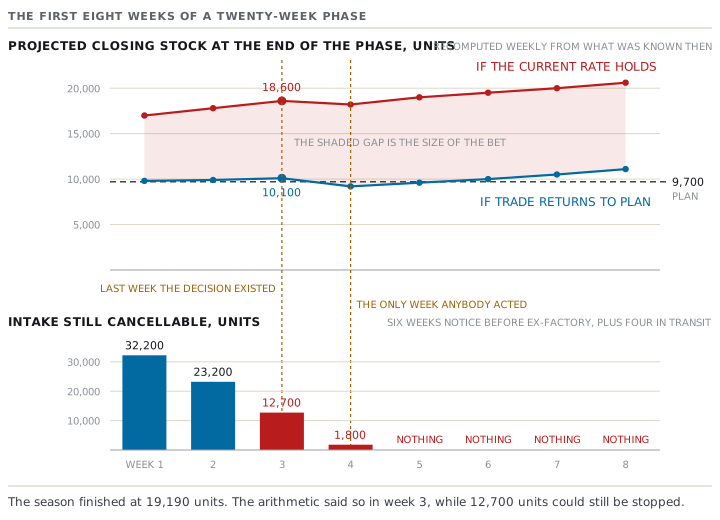
| End of week | Trading at | Projection if the rate holds | Projection if trade returns to plan | Still cancellable |
|---|---|---|---|---|
| 1 | 93.1% | 17,000 units | 9,800 units | 32,200 units |
| 2 | 92.3% | 17,800 units | 9,900 units | 23,200 units |
| 3 | 91.6% | 18,600 units | 10,100 units | 12,700 units |
| 4 | 90.8% | 18,200 units | 9,200 units | 1,800 units |
| 5 | 90.1% | 19,000 units | 9,600 units | 0 |
| 6 | 89.6% | 19,500 units | 10,000 units | 0 |
The plan was 9,700 units. The season finished at 19,190. At the end of week 3, on three weeks of data, the projection said 18,600 — within six hundred units of what actually happened, seventeen weeks before it happened, at a moment when 12,700 units were still cancellable.
The projections are rounded to the nearest hundred. The week-4 figure falls rather than rises because that is the cancellation showing up: the one action anybody took is visible in the row.
And the honest half of that, which is the part that makes it teachable
The projection has two ends and both are in the table. If trade had returned to plan from week 4 onwards, Penhallow would have finished at roughly 10,100 units — on plan. So the week-3 question was never "what will happen", because nobody knew. It was:
Are you willing to bet 12,700 units on trade returning to plan?
That is a question a merchandising director can actually answer, in week 3, with three weeks of data and a mild autumn on the forecast. It has a price on both sides. Cancelling costs supplier goodwill, a chunk of Christmas cover if trade recovers, and a stock-out on lines that are working. Not cancelling costs the difference between the two ends of the projection.
Whereas "sales are 8.4% behind after three weeks" is not a question at all. It is an observation, and the only honest response to it in week 3 is to keep watching.
Why the sheet in front of them looked fine
Three reasons, and each one is a control that Penhallow now has and did not.
The cover column was reassuring, and the number it divided by was a lie. At the end of week 3 cover read 8.7 weeks against a plan of 8.6 — half a rounding away from perfect. But that divides the stock by the plan's forecast. Divide by what the department was actually trading at and it was 9.6.
| End of week | On the plan's forecast | On the running rate |
|---|---|---|
| 3 | 8.7 | 9.6 |
| 6 | 8.3 | 9.3 |
| 10 | 8.2 | 9.3 |
| 14 | 6.8 | 7.5 |
A whole week of cover, every week, hidden inside a division. Cover computed against a forecast nobody believes is not a conservative estimate. It is the wrong number, and it is wrong in the comfortable direction.
The sheet had no row for what was committed. Lesson 2's missing on-order line is the same defect seen from the stock side. The WSSI showed what had landed, and 62,400 units that were as good as landed were nowhere on it.
The money moved more slowly than the units. This is the last trap and the meanest one. At the end of the phase Penhallow's closing stock was GBP 623,675 against a plan of GBP 378,300 — 64.9% over. In units it was 19,190 against 9,700 — 97.8% over. The retail value understates the problem by half, because the markdowns already taken have written a chunk of it off. The money has absorbed the loss you have already recognised. The units are the loss you have not. Read both columns, always, and when they disagree believe the units.
What the closing stock actually costs
GBP 486,466.50 of cash is sitting in knitwear on the second Sunday of January. The plan said GBP 245,895. And the closing stock of one phase is the opening stock of the next, which appears in the spring open-to-buy as a subtraction:
spring OTB = planned closing + planned sales + planned markdown − opening stock − intake on order
Autumn's overhang reduces spring's open-to-buy by GBP 245,375 at retail, before spring has sold a single jumper. The buyer who spends spring's money is not the buyer who lost it, and there is no line on anybody's report that connects the two. An overbought season is paid for by the next range. That is exactly why the discipline for stopping it has to live in this lesson rather than in the post-mortem.
What eventually happens to those 19,190 units — the ladder, the channel, the point at which holding costs more than clearing — is course 17.4's subject, and it is a genuinely separate decision rather than a continuation of this one.
The six things Penhallow changed
Five are controls. The sixth is not, and it is the most interesting.
- An on-order row on the WSSI, at retail, by delivery week, sitting directly under intake.
- A commitment-lock calendar printed beside the intake plan: for every delivery week, the last trading week in which it can still be cut. One column, computed once a season, per supplier.
- A terminal-stock projection every week from week 2, carrying both ends and the plan, at the head of the sheet rather than the foot.
- Cover computed twice, on the plan's forecast and on the running rate, side by side, with the gap between them treated as the interesting number.
- A rebase rule agreed before the season starts, so that rebasing is a procedure rather than an admission. After week 3, if the cumulative rate sits outside an agreed band for two weeks running, the forecast is rebased. And both the sales line and the closing-stock target move, never just the one that feels like a measurement.
- The intake phasing was correct, and it is what removed the escape hatch. Penhallow front-loaded the buy so the shops were full for a peak-selling December, which is the right way to phase knitwear, and it is precisely why only 1.9% of the season was still open by week 4. A better-phased buy is a more committed buy. That is not an argument for phasing badly. It is an argument for knowing your lock dates, because the better your intake plan is, the earlier your season stops being changeable.
Check yourselfSix weeks into a twenty-week phase you are 10% behind on sales, and your terminal-stock projection says you will end 60% over on units. Your entire remaining intake is inside its cancellation windows. What is left to do, and what is the honest limit of it?Show the answer
Three things, in order of how much they are worth. Bring the markdown decision forward, because a price cut with fourteen weeks of trading left moves far more units than the same cut with four, and every week you wait is a week of selling you cannot buy back. Attack the timing of what is still to land. You usually cannot cancel it, but you can often delay a delivery, split it, or send part of it to another channel. Stock that arrives later is stock you are not marking down in December. And take the projection to whoever owns the next phase, because the overhang lands in their opening stock and their open-to-buy. They can plan around a number they are told in October far better than one they discover in January. The honest limit: none of this changes the units. They are bought, they are coming, and the season's outcome was set by a commitment made months ago. What is still available is how much of the loss you take at a price you chose, rather than at a price the calendar chooses for you.
Prompt · Tell me how much of this season is still mine
Early in a phase, when trade is a few points behind and you need to know what can still be changed before it stops mattering.
Act as a retail planning director. I am [NUMBER] weeks into a [NUMBER]-week phase and trading behind plan, and I want to know how much of the season I can still change. Here is what I have. My intake plan by delivery week: [PASTE - WEEK, UNITS, RETAIL VALUE]. My supplier terms: cancellation or reduction allowed up to [NUMBER] weeks before the ex-factory date, and transit from ex-factory to warehouse receipt is [NUMBER] weeks. If these differ by supplier, here they are per supplier: [PASTE]. My planned and actual unit sales by week so far: [PASTE]. My planned unit sales for the remaining weeks: [PASTE]. My closing stock in units this week is [NUMBER], and my planned stock at the end of the phase is [NUMBER]. Do the following. First, build me a commitment-lock calendar: for every delivery week, the last trading week in which it can still be cut, worked out from my own terms rather than from a general rule. Second, for each week from week one to now, tell me how many units were still cancellable at the end of that week, and what share of the whole buy that was. Third, compute a terminal-stock projection for each of those weeks using only what was known then: closing units, committed intake still to come, and remaining planned sales adjusted by the rate I was actually trading at. Give me two ends for each: the projection if the rate holds, and the projection if trade returns to plan. Fourth, put the projection and the cancellable figure side by side, and tell me the week in which those two curves crossed. Fifth, tell me what is still available to me now, in order of how much it is worth, and be honest about what none of it can change. Do not tell me to improve my forecast accuracy.
AI can make mistakes — check anything you act on.