Lessons · Lesson 1 of 3
What a fixture has to earn
Read a shop floor as a register of rented earning positions: charge every fixture its real footprint, then price it in gross margin per fixture-week, weeks of cover, and stock standing on the floor.
Lesson 1 of 3 · 38 min
The shop, and the basis
Every table, rail and stand in a shop sits on floor the business pays for. It pays whether or not anything on it sells. So treat each one as space rented by the week. Three questions then open up. What do the clothes on it bring in over a week? How long would the pile last? And how much of the company's money is standing still inside it? This lesson works all three out on a real floor.
Wrayburn is a womenswear retailer with 38 shops. Everything in this course happens in one of them, Bexholme: 300 square metres in total, of which 195 are womenswear selling floor. The phase is Spring/Summer 27: twelve trading weeks, from the week beginning 1 March 2027 to the week beginning 17 May 2027.
Four people appear. Odile Trantham is the womenswear buyer. She chooses the product. Miriam Vosper is the merchandiser. She owns the quantity and the money. Tamsin Landseer runs visual merchandising across all the shops. Fergus Brightwell manages Bexholme. Nobody in this course does anything foolish. By the end of lesson 3, one pair of fixtures has given away GBP 2,772 of gross margin in six weeks.
Say the basis once. Ticket prices exclude VAT (value added tax). Cost is the cost of the goods delivered into the shop. Gross margin = ticket − cost, and every margin percentage below is worked on the ticket. Rates of sale are units a week, taken from Bexholme's own till data. Where a figure comes from something Wrayburn measured, rather than something generally known, the page says so.
Four lines carry into the phase.
| Line | What it is | Ticket | Cost | Gross margin | GM% |
|---|---|---|---|---|---|
| WR-118 Cottrane | Jersey scoop tee, 4 colours | GBP 16.00 | GBP 6.00 | GBP 10.00 | 62.5% |
| WR-151 Halbrook | Cotton poplin shirt, 3 colours | GBP 39.00 | GBP 15.60 | GBP 23.40 | 60.0% |
| WR-236 Yelverdon | Wide-leg trouser, 3 colours | GBP 45.00 | GBP 18.90 | GBP 26.10 | 58.0% |
| WR-305 Melbrake | Merino-blend cardigan, 3 colours | GBP 69.00 | GBP 27.60 | GBP 41.40 | 60.0% |
Read that table the way most people read it and you will decide Melbrake is the best line in the shop. It earns GBP 41.40 a garment, four times what the tee earns. Hold that thought to the end of this lesson. It is the first thing visual merchandising has to unlearn.
A fixture is not furniture. It is a rented earning position
A shop floor is not measured in square metres of space. It is measured in square metres of space a shopper can use. A four-way stand sits on 1.21 square metres of carpet, and it is useless without room for a person to stand and reach the arms. So Wrayburn charges every fixture its base area plus the standing depth a shopper needs on the sides that are actually shopped — about 0.65 metres. It calls the result the fixture's charged footprint.
Work one out. The four-way is 1.10 m square, so its base is 1.21 m². It is shopped from two sides, so add 2 × (1.10 × 0.65) = 1.43 m². Charged footprint: 2.60 m², more than double the carpet it stands on.
| Fixture | Base | Shopping allowance | Charged footprint | Units held | At Bexholme |
|---|---|---|---|---|---|
| Front table, nest of two | 2.30 m² | 1.70 m² | 4.00 m² | 90 folded | 1 |
| Four-way stand | 1.21 m² | 1.39 m² | 2.60 m² | 96 | 6 |
| Two-arm with bust form | 0.70 m² | 0.90 m² | 1.60 m² | 28 | 4 |
| Straight rail, 1.8 m | 1.26 m² | 1.94 m² | 3.20 m² | 108 | 8 |
| Wall bay, 1.2 m | 0.42 m² | 1.08 m² | 1.50 m² | 42 | 26 |
That register is the whole shop: 90.60 m² of charged footprint holding 2,734 garments, inside 195 m² of selling floor. The other 104.40 m² is main walkway, fitting rooms, till point and the space in front of the door. None of it is waste. It is the reason a shopper reaches the fixtures at all.
The three numbers every fixture has
Every fixture in the register answers three questions, and the answers multiply into everything else.
- How many units does it hold? Its capacity.
- How many units a week does the line on it sell? Its rate of sale.
- What does one unit earn? Gross margin a unit.
From those three come the numbers that let you compare a table with a wall bay:
gross margin per fixture-week = rate of sale × gross margin a unit
weeks of cover on display = units on the fixture ÷ rate of sale
floor stock at cost = units on the fixture × cost a unit
Now put each of the four lines on the same fixture, a four-way filled to its 96 units, and read all three.
| Line | Rate of sale | GM a unit | GM per fixture-week | Weeks of cover at 96 units | Floor stock at cost | GM a week per GBP of floor stock |
|---|---|---|---|---|---|---|
| WR-118 Cottrane | 34 a week | GBP 10.00 | GBP 340.00 | 2.8 | GBP 576.00 | 59.0% |
| WR-236 Yelverdon | 11 a week | GBP 26.10 | GBP 287.10 | 8.7 | GBP 1,814.40 | 15.8% |
| WR-305 Melbrake | 6 a week | GBP 41.40 | GBP 248.40 | 16.0 | GBP 2,649.60 | 9.4% |
| WR-151 Halbrook | 9 a week | GBP 23.40 | GBP 210.60 | 10.7 | GBP 1,497.60 | 14.1% |
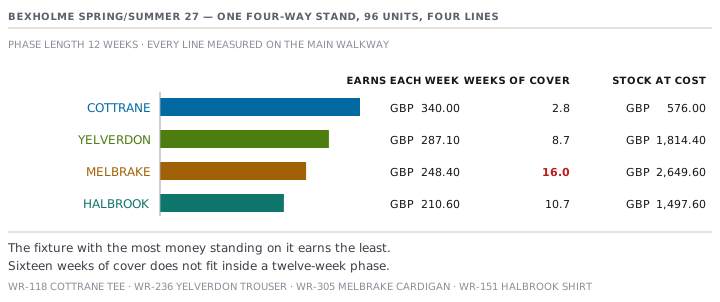
Three things fall out. The third one changes how a floor gets laid out.
The order reverses. Melbrake earns four times what Cottrane earns a garment, and less than Cottrane earns a week. The fixture is not sold by the garment. It is rented by the week.
The most valuable stock earns the least. A four-way of Melbrake is GBP 2,649.60 of Wrayburn's money, standing on 2.60 m² of the most expensive floor the company owns, returning 9.4% of itself a week. The same fixture in Cottrane holds GBP 576.00 and returns 59.0% a week. Same footprint, same rent, four and a half times the money at risk, three-quarters of the earnings.
Sixteen weeks of cover does not fit in a twelve-week phase. Melbrake sells six a week at Bexholme, so the whole phase is 72 units, and the fixture holds 96. Filling that four-way is not merchandising. It is deciding, in week 1, to have unsold cardigans at the end of the phase, and to pay for the floor they stood on while they waited.
Fill to the phase, not to the fixture
The reflex is to fill a fixture because it looks better full. That instinct is not wrong. It is incomplete, and Wrayburn has measured both halves of it.
The floor under a fixture. Bexholme's own stock counts and till data cover the previous two phases. They show that when a four-way dropped below 24 units, six garments an arm, the line's rate of sale fell the following week. On average it ran 31% below its rate in the weeks the same fixture was above 24. That is Bexholme's own number, from two phases in one shop. It is enough to plan the shop with, and it is not a law of retail.
The ceiling above it. The phase itself. A fixture should not hold more of a line than the shop will sell.
Put the two together and every line on every fixture has a workable band rather than a target.
| Fixture | Charged footprint | Units held | Weeks of cover | Phase demand | Verdict |
|---|---|---|---|---|---|
| Four-way stand | 2.60 m² | 96 | 16.0 | 72 units | Holds more than the phase will sell |
| Four-way, held at 40 | 2.60 m² | 40 | 6.7 | 72 units | Works, at full fixture rent |
| Wall bay, 1.2 m | 1.50 m² | 42 | 7.0 | 72 units | Same cover, 42% less floor charged |
The cardigan goes on the wall. Not because a wall bay is the traditional place for knitwear, but because that is the fixture whose capacity matches what the line will actually sell, at the lowest footprint that still clears the presentation minimum.
What this does not tell you yet
The whole of this lesson holds position constant. Every figure in the four-way table was measured with the fixture standing in the same place, a four-way on the main walkway. That is why the comparison is fair.
It is also why it is incomplete. The front table at Bexholme is 4.00 m² and holds 90 units, and nothing here says what it is worth to be on it. A fixture at the door and the same fixture in a side aisle are the same furniture. They are not the same asset, and no amount of arithmetic about capacity will produce the difference. Somebody has to measure it.
That is lesson 2.
Check yourselfA wall bay holding 42 units carries a jacket that sells 2 a week at GBP 58.00 gross margin. The bay beside it holds 42 belts selling 15 a week at GBP 7.20. Your buyer wants to give the belt bay to a second jacket colour. What do you say?Show the answer
Price both bays first. The jacket bay earns 2 × 58.00 = GBP 116.00 a fixture-week and carries 21 weeks of cover on display. The belt bay earns 15 × 7.20 = GBP 108.00 a fixture-week and carries 2.8 weeks. The two are within GBP 8.00 of each other, so on this evidence the swap is close to neutral in earnings. It is not neutral in risk. The jacket bay already holds twenty-one weeks of cover, and a second colour makes that worse, not better. So the useful answer is not yes or no. It is that the jacket does not need a second bay: it needs the first one held at fewer units and replenished. Then ask what the belt bay would earn in a poorer position, because that is the real alternative, and lesson 2 is about how to find out.
Prompt · Price my shop floor by the fixture
When you have a floor plan and a sales report, but nothing that says what each fixture earns.
I am building a fixture register for one shop. I will give you a list of fixtures with their base area, the sides they are shopped from, and the units each holds. Then a list of lines with their weekly rate of sale, ticket price and cost.

For every fixture, work out and show four numbers: charged footprint (base area plus 0.65 m of standing depth on each shopped side), gross margin per fixture-week (rate of sale times gross margin a unit), weeks of cover on display (units held divided by rate of sale), and floor stock at cost.

Then tell me three things. Which fixture carries the most stock at cost, and what it returns each week as a percentage of that stock. Any line whose weeks of cover on display is longer than my phase, and what the whole phase will actually sell at that shop. And any line whose capacity would be better matched by a smaller fixture, with the footprint saved.

Do not tell me anything looks fine just because no problem showed up. If I have not given you a rate of sale for a line, say the line is unpriced and leave it out of the ranking. Do not assume a number.
AI can make mistakes — check anything you act on.