Lessons · Lesson 2 of 3
Position is a number you can measure
Design a rotation test that survives the week it was run in, read a position index per line rather than per shop, and turn it into the rent a hero position charges.
Lesson 2 of 3 · 36 min
The sentence in the floor guide
Everyone in retail knows the front of a shop is worth more than the back. Almost nobody can say how much more. So the best places on a floor get handed out on seniority and instinct. This lesson turns that belief into a measurement. A handful of garments are moved around a real shop on a careful schedule. Then each place is read off in money.
Wrayburn's visual merchandising guide, which Tamsin Landseer wrote and every shop follows, contains this line:
Hero product goes to the front table.
Nobody at Wrayburn could say what the front table is worth. Not roughly. At all. The guide had been in force for six years, every shop obeyed it, and the number on the other side of the sentence had never been produced. That is normal, and it is why visual merchandising is so often argued in adjectives. When the quantity does not exist, taste is the only currency left in the room.
Bexholme has four kinds of selling position, and this lesson is about measuring the difference between them.
| Position | Fixture there | Where it is | |
|---|---|---|---|
| P1 | Front table | Front table, nest of two | The first 5 metres inside the door, on the sightline from the entrance |
| P2 | Main walkway | Four-way stand | Mid-floor, on the route everyone takes to the fitting rooms |
| P3 | Back wall | Wall bay, 1.2 m | Visible from the door, reached at the end of the walk |
| P4 | Side aisle | Straight rail, 1.8 m | Off the main path, seen only by a shopper who turns |
The obvious test, and the reason it lies
The obvious test is to put Cottrane on the front table for a week and count what it sells, then put it back on the four-way for a week and count again, and divide.
That test tells you almost nothing, for two reasons that have nothing to do with visual merchandising.
The week is not a constant. Bexholme counted 3,790 people through the door in week 1 and 4,370 in week 3, a 15% swing between two ordinary weeks in the same phase. A line that gained 15% by moving to the front table in week 3 gained nothing at all.
One line is not the shop. Whatever the tee does at the front, you have learned it about a GBP 16.00 tee.
The design Wrayburn used
Four lines, four positions, four weeks, arranged so that every line sits in every position exactly once, and every week contains all four positions exactly once.
| Line | Week 1 | Week 2 | Week 3 | Week 4 |
|---|---|---|---|---|
| WR-118 Cottrane | P1 front table | P2 walkway | P3 back wall | P4 side aisle |
| WR-151 Halbrook | P2 walkway | P3 back wall | P4 side aisle | P1 front table |
| WR-236 Yelverdon | P3 back wall | P4 side aisle | P1 front table | P2 walkway |
| WR-305 Melbrake | P4 side aisle | P1 front table | P2 walkway | P3 back wall |
Two rules made the test worth running.
Presentation quantity was held at 40 units in every position. Otherwise the test would have moved depth and position together — the front table holds 90 and the wall bay 42 — and no reading could be attributed to either. Forty units clears the presentation minimum from lesson 1 on all four fixtures.
Nothing else was allowed to change. No price, no promotion, no window, no new colour landing mid-test.
Here is what the tills recorded.
| Line | Week 1 | Week 2 | Week 3 | Week 4 |
|---|---|---|---|---|
| WR-118 Cottrane | 81 at P1 | 34 at P2 | 27 at P3 | 17 at P4 |
| WR-151 Halbrook | 8 at P2 | 6 at P3 | 5 at P4 | 19 at P1 |
| WR-236 Yelverdon | 8 at P3 | 6 at P4 | 20 at P1 | 11 at P2 |
| WR-305 Melbrake | 3 at P4 | 9 at P1 | 6 at P2 | 5 at P3 |
| Counted door footfall | 3,790 | 4,120 | 4,370 | 4,200 |
Reading it: the shop's index
Average each position down its own four readings.
| Position | The four readings | Mean | Index against P2 |
|---|---|---|---|
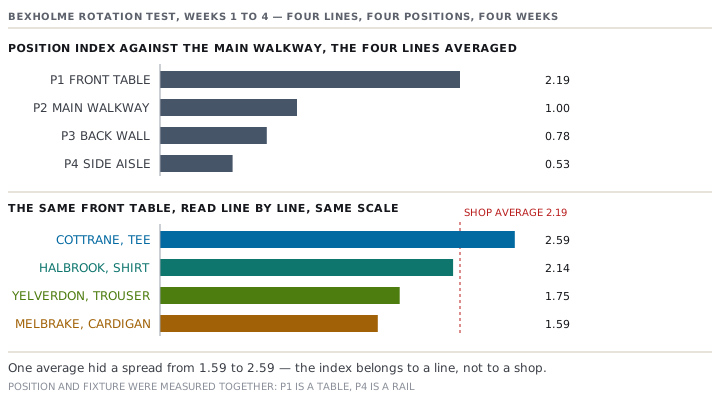
| P1 front table | 81, 19, 20, 9 | 32.25 | 2.19 |
| P2 main walkway | 34, 8, 11, 6 | 14.75 | 1.00 |
| P3 back wall | 27, 6, 8, 5 | 11.50 | 0.78 |
| P4 side aisle | 17, 5, 6, 3 | 7.75 | 0.53 |
No footfall adjustment was needed for that table. That is the entire reason for arranging the weeks the way they were arranged. Each position was measured once in week 1, once in week 2, once in week 3 and once in week 4. Whatever the weeks did, they did equally to all four positions, so the comparison between positions is clean without touching the numbers.
At Bexholme, then, the front table sells 2.19 times what the main walkway sells, and the side aisle sells 0.53 times it. A line moved from the side aisle to the front table sells roughly four times as much. That is the number the floor guide had been missing for six years.
Reading it again: the index belongs to a line, not to a shop
Now take one line at a time. A single line's four readings sit in four different weeks, so this time the footfall does have to come out. Each reading is divided by that week's footfall as a share of week 2, then compared with the same line's own walkway reading.
| Line | P1 front table | P2 walkway | P3 back wall | P4 side aisle |
|---|---|---|---|---|
| WR-118 Cottrane, tee at GBP 16.00 | 2.59 | 1.00 | 0.75 | 0.49 |
| WR-151 Halbrook, shirt at GBP 39.00 | 2.14 | 1.00 | 0.69 | 0.54 |
| WR-236 Yelverdon, trouser at GBP 45.00 | 1.75 | 1.00 | 0.81 | 0.56 |
| WR-305 Melbrake, cardigan at GBP 69.00 | 1.59 | 1.00 | 0.87 | 0.58 |
The shop average of 2.19 sits inside a spread from 1.59 to 2.59, and that spread is not noise-shaped. It is ordered by price, and by how considered the purchase is. The front table converts attention a shopper had not planned to give: a GBP 16.00 tee is bought on that attention, and a GBP 69.00 cardigan is not. Read the side-aisle column the same way in reverse. The cardigan loses least by being pushed into the side aisle, because the customer who wants it goes looking.
A hero position multiplies impulse. It barely moves a considered purchase. Give it to the line whose customer has not decided yet.
Presentation is part of the position
One more thing hides inside P1, and lesson 3 turns on it.
The Bexholme front table is a folded-stack table. Everything measured at P1 was measured folded, on a table, in the first five metres of the shop. That is not a place on the floor. It is a place and a way of showing goods, and the two cannot be separated in the reading.
A tee folds. A shirt folds. A cardigan folds. All three were in the test. Nothing that hangs was.
What the index is actually for
An index is only useful when it turns into money. Multiply it back out.
The best available occupant of the Bexholme front table is Cottrane: 34 a week on the walkway, index 2.59 at P1, so about 85 to 88 a week on the table, at GBP 10.00 of gross margin. Call it GBP 880 a fixture-week. That is the front table's rent: what Wrayburn gives up by putting anything else on it.
Which gives the test that lesson 3 is about. A move is two moves, and you have to price both:
A line earns a hero position when what it gains by moving in is more than what the incumbent loses by moving out.
gain = (new index − old index) × rate of sale × GM a unit
loss = (incumbent's old index − incumbent's new index) × its rate of sale × its GM a unit
The cheap half: adjacency
Position is charged to somebody. Adjacency is very nearly free, and Wrayburn tested that too, in the same four weeks.
In weeks 1 and 2, Yelverdon trousers stood on a four-way in the trouser run, and Cottrane tees were two fixtures away. In weeks 3 and 4, the tees moved onto the two-arm beside the trouser four-way, styled as the outfit both appeared in in the campaign. The till data:
| Yelverdon transactions | Also containing a Cottrane | Share | |
|---|---|---|---|
| Weeks 1 and 2, tees two fixtures away | 44 | 8 | 18.2% |
| Weeks 3 and 4, tees beside the trousers | 42 | 16 | 38.1% |
Four extra tees a week is GBP 40.00 of gross margin a week, and it cost nothing. The tees were going to stand somewhere regardless, and the two-arm was already there.
On 86 transactions, though, it is suggestive rather than proved. A two-sided exact test on those counts gives about 0.054, the wrong side of the line most people draw, on one shop and four weeks. Wrayburn kept the adjacency because it is free, not because it demonstrated anything. That is an honest reason to keep something, and a dishonest one to write a policy about.
Check yourselfYou want to know what your window is worth. A colleague suggests putting your best-selling dress in it for two weeks and comparing with the two weeks before. What is wrong with that, and what would you run instead?Show the answer
Two things are wrong. First, the two weeks before and the two weeks after are not the same two weeks. Footfall, weather and where you are in the phase have all moved, so any difference you find is the window and the calendar mixed together, with no way to separate them. Second, whatever you learn, you have learned it about one dress, when what you need is a number you can apply to the next line somebody wants to put there. Run a rotation instead: three or four lines, three or four positions including the window, arranged so each line sees each position once and each week contains every position once. Hold the number of units on show constant, so you are moving position and not depth. Then read the position means straight off, because the design has already cancelled the weeks. Read each line separately as well, because the window will not be worth the same to a coat as it is to a scarf.
Prompt · Design a rotation test I cannot fool myself with
Before you move product to find out what a selling position is worth.
Help me design a rotation test to measure what my selling positions are worth. I will tell you how many positions I want to test, which lines I can rotate, and how many weeks I have.

Build me a schedule in which every line sits in every position exactly once, and every week contains every position exactly once. Show it as a grid of line by week. Then explain in one paragraph why that arrangement means I do not have to adjust the position averages for weekly footfall, and why I DO have to adjust when I read a single line's own positions against each other.

Then list what I must hold constant for the test to mean anything: presentation quantity, price, promotion, window, and any new colour or size landing mid-test.

Finally, be blunt about the limits of what I will get. Tell me how many readings I will have per cell, whether position and fixture type are confounded in my design, and which of my conclusions I will not be entitled to draw from one shop and one season. If my design cannot support a conclusion I want, say so rather than qualifying it.
AI can make mistakes — check anything you act on.