Lessons · Lesson 1 of 3
How a woven is built
Build a woven fabric from the loom up, so a construction line on a tech pack stops being a code and starts telling you what cloth will arrive.
Lesson 1 of 3 · 34 min
The situation
A woven cloth is two sets of threads crossing at right angles. Almost everything the garment does is decided by how those threads cross. How it hangs. Which way it shrinks. Whether a seam pulls open. All of it starts there. This lesson builds the cloth from the loom up, then reaches the names a mill will quote you. A name on its own is not a specification. It is only the start of a conversation.
12 March, 11:20. A merchandising office in Lahore. Ashgrove, a British menswear retailer, confirms style SH-402: 14,000 men's long-sleeve business shirts. Ship date 30 July. Price FOB USD 8.90. The tech pack runs to twenty-two pages: measurements, labels, packing lists, carton marks.
The fabric is one line.
100% cotton poplin, 40s x 40s / 133 x 72, 57-58", 3.2 oz
Eight numbers and two words. Together they decide how the shirt hangs, whether the collar holds a press after three washes, and whether the side seams open at Ashgrove's warehouse in Warrington. They also decide how many yards of cloth you buy — so they decide what the shirt costs to make. By the end of this course, that one line will have taken USD 5,320 out of this order. Not because anybody lied. Because nobody read it.
This lesson builds the cloth. The next lesson reads the line. The third turns it into money.
Warp and weft, and why they are not interchangeable
A woven fabric is two sets of yarns crossing at right angles.
The warp runs along the length of the roll. It is wound onto a beam, threaded through the loom, and held under constant tension for the whole of weaving. Because it is under tension, it is usually the stronger, higher-twist yarn. On cotton it is usually sized — coated with a thin film of starch or PVA that is washed off after weaving. The coating protects it. One warp thread on a shirting loom is rubbed several hundred thousand times before it becomes cloth.
The weft — also called the filling, or the pick — runs across the roll. A rapier, an air jet or a projectile carries it across, one pick at a time. Old machines used a shuttle. The weft is under almost no tension. It is never sized. It is often the softer, lower-twist yarn — and when a mill needs to hit a price, the cheaper yarn goes in the weft.
Four things follow from this, and every one of them shows up in the garment.
- The fabric is stronger along the warp. That is exactly why a trouser leg or a shirt body is cut with the warp running down its length.
- The fabric shrinks more along the warp. The warp was stretched for hours; the weft was not. On a cotton shirting, warp shrinkage of 2 to 3 percent against weft shrinkage of 1 percent is normal. That is why length measurements move after a wash while chest measurements barely do.
- The fabric stretches more along the weft. The weft yarn lies in a deeper wave — called crimp — so it can straighten under load.
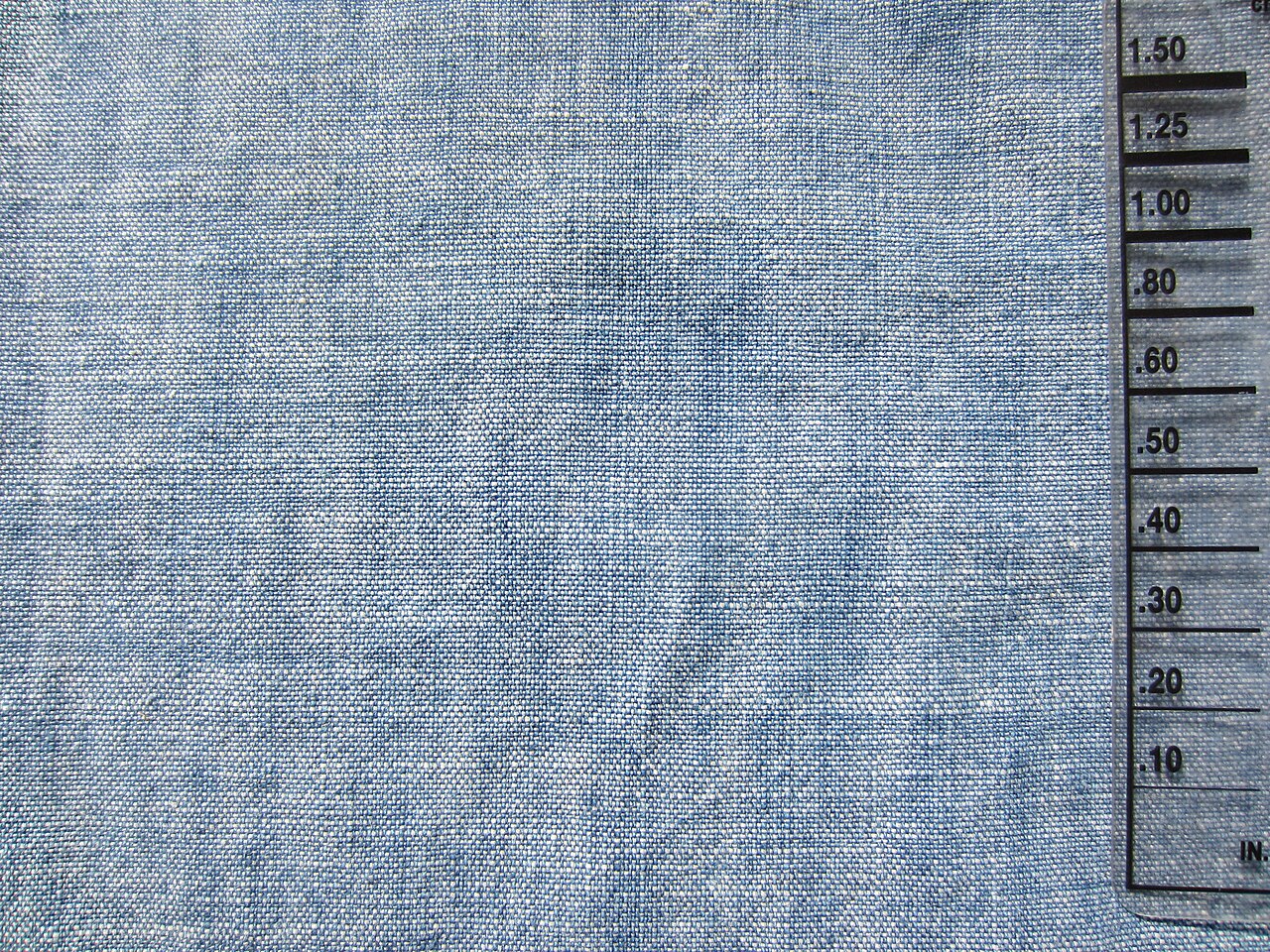
- The two directions look different. Our poplin has 133 warp ends and 72 weft picks in an inch, so the warp is nearly twice as crowded. The weft has to bend around it. That bending makes the fine crosswise rib that is the whole point of poplin.
The selvedge is not fabric you can cut
Each edge of the roll has a selvedge — the self-finished strip where the weft turns back or is tucked in. It is denser than the body of the cloth. The loom's grips held it, and it usually carries the pin holes of the stenter, the frame that dried the fabric.
On a modern shirting loom the selvedge is about half an inch on each side. So about one inch of every roll cannot be cut. That one inch is the difference between the full width a mill quotes and the cuttable width a marker can actually use. A marker is the cutting plan — the layout of pattern pieces on the cloth. This one inch is one of the two mistakes that will cost this order money in lesson three.
Grain and bias
Three directions matter when a pattern piece is laid on cloth.
- Lengthwise grain — parallel to the warp. Strongest, least stretchy. The grain line printed on almost every pattern piece follows it.
- Crosswise grain — parallel to the weft. A little more give.
- True bias — at 45 degrees to both.
Bias is arithmetic, not folklore. Cotton yarn itself barely stretches — a few percent before it breaks. But pull a plain-woven cotton on the true bias and it extends 15 to 20 percent, with no yarn stretching at all. The two sets of yarns simply rotate towards each other, and the square grid becomes a diamond. That is why bindings, piping and a Peter Pan collar are cut on the bias. It is also why a bias-cut panel grows under its own weight in wear, if nobody planned for it.
The same fact makes off-grain cutting a defect, not a preference. Lay a marker two degrees off the true warp. A shirt front 30 in long drifts sideways by 30 x tan 2 degrees, which is 30 x 0.0349 = 1.05 in from top to bottom. The placket bows. The buttons no longer sit on a straight line. After the first wash the whole front twists, because the fabric relaxes back onto its own grain. Skew is measured and given a tolerance — usually 2 to 3 percent of the panel width, tested to AATCC 179 after washing. It is one of the few defects that cannot be repaired at all.
The three base weaves
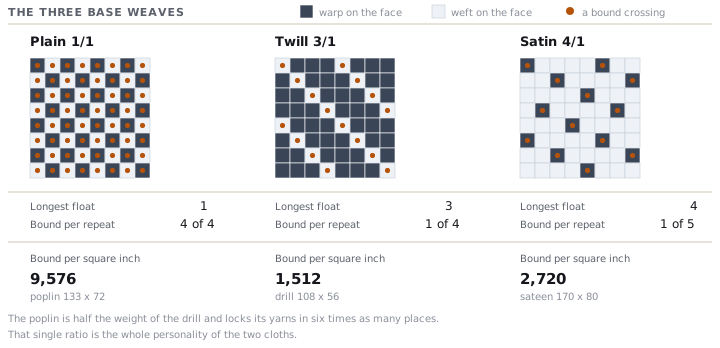
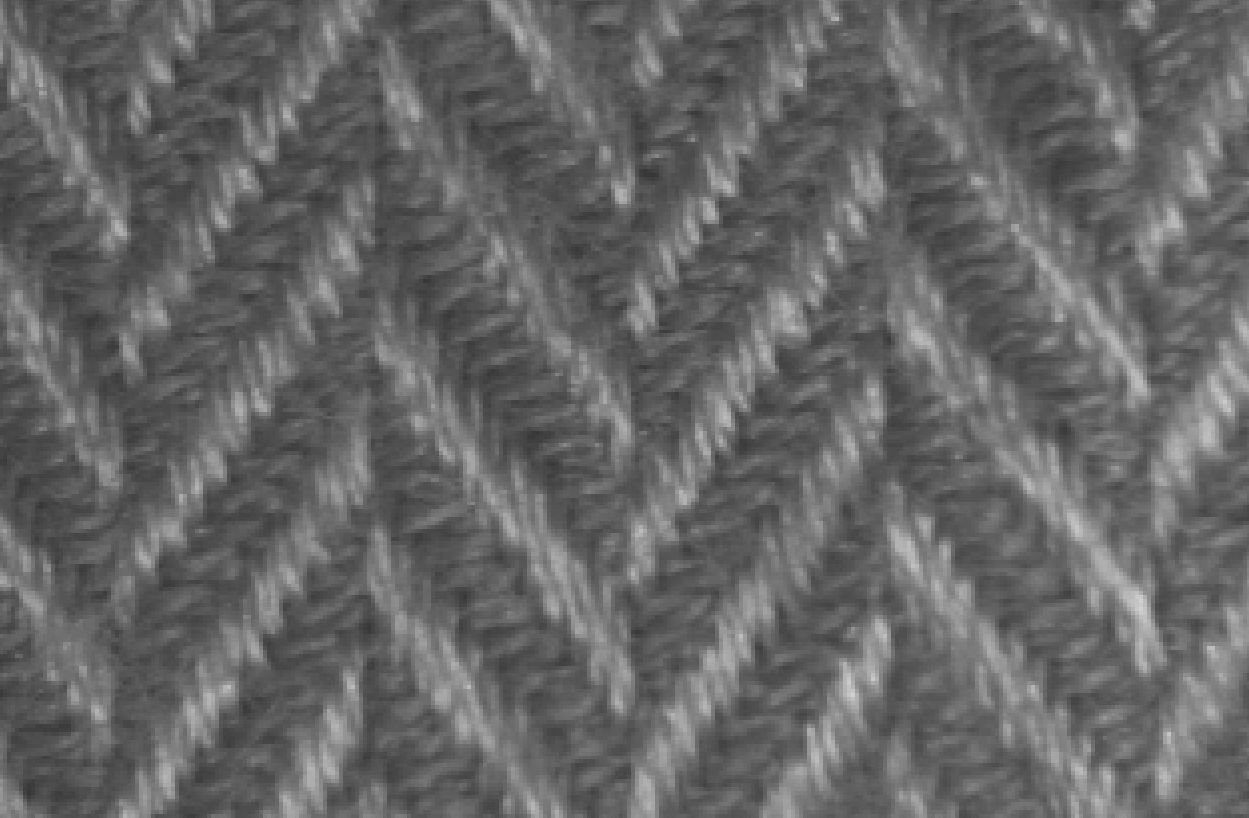
Everything woven is one of three structures, or comes from one of them. What separates them is the float: how far a yarn travels over the opposite set before it is bound down again.
| Weave | Smallest repeat | Binding points per repeat | Longest float | What it gives you |
|---|---|---|---|---|
| Plain 1/1 | 2 ends x 2 picks | 4 of 4 crossings | 1 | Most stable and crisp, prints sharply, best resistance to seam slippage |
| Twill 2/1, 3/1, 2/2 | 3 or 4 ends x 3 or 4 picks | 1 of 3, or 1 of 4 | 2 to 3 | Diagonal line, more drape, better tear strength and soil hiding at the same weight |
| Satin or sateen 4/1, 7/1 | 5 or 8 ends x 5 or 8 picks | 1 of 5, or 1 of 8 | 4 to 7 | Shine, softness, best drape — worst snagging and slippage |
Now put real numbers on it, because "more binding points" is a sentence, and this is a quantity you can count.
A square inch of our poplin has 133 x 72 = 9,576 yarn crossings. A plain weave binds every single one of them.
A square inch of a 3/1 cotton drill at 108 x 56 has 6,048 crossings. A 3/1 twill binds one crossing in four: 1,512.
A square inch of a 4/1 cotton sateen at 170 x 80 has 13,600 crossings and binds one in five: 2,720.
So the poplin, at less than half the weight of the drill, has more than six times as many places where a yarn is locked in position — 9,576 against 1,512. That one ratio is the whole personality of the two cloths. The poplin is crisp. It takes a sharp press, resists a seam pulling open, prints cleanly — and creases when you sit on it. The drill is heavy and still drapes. It tears at a far higher force, because its yarns can bunch together ahead of the tear instead of snapping one at a time. It hides dirt in the diagonal, and it will not hold a knife crease without a resin finish.
The twill line has an angle, and the angle is arithmetic
In a regular twill, the diagonal moves over by one end for every pick. So it rises by one pick spacing — 1 divided by the picks per inch — and runs across by one end spacing — 1 divided by the ends per inch. The angle from the horizontal is therefore the arctangent of ends per inch divided by picks per inch.
- A balanced twill, equal ends and picks, gives 45 degrees.
- Denim at 68 x 46 gives arctan of 1.48, which is 56 degrees — the familiar, slightly steep line on a jean.
- Gabardine at 120 x 60 gives arctan of 2.00, which is 63 degrees — a steep, warp-faced, hard-wearing twill. That is why a gabardine trouser shows a bright diagonal under a shop light.
A steeper twill puts more warp on the face. More warp on the face means the face wears where the warp wears. It also means the fabric follows the warp in strength, in shrinkage and in cost.
The derivative names you will actually be quoted
| Name | Weave | Typical construction | Weight | What it is for |
|---|---|---|---|---|
| Poplin | Plain | 40s x 40s / 110 x 70 | 3.1 oz, 105 gsm | Crisp business shirting; the fine crosswise rib comes from the warp-heavy density |
| Oxford | 2/2 basket | 32s x 16s / 110 x 56 | 4.8 oz, 161 gsm | Soft, visibly textured casual shirting; the coarse weft is the look |
| Chambray | Plain | 20s x 20s / 60 x 60 | 4.1 oz, 140 gsm | Coloured warp, white weft; the pale cast is the structure, not a wash |
| Twill | 2/1 | 32s x 32s / 130 x 70 | 4.3 oz, 145 gsm | Softer shirting than poplin at the same weight, creases less |
| Drill | 3/1 | 16s x 12s / 108 x 56 | 7.8 oz, 265 gsm | Chinos, workwear, uniform bottoms |
| Gabardine | 2/2 steep | 16s x 16s / 120 x 60 | 7.7 oz, 262 gsm | Tailored bottoms; a clean steep diagonal, holds a crease with a finish |
| Denim | 3/1 warp-faced | 7s x 7s / 68 x 46 | 11.2 oz, 379 gsm | Indigo warp, undyed weft; the white inside face is the weave, not a bleach |
| Sateen | 4/1 weft-faced | 40s x 40s / 170 x 80 | 4.3 oz, 145 gsm | Shine and drape in a light cloth; watch slippage and snagging |
| Dobby | Small figured | 40s x 40s / 144 x 76 | 3.8 oz, 128 gsm | Geometric texture woven in, from a dobby head with up to about 24 shafts |
| Jacquard | Individually controlled ends | Any | Any | Large woven figures, because every end is lifted on its own rather than in shafts |
Two things in that table are worth saying out loud. Dobby and jacquard are not weaves — they are looms. They name how the pattern is controlled, not how the yarns cross. A dobby cloth is usually a plain or twill ground with small figures worked in. And every weight in that table was calculated from the construction beside it, not looked up. Lesson two shows you that arithmetic. It is the single most useful thing in this course.
Prompt · Work out what this cloth actually is
When a swatch arrives with a name on the tag and nothing else, and you have to decide whether it is the fabric the tech pack asked for.
Act as a senior woven fabric technologist. I have a swatch in front of me and a specification that may or may not describe it. Here is what the tech pack asks for: [PASTE THE FABRIC LINE FROM THE TECH PACK]. Here is what I can see and measure on the swatch: face appearance [PLAIN / DIAGONAL / SMOOTH AND LUSTROUS / TEXTURED], direction and angle of any diagonal [DESCRIBE], ends per inch counted with a pick glass [NUMBER], picks per inch [NUMBER], measured weight [GSM OR OZ], apparent yarn type [SINGLE / PLIED / SLUB / FILAMENT], colour arrangement [SOLID / COLOURED WARP AND WHITE WEFT / YARN DYED CHECK OR STRIPE], and how it behaves in my hand [DESCRIBE THE DRAPE, THE CRISPNESS, THE RECOVERY FROM A CRUSH]. Do the following. First, name the base weave and the derivative you believe this is, and say which observation each conclusion rests on. Second, if there is a diagonal, calculate the twill angle from my ends and picks and say whether what I am seeing agrees with it. Third, estimate the yarn counts from my measured weight and density using the relationship that grams per square metre equals 23.3 times ends per inch over warp count plus picks per inch over weft count, and show the working. Fourth, tell me every way this swatch could differ from the tech pack line without being obviously wrong, and which of those differences would change the garment. Fifth, list what I cannot determine by hand and must send to a lab. Do not tell me what the fabric probably is if my observations do not support it; say which observation is missing instead.
AI can make mistakes — check anything you act on.
Check yourselfA mill offers you a 4/1 sateen and a plain poplin, both 145 gsm, both 40s cotton. Your garment is a fitted dress with princess seams under stress. Which is riskier, and why?Show the answer
The sateen. In a 4/1 weave, each yarn floats over four opposite yarns and is bound down once in five crossings. So the yarns can slide past each other under load. At a princess seam under body tension, that shows up as seam slippage: the stitch line stays intact while the fabric opens up beside it. That defect cannot be repaired. The poplin binds every crossing, so it holds. If the design needs the sateen's drape and shine, do not argue about the fabric. Specify a seam slippage test to ISO 13936-2, ask for the result in newtons before bulk, and design a wider seam allowance with a stronger seam construction.
Check yourselfWhy does a shirt body get cut with the warp running down the body rather than across it, even when cutting it across would save fabric on a narrow cloth?Show the answer
Three reasons, all structural. The warp is the stronger direction, so the length of the garment carries the load. The warp is the direction that shrinks most, and shrinkage down the body can be allowed for in one measurement — shrinkage around the chest would change the fit. And the warp is the less stretchy direction, so the body does not grow longer in wear. Turning a panel to save fabric is called cutting off-grain. On a check or a stripe it is visible at once. On a plain cloth it shows up after the first wash, as twisting.