Lessons · Lesson 2 of 3
Reading the fabric line
Take a real woven specification apart field by field, and cross-check the weight against the construction before anybody books yarn.
Lesson 2 of 3 · 40 min
The situation
A mill quotes a fabric in one line of numbers and abbreviations. That line is the whole contract. The yarn is bought against it. The loom is set to it. The cost sheet is built on it. This lesson takes the line apart, one field at a time. It ends with half a minute of arithmetic that almost nobody does — and that half minute catches a wrong figure nothing further down the chain will catch.
Same day, 14:40. The offer sheet arrives from Nantong Yuhe Textile, the mill Ashgrove has nominated for SH-402. One line, one price:
40s x 40s / 133 x 72 / 57-58" / 3.2 oz / USD 1.42 per yard, FOB Shanghai
Here is that offer as it really arrives. The badge numbers match the fields of this lesson:
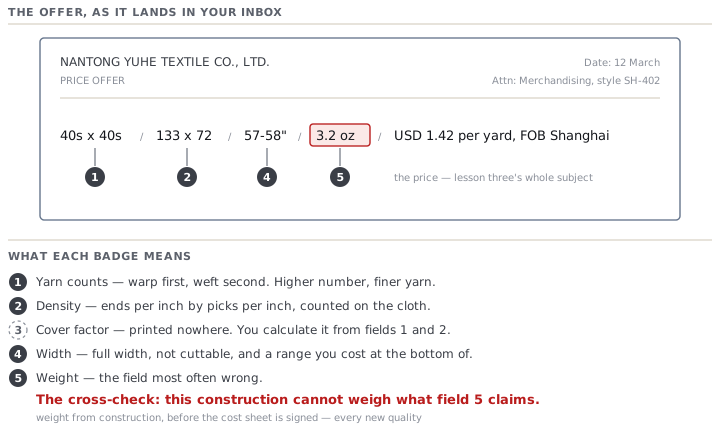
Everything you need to accept or refuse this fabric is in that line. So is a mistake that will cost USD 5,320 if it reaches the cost sheet unchallenged. We will read it left to right. Then we will do the one piece of arithmetic that catches the mistake.
Field one: 40s x 40s, the yarn counts
40s is an English cotton count, written Ne. It counts length per unit of weight. And it runs backwards from what most people expect: the higher the number, the finer the yarn.
The definition starts with a hank — a coil of 840 yards. A yarn is 40s when one pound of it contains forty of those hanks.
- One pound of 40s cotton is 40 x 840 = 33,600 yards.
- One pound is 453.6 grams. So one yard of 40s weighs 453.6 divided by 33,600 = 0.0135 grams.
- Most testing labs use the metric unit instead: tex, which is grams per 1,000 metres. The conversion is tex = 590.5 divided by Ne. So 40s is 590.5 / 40 = 14.8 tex.
Warp count is written first, weft second. 40s x 40s is a balanced yarn pair. 40s x 30s would mean a coarser weft — a fuller feel and a stronger crosswise rib, for less money. Coarse yarn is cheaper per pound, and there is less of it per inch.
One more notation you must be able to read. 40s/2, sometimes written 2/40s, means two 40s single yarns twisted together. Its resultant count is 20s — half as fine, because there is twice the weight in the same length. But a two-fold 20s is rounder, smoother, stronger and far less hairy than a single 20s. So a two-fold poplin at a given weight feels better and costs perhaps 20 percent more. When a buyer says a competitor's shirt "feels better at the same weight", two-fold yarn is usually the answer.
Field two: 133 x 72, the density
Ends per inch by picks per inch, counted on the finished cloth. Ends are warp. Picks are weft. The order never changes.
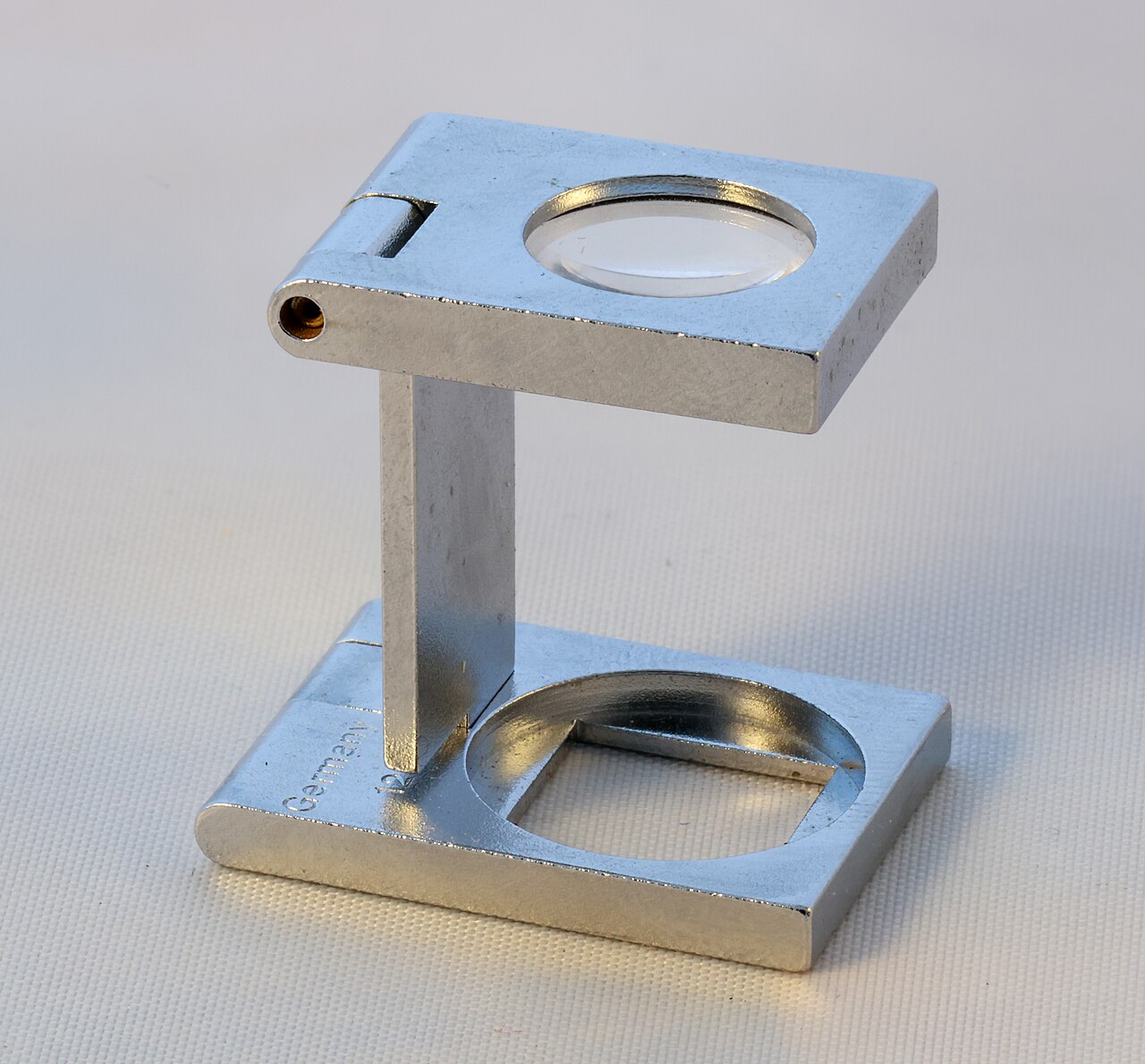
You count them with a pick glass — a small folding magnifier with a window of a known size. Count over one inch in five places across the width and average them. Or count over two inches and halve, which is more accurate, because one miscount matters less. Do it on the finished roll, not on the offer sheet.
Two readings come straight off these numbers.
The total. 133 + 72 = 205 threads per inch. Shirting mills use this number as shorthand, and it is a fair first sort. Below about 150 is a coarse or open cloth. 180 to 220 is normal business shirting. Above 250 is a fine cloth built on 80s or 100s yarn, and priced accordingly.
The balance. 133 divided by 72 = 1.85. The warp is nearly twice as dense as the weft. That is normal, and it is deliberate. Adding warp is cheap: you add it once, when the beam is prepared. Adding picks costs loom time on every inch of cloth. A warp-heavy cloth is stiffer along its length, stronger along its length, and shows a crosswise rib. It is also why the mill's price moves far more when you ask for more picks than when you ask for more ends.
Field three: the cover factor, which is what the density actually means
Density on its own means nothing without the yarn count. 133 ends of 40s and 133 ends of 20s are two different cloths, because the 20s yarn is twice as thick and covers twice as much ground.
Cover factor combines the two. In the English cotton system:
K1 (warp) = ends per inch  /  square root of warp count
K2 (weft) = picks per inch /  square root of weft count
K (cloth) = K1 + K2 - (K1 x K2 / 28)
For our poplin, the square root of 40 is 6.32.
- K1 = 133 / 6.32 = 21.0
- K2 = 72 / 6.32 = 11.4
- K1 + K2 = 32.4, and K1 x K2 = 239.4, which divided by 28 is 8.6
- K = 32.4 - 8.6 = 23.8
The highest possible cloth cover factor in this system is 28. At that point the yarns are jammed against each other and the loom physically cannot insert another pick. So this poplin sits at 23.8 out of 28 — 85 percent of a completely closed cloth. That is a dense, tightly built shirting.
| Cloth cover factor | What it is | How it behaves |
|---|---|---|
| Under 14 | Voile, gauze, open weave | Very fluid, sheer, seams open easily, prints bleed through |
| 14 to 18 | Lawn, light summer shirting | Soft, cool, needs a generous seam allowance |
| 18 to 22 | Normal shirting and light bottomweight | The commercial middle; balanced in every respect |
| 22 to 25 | Poplin, dense shirting, tight twill | Crisp, holds a press, resists seam slippage, harder to sew and to needle |
| Above 26 | Near the loom's limit | Windproof and water-resistant qualities, expensive, slow to weave |
Cover factor is the one number that predicts the most: drape, air flow through the cloth, seam slippage, print sharpness, how hard the fabric is to needle, and how much it will shrink. Learn to calculate it and you can compare two offers that share no other number.
Prompt · Take a mill offer apart before it reaches the cost sheet
The hour a mill quotation arrives, when the numbers still look like a code and nothing has been booked.
Act as a senior fabric sourcing merchandiser. Take this mill offer apart field by field before I cost anything. The offer: [PASTE THE FULL LINE, INCLUDING COMPOSITION, COUNTS, DENSITY, WIDTH, WEIGHT, FINISH AND PRICE]. The mill is [MILL AND COUNTRY], the currency and terms are [PRICE, CURRENCY, UNIT, INCOTERM], and the buyer's specification for this fabric is [PASTE THE TECH PACK LINE]. Do the following and show every calculation. First, state each field in plain words: what the yarn counts mean including any plied notation, what the density means and which direction is dominant, what the width means and whether it is full or cuttable, and what the weight means in both ounces per square yard and grams per square metre using the conversion that grams per square metre equals ounces per square yard times 33.906. Second, calculate the cloth cover factor from the counts and the density, using ends per inch over the square root of the warp count plus picks per inch over the square root of the weft count minus their product over 28, and tell me which band that lands in and what that band behaves like. Third, calculate the weight the construction implies, using 23.3 times ends per inch over warp count plus picks per inch over weft count, and compare it against the quoted weight. If the two differ by more than five percent, say so explicitly, say which of the two is more likely to be the error, and write the exact question I should send the mill. Fourth, convert the price into the other unit the trade uses, per yard against per kilogram, so I can compare it with offers quoted the other way. Fifth, list every field the offer does not state that I must ask for before booking. Do not smooth over a discrepancy; a quoted weight that the construction cannot produce is the finding, not a rounding difference.
AI can make mistakes — check anything you act on.
Field four: 57-58 inches, the width
Two traps live in this field. Both of them are money.
Full width is not cuttable width. The quoted figure is edge to edge, selvedge included. On a shirting with about half an inch of selvedge each side, roughly one inch cannot be cut. A 58 in full width is a 57 in cuttable width. A marker made at 58 in will run off the edge of the cloth on every ply.
A range is a range. 57-58" means the mill may deliver anywhere between the two. It will not tell you which roll is which until the container lands. So you cost at the bottom of the band — never the middle, never the top. That gives 57 in full width, minus one inch of selvedge: 56 in cuttable. Four inches narrower than the 60 in the cost sheet for SH-402 was built on.
Ask the mill two questions in writing, every time. Is the quoted width full or cuttable? And what is the guaranteed minimum width you will accept a claim against? A mill that will not put a minimum in writing is telling you the bottom of the band is optimistic.
Field five: 3.2 oz, the weight
Two conventions, one fabric.
- oz/yd2 — ounces per square yard. The American and Chinese trade convention for shirting and denim.
- gsm — grams per square metre. The metric convention, and the one every test report uses.
The conversion is a constant you should simply know:
gsm = oz/yd2 x 33.906
oz/yd2 = gsm / 33.906
It is worth seeing where 33.906 comes from, so you never doubt it. One ounce is 28.3495 grams. One square yard is 0.836127 square metres. So grams per square metre is 28.3495 divided by 0.836127 = 33.906.
So the offered fabric is 3.2 x 33.906 = 108.5 gsm.
Four reference points worth memorising, so you can sanity-check any quotation in your head: 100 gsm is 2.95 oz, 150 gsm is 4.42 oz, 200 gsm is 5.90 oz, and 300 gsm is 8.85 oz.
The cross-check that catches the error
Here is the arithmetic almost nobody does. It takes thirty seconds.
A fabric's weight is not an opinion. It is the yarn it contains — and you know exactly how much yarn it contains, because that is what the construction says.
Take one square metre, which is 39.37 inches each way. It holds EPI x 39.37 warp ends, and each one is 39.37 inches long, which is 1.0936 yards. So the warp in one square metre measures EPI x 43.06 yards. One yard of Ne yarn weighs 453.6 divided by 840 divided by Ne, which is 0.54 / Ne grams. Multiply the two: the warp weighs 23.3 x EPI / Ne grams. The weft is the same sum, with picks and the weft count. So:
gsm = 23.3 x ( EPI / warp count + PPI / weft count )Run it on the offer:
- 133 / 40 = 3.33
- 72 / 40 = 1.80
- 3.33 + 1.80 = 5.13
- 5.13 x 23.3 = 119.5 gsm
And that is before crimp. The yarn in a woven is 3 to 6 percent longer than the cloth it makes, because it waves over and under. So the true weight is higher still.
The mill quoted 108.5 gsm. The construction says at least 119.5. The two cannot both be true. The gap is 10 percent — far outside any rounding or moisture argument.
What the phone call found
Nantong Yuhe's merchandiser checks and comes back within the hour. The 3.2 oz on the price list belongs to their standard 40s x 40s / 110 x 70 poplin. Run the same sum on that construction: 110/40 = 2.75, plus 70/40 = 1.75, is 4.50, times 23.3 = 104.9 gsm — which is 3.1 oz. That is their 3.2 oz quality. The weight was simply copied across when the denser 133 x 72 line was written.
The 133 x 72 quality is 3.5 oz. And 3.5 x 33.906 = 118.7 gsm — within one gram of the 119.5 the construction predicted. The arithmetic was right before the mill confirmed it.
The price moves too, and the size of the move is checkable as well. The denser cloth carries 119.5 / 104.9 = 14 percent more yarn per square metre. Yarn is roughly 60 percent of the cost of an unfinished (greige) shirting. So 60 percent of a 14 percent increase is about 8 percent on the piece price: 1.42 x 1.08 is 1.53. The mill quotes USD 1.54 per yard. That is a fair revision — and you can say so with confidence, instead of haggling blind.
One last conversion, because mills in some markets quote by weight rather than by length. At 118.7 gsm and 58 in full width, one running yard covers 1.4732 x 0.9144 = 1.3471 square metres, so it weighs 159.9 grams. USD 1.54 per yard divided by 0.1599 kg is USD 9.63 per kilogram. Now you can compare a Chinese offer per yard against an Indian offer per kilogram without guessing.
Check yourselfA mill offers a cotton twill at 32s x 20s, 120 x 64, and quotes it as 5.5 oz. Does the quotation hold up?Show the answer
Calculate it. 120 / 32 = 3.75, and 64 / 20 = 3.20, so the sum is 6.95. Times 23.3 gives 161.9 gsm, and 161.9 divided by 33.906 is 4.8 oz. The quotation says 5.5 oz, which would be 186 gsm — about 15 percent more cloth than this construction can produce. Either the counts are wrong, or the density is wrong, or the weight belongs to a different quality. You ask before you cost. Note that this error runs the other way from the poplin in this lesson: here the mill has quoted a heavier fabric than it can weave. You would have costed too much fabric, and lost the order on price for a reason nobody could see.
Check yourselfYour buyer's tech pack calls for 130 gsm. Two mills quote: mill A at 40s x 40s and 144 x 79, mill B at 30s x 30s and 108 x 59. Both calculate to 130 gsm. What is different?Show the answer
The cover factor — and with it, almost everything the fabric will do. Mill A: 144 / 40 = 3.60 and 79 / 40 = 1.98, so 5.58 x 23.3 = 130 gsm. The square root of 40 is 6.32, so K1 is 22.8 and K2 is 12.5, and the cloth cover factor is 25.1. Mill B: 108 / 30 = 3.60 and 59 / 30 = 1.97, so 5.57 x 23.3 = 130 gsm. The square root of 30 is 5.48, so K1 is 19.7 and K2 is 10.8, and the cover factor is 22.9. Mill A is the denser, finer, crisper cloth, built from more and finer yarn, and it will cost more. Mill B reaches the same weight with coarser yarn set more loosely. It feels softer and fuller, prints less sharply, and slips more easily at a seam. Same weight is not the same fabric. Weight alone has never been a specification.