Lessons · Lesson 3 of 3
What the construction costs you
Turn a construction and a width into consumption, dollars, and a list of the things this cloth will do in the garment.
Lesson 3 of 3 · 38 min
The situation
Everything a fabric specification decides turns into money in the end. This lesson does the conversion. It follows cloth that arrives narrower than the costing assumed, all the way to what each garment eats. It keeps the narrow cloth separate from the higher price — because a costing argument that mixes the two cannot be won. The second half reads the same specification the other way, and asks what the cloth will do once it is a garment.
14 March, 09:30. The corrected offer is in: 40s x 40s / 133 x 72 / 57-58" / 3.5 oz / USD 1.54 per yard. The cost sheet for SH-402 was built three weeks ago, before the mill was nominated, on last season's shirting from a different supplier. Two lines of that cost sheet are now wrong. This lesson is the arithmetic that finds out how wrong.
The costed fabric line said: 1.65 yards a shirt at 60 in cuttable, USD 1.42 a yard.
Width to consumption
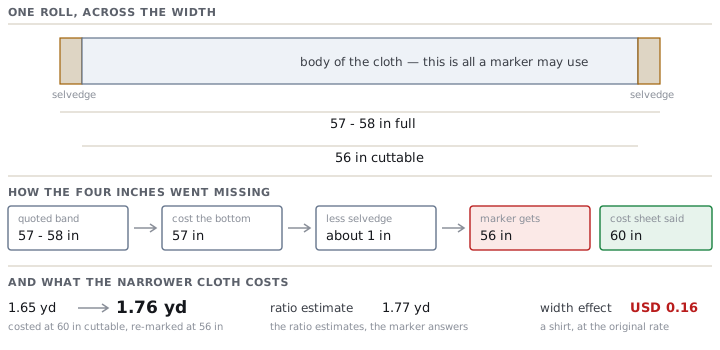
Start with what the new fabric actually gives a cutting table.
The offer says 57-58 in. You cost at the bottom of the band, so 57 in of full width. Take off about one inch of selvedge, and the marker has 56 in to work with. The cost sheet assumed 60 in cuttable. The marker just lost four inches of working width — and nobody sent an email about it, because from the mill's side nothing is wrong. They quoted a width, and they will ship inside it.
A marker uses fabric in proportion to its length, and the length rises roughly as the inverse of the width. So the first estimate is a ratio:
new consumption = 1.65 x (60 / 56) = 1.65 x 1.0714 = 1.77 yardsThen you make the real marker. The CAD room comes back with 1.76 yards at 56 in cuttable — a little better than the ratio, because the two sleeves and the yoke re-nested into the narrower row instead of each taking a row of its own.
That difference matters as a habit of mind. The ratio is a costing estimate. The marker is the answer. And the marker does not always land on the good side. When a narrow width forces one large piece — a back, a front, a two-piece sleeve — out of a row it was sharing, consumption can jump well above what the ratio predicts. On a wide-bodied garment cut from a narrow cloth, always make the marker before you quote.
Consumption to dollars
Two changes happened at once. Separate them. Mixing them together is how a costing argument becomes unwinnable.
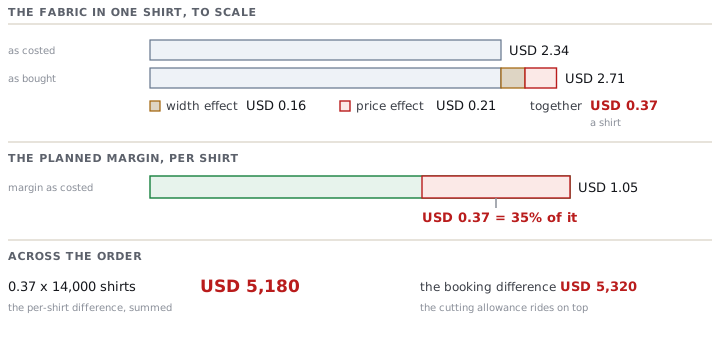
The width effect, priced at the original rate so it stands alone:
(1.76 - 1.65) x 1.42 = 0.11 x 1.42 = USD 0.16 a shirtThe weight and price effect, on the consumption you will actually cut:
1.76 x (1.54 - 1.42) = 1.76 x 0.12 = USD 0.21 a shirtTogether: USD 0.37 a shirt. Across 14,000 shirts: USD 5,180.
Now put that next to the deal. FOB is USD 8.90, and the costed margin on SH-402 was USD 1.05 a shirt, which is 11.8 percent. So USD 0.37 is 35 percent of the margin on the order. It came from two fields on a one-line fabric offer that nobody read against the cost sheet.
| Cost line | As costed | As it will be bought |
|---|---|---|
| Cuttable width | 60 in | 56 in |
| Consumption per shirt | 1.65 yd | 1.76 yd |
| Fabric price | USD 1.42 / yd | USD 1.54 / yd |
| Fabric cost per shirt | USD 2.34 | USD 2.71 |
| Order consumption | 23,100 yd | 24,640 yd |
| Booking with 3 percent allowance | 23,800 yd | 25,400 yd |
| Fabric booking value | USD 33,796 | USD 39,116 |
Notice that the booking difference is USD 5,320, while the per-shirt difference is USD 5,180. The gap is the cutting allowance: the 3 percent rides on top of a bigger number, so a rise in consumption always costs slightly more than the per-piece arithmetic suggests. Three percent is a normal allowance for a plain shirting. It covers end-of-roll losses, splicing where the shade changes, and cutting waste. On a check or a stripe that has to be matched at the placket, the yoke and the pocket, the allowance is 8 to 12 percent — and using 3 percent on a check is the second most expensive habit in this job.
Prompt · Recost consumption when the width is not what you costed
The moment a delivered or quoted width differs from the width the cost sheet was built on, before the marker is made.
Act as a senior garment costing merchandiser. A width has changed and I need to know what it costs before I commit. The order: buyer [BUYER], PO [NUMBER], style [STYLE], garment [DESCRIBE], quantity [PCS], FOB [PRICE], costed margin [VALUE AND PERCENT] per piece. As costed: cuttable width [INCHES], consumption [YARDS OR METRES] per piece, fabric price [PRICE PER UNIT], cutting allowance [PERCENT]. As it now stands: quoted or delivered width [INCHES] and state whether that figure is full or cuttable, selvedge width if known [INCHES], revised fabric price if any [PRICE PER UNIT]. Do the following. First, convert the new width into a cuttable width, taking the bottom of any quoted range and subtracting the selvedge, and say plainly which assumptions you made. Second, estimate the new consumption by the inverse width ratio and show the arithmetic, then tell me clearly that this is an estimate and a real marker must confirm it, and name the garment pieces most likely to make the real marker worse than the ratio. Third, separate the cost impact into the width effect priced at the original rate and the price effect on the new consumption, so the two are never argued together. Fourth, give me the per-piece impact, the impact across the whole order, and the impact as a percentage of the costed margin. Fifth, restate the fabric booking in both cases including the cutting allowance, and explain why the booking difference is larger than the per-piece difference. Sixth, tell me what I should send to the buyer and what I should send to the mill, and which of the two is actually responsible for this change. If the cutting allowance I gave you is under five percent and the fabric is a check or a stripe, say so and tell me what it should be.
AI can make mistakes — check anything you act on.
What the construction predicts in the garment
Consumption is the loud consequence. The quiet ones show up in the wash test, in the pressing room and at the distribution centre. Every one of them can be read from the construction you now know how to take apart.
| What you care about | What in the construction drives it | How it is measured |
|---|---|---|
| Drape and hand | Float length first, then yarn count and weight. Long floats and finer yarn drape; plain weave and coarse yarn do not | Judged by hand against an approved swatch; rarely a numbered specification |
| Tear strength | Float length and yarn strength. A twill tears at a much higher force than a plain weave of the same weight, because its yarns can bunch ahead of the tear instead of breaking one at a time | ISO 13937-2, warp and weft, reported in newtons |
| Tensile strength | Yarn count, twist and density | ISO 13934-1, strip method |
| Seam slippage | Low cover factor plus long floats plus smooth yarn. This is the defect a satin or a loose twill produces and a poplin does not | ISO 13936-2, the force at which the seam opens a stated amount, commonly 6 mm |
| Shrinkage | Warp tension and take-up during weaving, and what the finisher does about it. Warp always shrinks more than weft | ISO 6330 or AATCC 135, three washes, warp and weft reported separately |
| Skew and twist | Off-grain finishing at the stenter, made worse by a steep twill, which has a built-in bias | AATCC 179, measured after washing |
| Pressing behaviour | Cover factor and float length. High cover holds a crease; a long float glazes and shines if the plate is too hot | Judged on the pressing sample; set a plate temperature and a dwell time in the tech pack |
| Abrasion | Cover factor and yarn twist | ISO 12947, Martindale, rubs to end point |
Two of those deserve their own arithmetic.
Shrinkage is a division, not an addition. A shirt body finishes at 76 cm, and the fabric shrinks 3 percent in the warp. The cut length is not 76 plus 3 percent. It is 76 divided by 0.97 = 78.4 cm — because the 3 percent is lost from the larger cut length, not added to the smaller finished one. At 3 percent, the two methods differ by less than a millimetre, and nobody notices. At 10 percent — an unsanforised cloth, a heavy denim, a linen — adding gives 83.6 cm and dividing gives 84.4 cm, and that eight-millimetre error is the whole tolerance. Divide, always. The habit costs you nothing on the days it does not matter.
Tear strength is where the twill earns its place. Our poplin at 119 gsm will typically tear somewhere between 8 and 12 newtons. The 3/1 drill from lesson one, at 265 gsm, tears at three to four times that — more than the weight difference alone can explain, because the long floats let a group of yarns gather and share the load. If a buyer demands a minimum tear strength on a lightweight cloth, the answer is rarely more weight. It is usually a change of weave, a plied yarn, or both.
The three questions to send before approving any fabric
Every one of them exists because it has cost somebody an order.
- Is the quoted width full or cuttable, and what minimum will you accept a claim against? This is the four inches that cost
SH-402USD 0.16 a shirt. - Is the quoted weight finished or greige, and at what construction? This is the field that was copied from another quality, and it cost
SH-402USD 0.21 a shirt. - What is the residual shrinkage after the finish you are actually applying — warp and weft, tested to which method? Sanforised, mercerised and resin-finished versions of the same greige cloth shrink differently. The mill's standard shrinkage figure is usually for their standard finish, not yours.
Check yourselfThe container lands and the rolls measure 59 in full width, not the 57 in you costed. What do you do, and what is it worth?Show the answer
Re-make the marker before the first lay. At 59 in full width the cuttable width is 58 in, so consumption falls to 1.76 x 56 / 58 = 1.70 yards. That saves 0.06 yards, or USD 0.09 a shirt — USD 1,260 across the order. Cutting the 56 in marker on 58 in cloth would leave two inches unused down the whole length of every lay. That is 2 divided by 58, or 3.4 percent of everything you bought, thrown away as a strip. The saving is worth having. And it is worth telling the buyer about, if the extra width came with a price increase you are being asked to absorb.
Check yourselfA buyer refuses your request to change a 4/1 sateen to a 2/1 twill after the seam slippage test failed at 40 N against a 60 N requirement. What else can you offer?Show the answer
Everything that makes the yarns harder to slide, without changing the weave. Raise the cover factor by adding picks — the most effective single change, and the one you can calculate the cost of. Move to a plied or higher-twist weft, which grips better than a smooth single yarn. Change the seam construction: a French seam or a double-needle lap seam spreads the load across more yarns than a plain seam. Widen the seam allowance, because slippage is measured as opening at a stated force, and more allowance means more yarns are engaged. And re-test rather than argue: bring the measured number back, in newtons, against the specification. A fabric argument you win with a test report costs you one week. A fabric argument you win with an opinion does not stay won.