Lessons · Lesson 2 of 3
Reading a knit spec, and buying fabric by the kilo
Take a one-line knit specification apart, weigh a delivered roll properly, and cost a knitted garment in kilos instead of metres.
Lesson 2 of 3 · 34 min
The situation
Knitted cloth is bought by weight rather than by length. That habit moves a risk onto the buyer that woven fabric leaves with the mill. This lesson reads a knit specification token by token, and lists what it does not say. Somebody else will decide every one of those things later, in their own interest. It then shows how a roll is properly weighed, and how a pattern becomes kilos and a cost.
Sunday, 14 February, 10:15, goods-in at the garment factory in Obour City. The first delivery against PO LQ-3308 has arrived from the knitter: eighteen rolls, 428 kg on the weighbridge ticket, white, dyed and finished. The store keeper wants a signature. The merchandiser has the tech pack open at the fabric page and the line on it is the same one line as before.
30/1 combed cotton single jersey, 24 gauge, 160 GSM ±5%, open width, 180 cm finished
Signing that ticket accepts the fabric. Everything downstream — the marker, the cut plan, the consumption the order was costed on, the shrinkage the pattern was corrected for — is now built on whatever is actually on those rolls. So before the pen moves, the line gets read properly, token by token, and the fabric gets measured against it.
What the line commits
Six tokens, and each one is a decision somebody made.
- 30/1 — the yarn count, cotton system. 30 hanks of 840 yards to the pound, single, not plied. In tex that is 590.5 divided by 30, or 19.7. This is a lever on weight and on price.
- combed cotton — combed, not carded. The short fibres and neps have been taken out, which buys a smoother surface and better pilling, at roughly USD 0.35 more per kilo of yarn. It does not change the weight.
- single jersey — the structure. One needle bed, plain face, purl back.
- 24 gauge — needles per inch on the cylinder. Fixed by the machine.
- 160 GSM ±5% — the finished weight, with the tolerance stated. 152 to 168 grams per square metre.
- open width — the presentation. The tube has been slit and finished flat.
Structure deserves its own table, because "knit" on a tech pack could mean any of these and they do not behave alike.
| Structure | How it is built | Typical GSM | Curls | Ladders | Used for |
|---|---|---|---|---|---|
| Single jersey | One needle bed, plain face | 120 to 200 | Yes | Yes | Tees, basic polos, linings |
| Rib 1x1 | Two beds, alternate needles | 180 to 260 | No | Limited | Collars, cuffs, fitted tops |
| Rib 2x2 | Two beds, two needles on, two off | 200 to 300 | No | Limited | Cuffs, waistbands, ribbed bodies |
| Interlock | Two ribs interlocked, both faces plain | 180 to 260 | No | No | Polos, underwear, babywear |
| Pique or lacoste | Tuck stitches on a single jersey base | 170 to 230 | Slightly | Yes | Polo shirts |
| French terry | A third yarn laid in as unbrushed loops on the back | 220 to 320 | Slightly | Yes | Sweatshirts, joggers |
| Fleece | The terry back brushed and raised | 260 to 400 | Slightly | Yes | Hoodies, winter sweats |
| Tricot, warp knit | Two guide bars, fine and closed | 40 to 150 | No | No | Linings, swimwear, sports |
| Raschel, mesh, lace, warp knit | Open structures, many guide bars | 30 to 200 | No | No | Mesh panels, lace, trims |
| Powernet, warp knit | Raschel with elastane in both directions | 150 to 250 | No | No | Bra backs, shapewear |
Note the curling and laddering columns, because they are the ones that reach the sewing floor. Single jersey curls and ladders; interlock does neither. That is why a tee body is single jersey and its neck rib is not, and why an interlock polo costs more per kilo and less in sewing minutes.
What the line leaves open
Now the harder half. Everything the line does not say is a decision that will still get made — by the knitter, on the day, in his own interest. On this order that list is:
- Stitch length. Lesson 1: this is the weight. Unstated.
- The state the GSM is measured in. Greige, wet, conditioned, after relaxation, after how long? A roll weighed hot off the compactor — the finishing machine that pre-shrinks a knit — and the same roll weighed after 24 hours in the store are not the same GSM.
- Finished width. The line says 180 cm; it does not say usable width, and the curl at the edge of an open-width single jersey is not usable.
- Yarn type. Ring-spun, compact or open-end, and the twist level. This will come back in lesson 3 as spirality.
- Shrinkage. No tolerance, no test method, no number of washes.
- Spirality. Same.
- Colour fastness and pilling. Usually in the buyer's manual rather than the tech pack, but somebody has to have read it.
A merchandiser cannot fix all seven on a Sunday morning. The point of listing them is that each is a claim somebody will make later, and the ones without a number in the file are the ones you will lose.
Weigh it properly
A GSM cutter is a circular punch that takes exactly 100 square centimetres of fabric. Weigh the disc in grams and multiply by 100 and you have grams per square metre. One cut tells you almost nothing, so take five, spread across the full width of the roll, and write all five down.
| Cut position | Disc weight | GSM |
|---|---|---|
| Left selvedge, 10 cm in | 1.58 g | 158 |
| Left quarter | 1.62 g | 162 |
| Centre | 1.71 g | 171 |
| Right quarter | 1.74 g | 174 |
| Right selvedge, 10 cm in | 1.69 g | 169 |
The average of the five discs is 8.34 divided by 5, which is 1.668 g, so 167 GSM. Against a tolerance of 152 to 168 that passes — and if the merchandiser reports the average and signs, he has told his own factory something untrue.
Look at the spread instead. The left edge is 158 and the right quarter is 174, a range of 16 GSM across one width of fabric. Two of five cuts sit outside the tolerance. That pattern, light on one side and heavy on the other, is not random. It is a stenter (the wide finishing frame that grips the fabric by its edges) or a compactor pulling the fabric off-centre, or a group of feeders running a different stitch length. Whatever the cause, the garments cut from the right-hand side of the marker will be heavier, denser and will shrink differently from the ones cut on the left. And they will end up in the same carton.
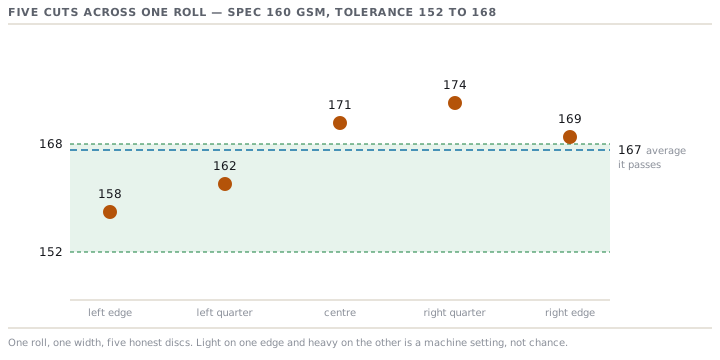
The average passes. The fabric does not. The conversation to have on Sunday is about the spread, and it is a much easier conversation to have before the rolls are cut than after.
Tubular or open width
A circular machine makes a tube. What happens next is a commercial decision.
Tubular fabric is dyed and finished as a tube and delivered folded flat. The tube off our 30 inch cylinder lays flat at about 90 cm. There are no selvedges, there is no slitting cost, and there is a permanent crease down each fold. It suits basic bodies where the crease can be avoided in the marker.
Open width means the tube is slit along one wale and finished flat, so a 90 cm tube becomes 180 cm of open-width fabric — which is exactly where the number on our tech pack came from. It costs more per kilo. It buys a flat, evenly tensioned fabric, a marker that can use the full width, no crease, and a much better chance of controlling spirality, because a tube cannot be held straight on a stenter and a flat fabric can.
If the tech pack says open width and the knitter delivers tubular because it was cheaper, the marker no longer fits and nobody discovers it until the spreading table.
Why the kilo, and not the metre
Wovens are bought by the metre. Knits are bought by the kilo, everywhere in the world, and the reason is not tradition.
A metre of knitted fabric is not a repeatable quantity. Pull the roll and it lengthens and narrows; relax it and it shortens and widens. The same fabric measured on the roll, on the table and after a night in the store gives three different lengths. Weight is the only property of a knit that does not change with how you handle it, so weight is what is traded.
That single fact moves a commercial risk from the mill to you, and most merchandisers meet it the hard way.
Costing the tee
Start from the pattern, not from a rule of thumb.
| Step | Figure |
|---|---|
| Net pattern area, size M, all panels including neck rib | 1.04 sq m |
| Marker efficiency achieved on 180 cm | 82% |
| Gross area on the marker, size M | 1.27 sq m |
| Size-run average across S to XXL | 1.34 sq m |
| Times the fabric weight, 160 grams per sq m | 214 g |
| Plus 5% for roll ends, shade change-overs and process loss | 225 g |
| Fabric per garment | 0.225 kg |
So the order needs 12,000 × 0.225, which is 2,700 kg. At USD 6.40 per kilo the fabric bill is USD 17,280, or USD 1.44 per tee against an FOB of USD 4.20 — 34.3% of the selling price, in one line.
The cutting room will want that in metres, and the conversion is arithmetic you should be able to do without asking. One linear metre of 180 cm open width at 160 GSM weighs 1.8 × 0.160, which is 0.288 kg. So 2,700 kg is 2,700 divided by 0.288, or 9,375 metres, and a 25 kg roll is 86.8 metres.
What a heavy delivery costs
Now the risk the kilo carries. Suppose the knitter, protecting himself against a light rejection, runs the stitch length tight and delivers at 172 GSM. It looks like a better fabric. The buyer's tolerance is 168, so it is out of spec at the top — but the more expensive fact is that you buy by the kilo and the garments have not changed size.
The same garment area at 172 instead of 160 GSM is 0.225 × 172 divided by 160, which is 0.242 kg per tee. Times 12,000 that is 2,904 kg, and at USD 6.40 that is USD 18,585.60 against the USD 17,280 you costed.
USD 1,305.60 gone, on an order worth USD 50,400 — 2.6% of the selling price, for fabric nobody asked for and the buyer will not pay for. Compare the same mistake on a woven bought by the metre. A mill that delivers 10% heavier cloth at the same width and metreage bills you exactly the same money, because the weight risk sits with the mill in the price per metre. On a knit it sits with you.
Check yourselfYour knitter quotes USD 6.40 per kilo for the 160 GSM single jersey and USD 6.95 for the same yarn in interlock. Which is more expensive per garment?Show the answer
You cannot tell from the kilo price, and that is the trap. Interlock is a double-faced structure, so at the same yarn and gauge it is much heavier — call it 220 GSM against 160. The tee then needs 0.225 × 220 divided by 160, about 0.309 kg, and at USD 6.95 that is USD 2.15 a garment against USD 1.44 for the single jersey. The kilo price rose by 9% and the garment cost rose by 49%. Always convert a fabric price to a cost per garment before you compare two constructions.
Check yourselfThe five GSM cuts on a delivery read 151, 153, 158, 161 and 162. The tolerance is 152 to 168. What do you do?Show the answer
The average is 157, comfortably inside, and one cut at 151 is below the floor — but the important reading is the trend: the fabric is light on one edge and climbing across the width. Do not reject on one disc. Take five more cuts on a second roll from the same lot to see whether the gradient repeats. If it does, it is a machine or finishing setting and it will be in every roll of the lot, so raise it now while there is time to correct the remaining production. If it does not, it is one roll and you handle it as one roll. Rejecting a lot on a single disc is how a merchandiser loses the argument he was right about.
Prompt · Cost a knitted garment in kilos, not metres
When a knit consumption figure has been typed into a cost sheet and nobody can say where it came from, or when the first bulk delivery has arrived and the costing needs re-running against what actually turned up.
Act as a senior garment costing engineer working on knitted product. Garment [GARMENT], style [STYLE], buyer [BUYER], order [QTY] pcs, size ratio [PASTE THE RATIO], FOB [PRICE] per piece. Fabric as specified: [STRUCTURE], [YARN COUNT], [GSM] GSM with a tolerance of [TOLERANCE], [TUBULAR OR OPEN WIDTH] at [WIDTH] cm, quoted at [PRICE] per kilo. Pattern data: net pattern area for the base size [AREA] square metres, marker efficiency achieved [PERCENT], any trims knitted separately such as rib collars and cuffs [DESCRIBE]. Work the consumption from the pattern rather than from a rule of thumb, showing every step: net area, gross area at the stated marker efficiency, the size-run average, grams per garment at the specified fabric weight, and the allowance you add for roll ends, shade change-overs and process loss — state that allowance as a percentage and justify it. Then give me fabric kilos for the whole order, the fabric bill, the cost per garment and that cost as a percentage of FOB. Then convert kilos to linear metres for the cutting room using the stated width and weight, and tell me the metres per roll at [ROLL WEIGHT] kg. Finally, and this is the part I want most, re-run the whole calculation at the top and the bottom of the GSM tolerance and at a marker efficiency four points below the one I gave you, and show me in dollars what each of those costs me on this order. Flag any figure I gave you that looks implausible for this construction rather than using it silently.
AI can make mistakes — check anything you act on.