Lessons · Lesson 3 of 3
What a knit does that a woven does not
Trace a spirality complaint back to a twist and a finishing decision, and a shrinkage failure back to a roll that passed its own test.
Lesson 3 of 3 · 33 min
The situation
A complaint arrives from a shop. After a few washes the side seams of a plain tee have walked round towards the front, and the bodies have come up short. Nobody sewed them badly, and the factory holds signed reports saying the cloth passed. This lesson explains two things a knit does that a woven cloth does not. Each one is traced back to the decision, taken weeks earlier, that caused it.
23 March, 11:40. An email from Lindqvist's quality office in Stockholm, subject line "TS-204 — wearer trial, 3 washes". Attached are photographs of six white tees hanging on a rail. The side seams are not down the sides. On every one of them the seam has walked round towards the front, by different amounts, and on the worst it is sitting almost over the hip bone.
Underneath, two lines of measurement:
- Side seam displacement after three home washes: 52 mm on a body length of 700 mm.
- Body length after three home washes: 66.2 cm against a spec of 71.0 cm.
Both fail. The buyer's manual allows 5% on each. And in the factory's own file are two test reports, both signed, both showing the fabric passed.
This is not a rare event and it is not bad luck. Both failures are things a knit does and a woven does not, and both were decided weeks earlier by people who were not thinking about a wash test.
Spirality: the seam that walks
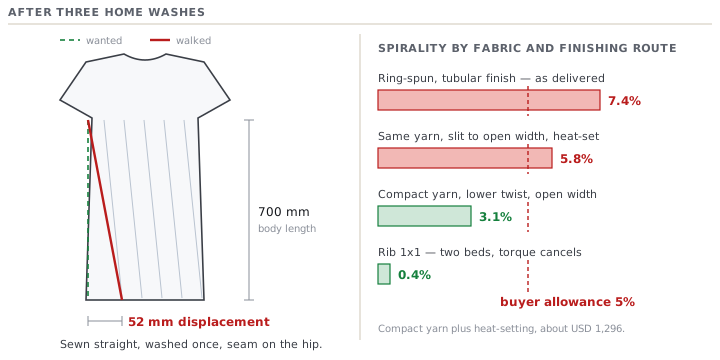
Spirality is the fabric's wale line refusing to run parallel to the fabric's length. In a tube of single jersey the wales lean, and after washing they lean further. Cut a garment out of leaning fabric, sew the side seams straight, wash it, and the seam follows the wales instead of the body.
Measure it as displacement over length:
52 divided by 700, which is 7.4%. The allowance is 5%. The lot fails by a margin that no pressing operation will recover, because there is nothing wrong with the sewing.
The cause is torque in the yarn. A single ring-spun yarn is twisted in one direction, and it wants to untwist. In a woven, the yarn is held straight and clamped at every crossing, so the torque has nowhere to go. In a single jersey, the yarn is a free curve, and every loop is very slightly rotated by the torque still in it. Multiply by 20 courses per centimetre and the whole fabric leans.
Three things make it worse, and all three were true of this order.
- A high twist multiplier. The yarn was 30/1 ring-spun at a twist multiplier of 4.2 — a hard, strong yarn, chosen by the spinner because it runs well and breaks less. More twist is more residual torque.
- A single yarn rather than a plied one. A two-ply yarn is twisted the other way in the plying, which cancels most of the torque. Nobody buys plied yarn for a basic tee.
- Tubular finishing. A tube cannot be held straight. On a stenter the fabric is gripped by both edges and pulled square; a tube has no edges to grip, so whatever lean is in it is set into it by the drying heat.
The factory ran four trials, one week apart. This is the table that settles the argument:
| Fabric and route | Spirality |
|---|---|
| As delivered — 30/1 ring-spun, twist multiplier 4.2, tubular finish | 7.4% |
| Same yarn, slit to open width and heat-set | 5.8% |
| Compact-spun 30/1, twist multiplier 3.7, open width, heat-set | 3.1% |
| Rib 1x1 in the same yarn, a balanced structure | 0.4% |
Read the last row before the others. Rib and interlock are built on two needle beds, and the two faces lean against each other, so the torque cancels inside the fabric. Spirality is a single-jersey problem. If the garment can be built in interlock, the problem does not have to be solved at all.
Read the middle two rows for the money. Compact yarn costs about USD 0.30 more per kilo, which on 2,700 kg is USD 810. Slitting and open-width heat-setting costs about USD 0.18 per kilo, or USD 486. Together USD 1,296 — 2.6% of the order value, decided in February, against a wearer trial in March that puts the whole 12,000 pieces at risk.
Shrinkage that passed on the roll and failed on the garment
The second failure is the one that generates the most heat in a factory, because both sides have a test report and both reports are honest.
The fabric test, run on a sample cut from the roll: 4.2% length, 2.1% width. Inside the 5% allowance. Signed.
The garment test, run on a finished tee: body length 71.0 cm before, 66.2 cm after. That is 4.8 cm on 71.0, which is 6.8%. Outside the allowance. Also signed.
Three reasons a roll passes and the garment made from it fails, and on this order all three were live.
The test was not the same test. The roll was washed once and dried flat. The buyer's standard is three home washes with a tumble dry. Knitted cotton does most of its shrinking in the first wash and keeps giving back a little in the next two, and tumble drying is far more aggressive than flat drying. Two different methods produce two different numbers, and neither laboratory did anything wrong.
The fabric was cut before it had relaxed. The rolls arrived on Sunday and were spread on Monday morning. A knit comes off the winder under tension and stays stretched for hours; on the cutting table this lot was measurably longer than it would ever be again. Cut a pattern into stretched fabric and every panel is short the moment the fabric lets go. A knit is relaxed on the table for 24 hours before it is cut, unrolled and un-plied, and no cutting plan that skips that is worth arguing about.
The compactor was set wrong. Compacting is the finishing step that pushes the fabric back on itself lengthwise so the shrinkage has already been taken out before it leaves the mill. It is set as an over-feed percentage. This lot ran at 4% over-feed where the fabric needed about 8%. The residual shrinkage was still in the roll — which is precisely why the roll weighed what it should and measured what it should. The mill delivered a fabric that was correct in every dimension you can measure with a tape and wrong in the only one that matters after a wash.
The damage was lot-specific: 3,200 pieces cut from dye lot D-77 came out at 6.8%, and the rest of the order measured 4.6% and passed. That distinction is worth a day of somebody's time, because it is the difference between a rework of 3,200 pieces and a rejection of 12,000.
Curling, laddering and the cutting table
Two more knit behaviours, both of which cost money quietly rather than dramatically.
Curling. A single jersey edge rolls, always, because the loops are asymmetric and the fabric relieves its own stress by folding. The top and bottom edges roll towards the back, the side edges roll towards the face. On the spreading table that means the outer few centimetres of an open-width roll cannot be trusted, so a 180 cm fabric is cut on about 176 cm. Every garment then carries about 2.3% more fabric than the marker claims — 61 kg on this order, USD 390, invisible in the cost sheet because it disappears into the wastage line. Curling is also why a neck binding is never cut from single jersey: a 3 cm strip of it rolls into a tube and no sewing operator can hold it flat. That is what the rib is for.
Laddering. A knit is one yarn. Break a loop and the loops above it have nothing holding them, so the fabric runs down the wale — the same thing a stocking does. In production this shows up as a needle line: one damaged needle in the 2,256 on the cylinder drops its column continuously, and the machine keeps running. At 1.2 metres of tube a minute, an undetected broken needle ruins a whole 25 kg roll — 86.8 metres, USD 160 of fabric — and none of it is repairable, because you cannot re-form a run. Interlock and warp knits do not ladder, which is one of the reasons a swimwear or lingerie buyer specifies them.
Recovery, and the difference between stretch and growth
Everything a knit does comes back to the loop changing shape. Stretch is how far it changes; recovery is whether it comes back, and the gap between them is called growth.
Test it the way a quality lab does. Mark 10 cm on a relaxed rib collar, stretch it to 15 cm — 50% extension — hold it for thirty minutes, release it, and measure an hour later. This collar came back to 10.4 cm: 4% growth, inside the 5% the buyer allows. A collar that keeps 10 cm of growth on every 10 cm stretched is a tee that goes over a head once and never fits again. That is the single most common consumer complaint on knitted tops.
Cotton has almost no elastic recovery of its own. What recovers is the geometry of the loop, plus whatever elastane is in the yarn. Which is why a 5% elastane single jersey is not a slightly stretchier fabric — it is a fabric that comes back, and that is a different product.
Check yourselfA tee measures 70 cm body length off the sewing line and 66 cm after one wash. The pattern was cut from fabric that had been on the table for two hours. Is this a fabric problem or a cutting problem?Show the answer
You cannot yet tell, and that is the answer to give. Measure it again after relaxing fabric from the same roll for 24 hours, cutting a second set of bodies and washing those. If the second set holds, the fabric is stable and the loss was tension built into the cut. If the second set shrinks the same way, the residual shrinkage is in the fabric and belongs to the mill's compacting. Running that comparison costs half a day and it decides who pays, which is why it is worth doing before anybody sends an email.
Check yourselfYour buyer allows 5% spirality. Your fabric is measuring 7.4%. The knitter offers to reduce the twist multiplier from 4.2 to 3.7 at no extra cost. Do you accept?Show the answer
Accept, but do not stop there — the trials show a twist change alone gets you part of the way, and the finishing route is doing at least as much work. Ask for the twist change and open-width heat-setting together, and be aware of what lower twist costs elsewhere: a softer yarn is weaker, so expect more yarn breaks in knitting, more needle lines and slightly worse pilling. Nothing about a knit is adjusted in one place only, and a knitter offering a change at no cost is usually moving the cost somewhere you have not looked.
Prompt · Trace a spirality or shrinkage failure to its cause
The day a wearer trial, a garment wash test or a customer complaint comes back on a knitted style and the fabric test report in your own file says the fabric passed.
Act as a senior knitted-fabric technologist investigating a failure. The complaint: [DESCRIBE IT, WITH THE BUYER'S WORDING]. Measurements taken: [PASTE THEM, WITH THE BEFORE AND AFTER FIGURES AND THE LENGTHS THEY WERE MEASURED OVER]. The buyer's allowance and test method: [PASTE]. What my own file already contains: fabric test report [PASTE, INCLUDING THE METHOD AND THE NUMBER OF WASHES], dye lot numbers affected [LIST], quantity cut from each lot [LIST]. Fabric facts: [STRUCTURE], [YARN COUNT AND SPINNING SYSTEM], twist multiplier [IF KNOWN], stitch length [IF KNOWN], [TUBULAR OR OPEN WIDTH] finishing, compacting over-feed [IF KNOWN], heat-set [YES OR NO]. Production facts: date the fabric was delivered [DATE], date it was spread [DATE], hours relaxed on the table before cutting [HOURS]. Do this. First, convert every measurement into the percentage the buyer's allowance is written in, and state plainly whether it passes or fails and by how much. Second, list the candidate causes in order of how much of the observed failure each could account for, separating fabric causes from finishing causes from cutting-room causes. Third, for each candidate, give me the single cheapest test that would confirm or eliminate it, and how long that test takes. Fourth, tell me which causes are mine, which are the mill's and which are shared, and what evidence I would need to hold in each case. Fifth, price the fixes: the yarn or finishing change per kilo across the whole order, against the cost of reworking or replacing the affected quantity. Where my own test passed and the garment failed, explain specifically why the two tests can honestly disagree — I need to be able to say this to a mill without accusing anyone of falsifying a report.
AI can make mistakes — check anything you act on.