Lessons · Lesson 1 of 3
The loop, the machine, and where the weight comes from
Read a knitted construction off the roll and off the machine, and calculate what the fabric will weigh before a single kilo is knitted.
Lesson 1 of 3 · 32 min
The situation
Nearly everything a merchandiser knows about cloth was learned on woven fabric. Almost none of it carries across to a knit. A knit is one thread bent into loops, each loop pulled through the one below it. That one difference explains why it stretches, why it unravels, and why it loses its size. This lesson takes a knitting machine apart, then turns its settings into the weight of the cloth.
11 February, 07:20, a knitting hall in 10th of Ramadan City, an hour north-east of Cairo. Twenty-eight circular machines running, and the noise is a steady hiss rather than the clatter of a weaving shed. PO LQ-3308 for the Swedish retailer Lindqvist: 12,000 men's short-sleeve tees, style TS-204, white 5,000, navy 4,000, olive 3,000. FOB USD 4.20, order value USD 50,400.
The tech pack gives the fabric in one line.
30/1 combed cotton single jersey, 24 gauge, 160 GSM ±5%, open width, 180 cm finished
The merchandiser approved that line. The knitter quoted USD 6.40 per kilo against it. The first delivery is due at the dyehouse on Sunday. And nowhere in the file does anybody state the stitch length — the length of yarn in one loop. Not in the tech pack, not in the purchase order, not in the knitter's quotation. That is the one number that decides whether this fabric arrives at 160 grams per square metre or at 145.
That missing number is the subject of this lesson. To see why it matters, first look at what a knit actually is.
A loop is not a crossing
A woven fabric is two separate sets of yarn held at right angles. Warp runs the length of the roll, weft runs across it, and they are locked by friction at every crossing. Nothing moves much. If you pull a woven on the bias it will distort, but pull it along the warp and it barely gives, because you are pulling on a straight yarn.
A knit is one yarn, bent into loops, with each loop drawn through the loop below it. There is no crossing and no locking. When you pull a knit, the loop does not have to stretch — it changes shape. It gets longer and narrower, and the yarn simply migrates round the curve. Let go and, if the yarn has any elastic recovery at all, it comes back.
That is the whole difference, and every behaviour later in this course falls out of it. A knit stretches without an elastane fibre in it. A knit recovers, or fails to. A knit can be unmade by pulling one yarn, because there is only one yarn. A knit is dimensionally unstable until somebody makes it stable, because a loop that can change shape can change shape in a washing machine as easily as in your hands.
Courses and wales
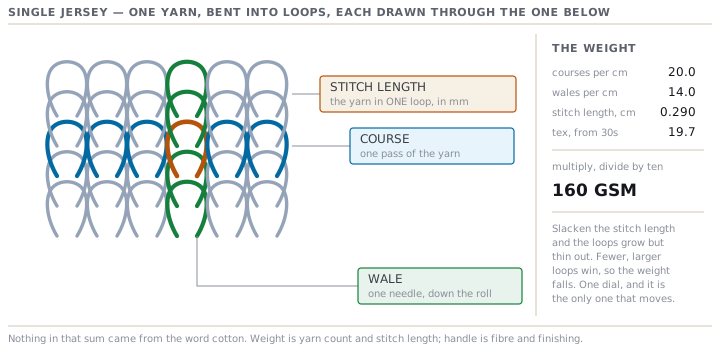
Two words, and you will use both every day.
- A course is a row of loops running across the fabric, the way weft runs across a woven. One course is one pass of the yarn.
- A wale is a column of loops running along the fabric, the way warp runs along a woven. One wale is the track of one needle.
Count them with a magnifier on a cutting table and you have measured the fabric. Our delivered roll counts 20.0 courses per cm and 14.0 wales per cm. That is not decoration; in a moment it becomes the weight.
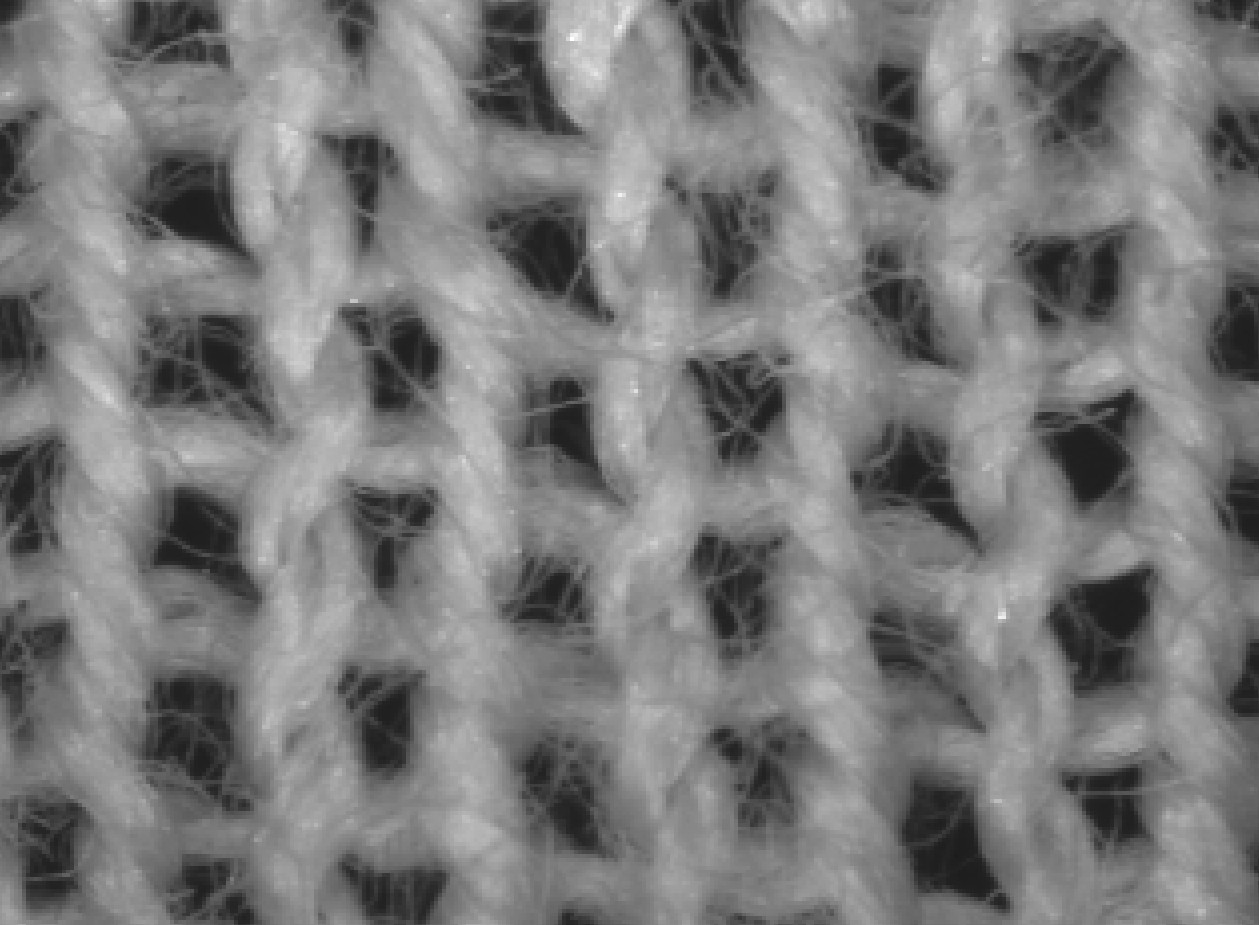
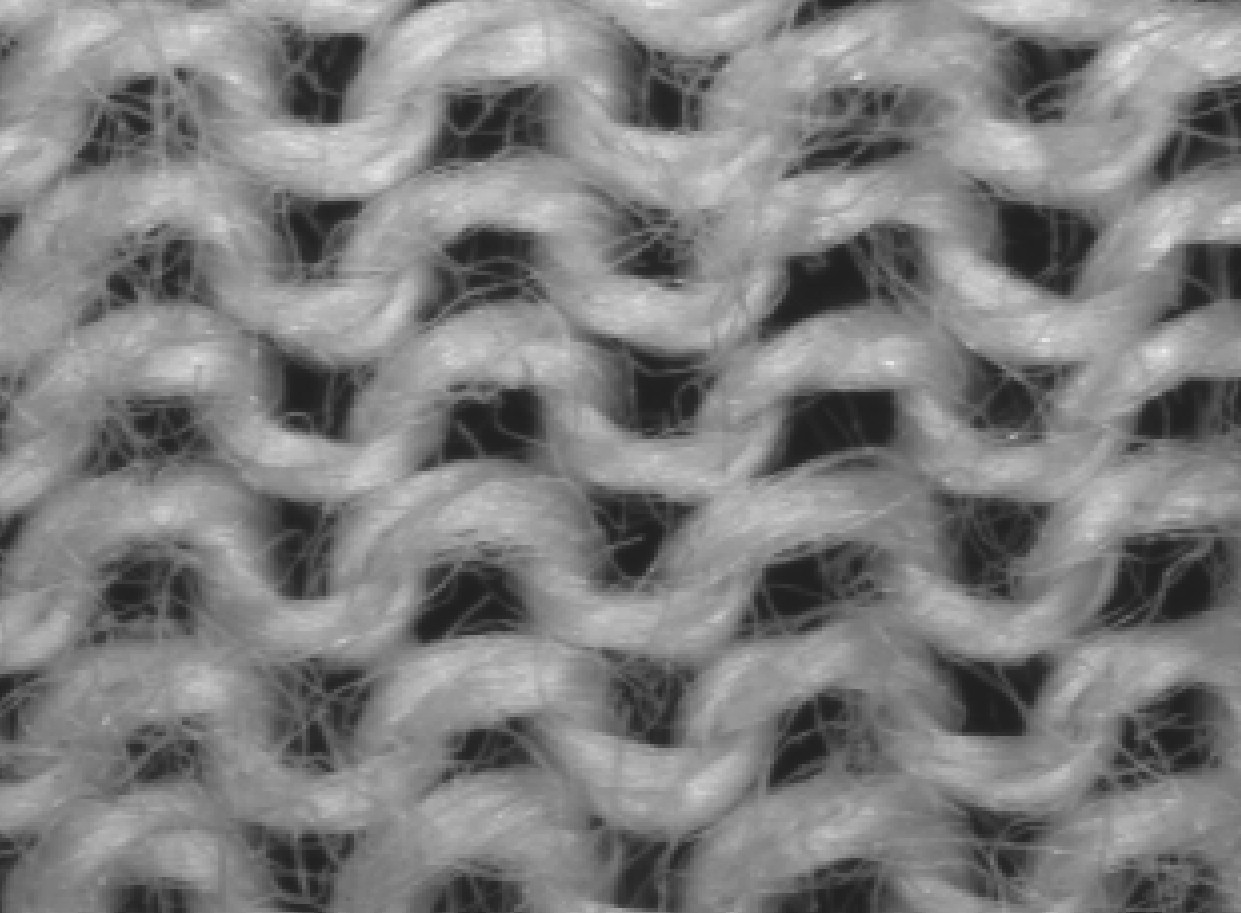
There are two families, and the difference is which direction the yarn travels.
| Weft knit | Warp knit | |
|---|---|---|
| Yarn path | One yarn feeds across, loop by loop, along a course | Many yarns, one per needle, feeding down the length |
| Machine | Circular or flat bed | Tricot or raschel, always flat |
| Runs if a loop breaks | Yes, down a wale | Almost never |
| Stretch | High in width, moderate in length | Moderate, more stable |
| Typical fabrics | Single jersey, interlock, rib, piqué, fleece, French terry | Tricot, mesh, powernet, lace, raschel |
| Bought as | Tubular or open-width rolls, by the kilo | Open-width rolls, by the kilo or the metre |
Almost every jersey garment you will ever buy — tees, polos, sweatshirts, leggings, underwear tops — is weft knit. Warp knit is the specialist: it does not ladder, it holds its shape, and it is what a swim short lining, a sports mesh panel, a bra powernet or a lace trim is made of. If a spec says tricot or raschel, you are not buying from a circular knitter and you should not send it to one.
The machine sets the limits
A circular knitter's machine is described by three numbers, and only one of them is adjustable.
Gauge is needles per inch on the cylinder. 24 gauge means 24 needles in every inch of the circumference. Higher gauge means finer needles, thinner yarn, a smaller loop and a smoother, lighter fabric. It is fixed for the life of the machine: nobody changes the gauge of a running cylinder, they move the order to a different machine.
Cylinder diameter is the width of the machine in inches — commonly 30, 34 or 38 inches on jersey machines. It sets how wide the tube comes out.
Needle count falls out of the other two. The cylinder is 30 inches across, so its circumference is 30 × 3.1416, which is 94.2 inches. At 24 needles to the inch that is 2,262 needles. The machine on the floor is built with 2,256, because needle counts are rounded to what the cylinder's grooves allow, not to the arithmetic. That count is the number of wales the fabric will have, forever. Every wale in that roll is one needle's output. When a merchandiser is told "the fabric has a needle line", this is why: one damaged needle, one ruined column, running the whole length of the roll.
Feeders are how many places round the cylinder the yarn is fed in. This machine has 96. One revolution lays 96 courses. At 25 revolutions a minute it lays 2,400 courses a minute, which at 20.0 courses per cm is 1.2 metres of tube every minute. That is why knitting is never the bottleneck in a critical path and dyeing always is.
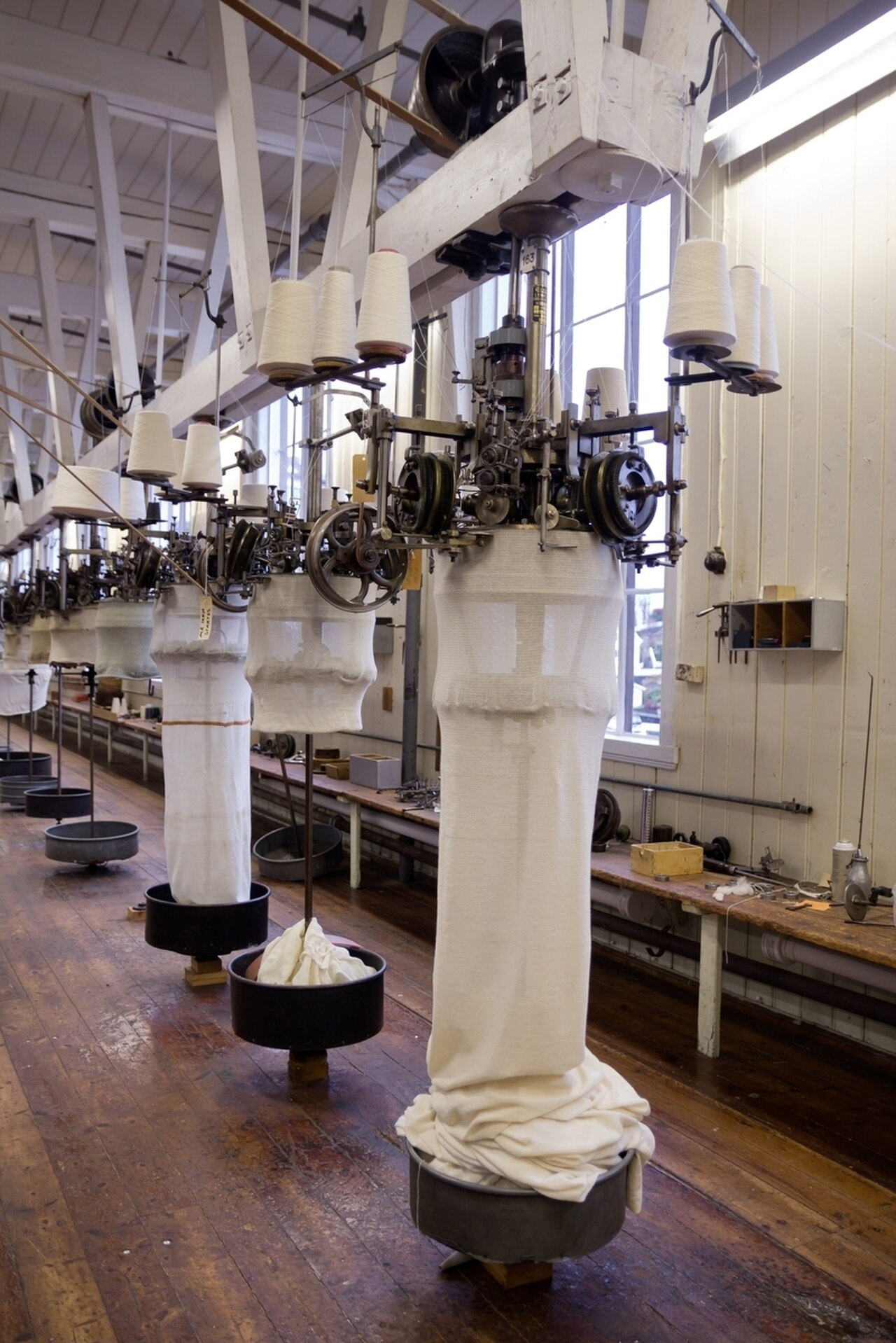
Stitch length is the only setting the knitter can change while the machine runs, and it is the one nobody wrote down.
Where the weight comes from
Stitch length — also called loop length — is the length of yarn pulled into one loop, measured in millimetres. The knitter sets it on the take-down and the yarn feed. On our fabric it is 2.90 mm, which is 0.290 cm.
Now the arithmetic that a merchandiser should be able to do on the back of the tech pack. Fabric weight is written as GSM — grams per square metre. It is loops per square metre, times yarn per loop, times weight per length of yarn. In the units the trade actually uses:
GSM = courses per cm × wales per cm × stitch length in cm × tex ÷ 10
Tex is grams per 1,000 metres of yarn, and you get it from the cotton count by dividing 590.5 by the count. A 30/1 yarn is 590.5 ÷ 30, which is 19.7 tex.
So for the delivered roll: 20.0 × 14.0 × 0.290 × 19.7 ÷ 10 = 160. The fabric is exactly on spec, and nothing about that result came from the word "cotton".
The dial that costs ten grams
Here is the part that decides the order. When the knitter slackens the stitch length, each loop takes more yarn — but the loops also get bigger, so there are fewer of them in a square metre. Fewer, larger loops win: the weight falls roughly in inverse proportion to the stitch length.
| Stitch length | Courses per cm | Wales per cm | Finished GSM |
|---|---|---|---|
| 2.75 mm | 21.1 | 14.8 | 169 |
| 2.90 mm | 20.0 | 14.0 | 160 |
| 3.05 mm | 19.0 | 13.3 | 152 |
| 3.20 mm | 18.1 | 12.7 | 145 |
Read the range. A tenth of a millimetre on one dial is worth about six grams per square metre. The buyer's tolerance is 160 GSM ±5%, which is 152 to 168. The 2.75 mm run is out of tolerance at the top. The 3.05 mm run sits exactly on the floor of it, and the 3.20 mm run is a rejection.
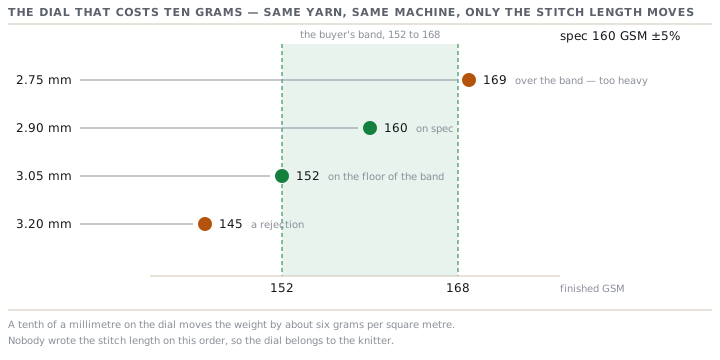
Nobody on this order specified 2.90 mm. A knitter with a busy machine and a per-kilo price has a quiet reason to run slack: slack knits faster, uses less yarn per metre and puts less strain on the needles. A knitter being paid per kilo by a customer who buys by the kilo has the opposite incentive. Either way, somebody who is not you is making the decision, on a dial, at 07:20. The first anyone finds out is when the rolls are weighed.
What the fibre does not decide
One more comparison, because merchandisers habitually reach for the fibre when a fabric feels wrong.
Change the yarn from 30/1 to 26/1 and leave everything else alone. Tex becomes 590.5 ÷ 26, which is 22.7, and the same loops now weigh 20.0 × 14.0 × 0.290 × 22.7 ÷ 10 = 184 GSM. A coarser yarn made the fabric heavier. Change from carded to combed cotton and the weight does not move at all. Combing removes short fibres and neps, which buys you a smoother surface, fewer slubs and better pilling behaviour. It costs about USD 0.35 more per kilo of yarn. It does not change a single loop.
Weight comes from yarn count and stitch length. Handle comes from fibre and finishing. They are different conversations and they are settled with different people.
Check yourselfA roll counts 18 wales and 26 courses per cm, knitted from 40/1 yarn at a stitch length of 2.60 mm. What does it weigh, and is that plausible for a single jersey tee?Show the answer
Tex is 590.5 divided by 40, which is 14.8. The weight is 26 × 18 × 0.260 × 14.8 divided by 10, which is 180 GSM. Plausible, but note what produced it: a fine yarn and a very tight, short loop. That is a dense, firm, expensive jersey — the kind used for a structured polo or a high-count pique — not a soft basic tee. Two fabrics can weigh the same and behave nothing alike, which is exactly why a GSM alone is never a specification.
Check yourselfYour knitter says he can only hold 160 GSM if he moves the order from a 24 gauge machine to a 28 gauge one. What is he really telling you?Show the answer
That the loop he needs is smaller than the one his 24 gauge needles can form comfortably with this yarn. Gauge, yarn count and stitch length have to sit in a workable range together: too fine a yarn on a coarse gauge makes a slack, holey fabric, and too coarse a yarn on a fine gauge breaks needles. Moving the machine is a legitimate answer, but it is a different machine with a different needle count and a different tube width. So ask what the finished open width becomes before you agree, because your marker was built on 180 cm.
Prompt · Close every open decision in a knit fabric line
Before a knit fabric line on a tech pack is sent to a knitter, when it reads like a specification but has not yet been checked for what it leaves to somebody else.
Act as a senior knitted-fabric technologist. Here is the fabric line as it currently stands on my tech pack: [PASTE THE LINE EXACTLY AS WRITTEN]. The garment is [GARMENT], style [STYLE], order quantity [QTY] pcs, buyer [BUYER], and the intended selling price is FOB [PRICE]. The knitter is [KNITTER] and has quoted [PRICE] per kilo. Do the following. First, take my line apart token by token and tell me for each token exactly what it commits the knitter to. Second — the part I actually need — list every decision this line leaves OPEN, and for each one say who will make it if I do not, which way their commercial interest points, and what it will cost me when it goes the wrong way. Cover at minimum: stitch length or loop length, the state and method the GSM is measured in, yarn type and spinning system, twist level and direction, finished usable width as opposed to nominal width, tubular versus open width, residual shrinkage with its test method and number of washes, spirality with its test method, pilling and colour fastness. Third, rewrite the line as a complete specification I can put on a purchase order, with a number and a tolerance against every item, and mark any number you had to assume rather than derive from what I gave you. Do not invent a tolerance the buyer has not stated — where I have not given you one, say so and tell me who to ask.
AI can make mistakes — check anything you act on.