Lessons · Lesson 1 of 3
The collar that bubbled
Fuse an interlining to a specification you can defend, and read a peel-bond result before the wash test does it for you.
Lesson 1 of 3 · 35 min
The situation
Inside a shirt's collar and cuffs sits a second, hidden layer, glued on to give body. It is among the cheapest parts of the garment and the easiest to get wrong. The machine that melts the glue cannot report the temperature that matters. A bond can then feel perfect while dry, and let go in the first wash. This lesson covers the settings that must land together, and a bench test that answers today.
14 March, 08:20, a shirt factory in Sadat City. PO NB-4471 for the German retailer Nordbeck: 12,600 men's oxford shirts, style OS-220, FOB USD 7.90, order value USD 99,540. On board 4 April.
The wash-test report has come back from the buyer's nominated laboratory. Twenty shirts, three domestic washes at 40 degrees Celsius, tumble dried. Six of the twenty collars have come out of the drum with a rippled, blistered face — the shell fabric lifted away from the interlining in patches the size of a thumbnail. The trade calls it bubbling. Nordbeck's report calls it delamination and holds the shipment.
By the time that email arrives, 9,200 collars have been fused and 3,400 shirts are fully assembled.
Nobody has changed the fabric. Nobody has changed the interlining. The purchase order for the interlining reads USD 1.35 per metre, and each shirt uses about 0.09 metres across collar, band, cuffs and placket. That is USD 0.12 of interlining inside a USD 7.90 shirt, one and a half percent of the selling price. That is the component that has just stopped the order.
What an interlining actually is
Two things laminated together, and you must specify both.
The base cloth carries the handle. A woven base has warp and weft, so it behaves like fabric: it has a grain, it must be cut on grain, and it gives the crispest, most tailored collar. A non-woven base is a web of fibres bonded chemically or thermally — cheap, dimensionally stable, no grain to respect, and it feels like paper if you buy it badly. A weft-insert base is a knitted or bonded structure with straight yarns laid in across the width. It drapes like a knit lengthwise and holds like a woven crosswise, which is why it is the default under a soft jacket front.
The resin does the sticking, and it is printed onto the base as dots. Powder dot is scattered and sintered. Paste dot is printed through a screen. Double dot puts a low-melt layer on top of a barrier layer, so the adhesive that grips the shell cannot travel back through the base into the press belt. Dot density is quoted as a mesh — CP 52, CP 17 — and a finer mesh with a lighter coat gives a softer, more washable bond than a coarse mesh with a heavy one.
| Type | Base construction | Typical weight | Where it belongs | Indicative price per metre |
|---|---|---|---|---|
| Woven fusible | Cotton or poly-cotton plain weave | 60 to 110 grams per square metre | Shirt collar, band, cuff, placket | USD 1.10 to 1.80 |
| Non-woven fusible | Bonded fibre web | 25 to 80 grams per square metre | Waistbands, facings, patch pockets, hems | USD 0.35 to 0.90 |
| Weft insert | Knit or bonded base with inserted weft | 45 to 95 grams per square metre | Soft jacket fronts, coat panels | USD 1.40 to 2.60 |
| Sewn-in canvas | Woven hair canvas, horsehair or goat | 180 to 320 grams per square metre | Tailored jacket chest and lapel | USD 4.50 to 14.00 |
Fusible is faster, cheaper and repeatable. Sewn-in is what a canvassed jacket has instead, because a fused chest piece cannot be moulded and will not recover its shape after a season on a hanger. The choice is a garment decision, not a procurement one, and it is made in the tech pack, not in the store room.
The fusing triangle
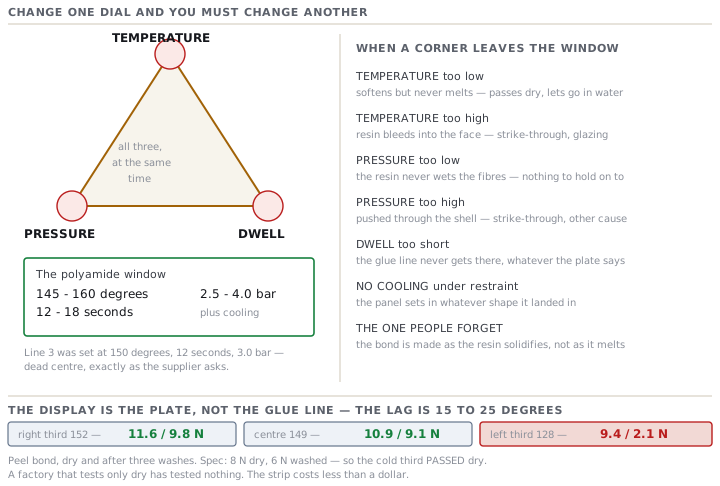
A fuse is three variables and one that everybody forgets.
- Temperature — the resin must reach its melt window at the glue line, not on the machine's display.
- Pressure — enough to push molten resin into the shell's surface fibres, not so much that it goes through.
- Time — the dwell the sandwich spends under that heat and pressure.
- Cooling under restraint — the bond is made as the resin solidifies. A panel pulled hot off the belt and thrown into a bin sets in whatever shape it landed in.
Change one and you must change another. Lower the temperature and lengthen the dwell. Raise the pressure and you can often drop the temperature a little, until you start pushing resin through the face.
| Resin | Fusing temperature | Dwell | Pressure | Survives washing | Survives dry cleaning |
|---|---|---|---|---|---|
| Polyamide, PA | 145 to 160 degrees | 12 to 18 seconds | 2.5 to 4.0 bar | Good | Poor |
| Co-polyester, PES | 160 to 175 degrees | 15 to 20 seconds | 3.0 to 4.5 bar | Good | Good |
| Low-density polyethylene | 120 to 140 degrees | 10 to 15 seconds | 2.0 to 3.0 bar | Fair | Poor |
| EVA | 110 to 130 degrees | 8 to 12 seconds | 1.5 to 2.5 bar | Poor | Poor |
Read the last two columns before the first three. A polyamide resin on a shirt that will be washed twice a week is right; the same resin on a wool jacket that goes to a dry cleaner will let go in the solvent. Nobody discovers that in a factory. They discover it in a shop, eleven months later, one garment at a time.
Working the failure
The machine on line 3 was set to 150 degrees, 12 seconds, 3.0 bar — dead centre of the polyamide window. That is exactly what the interlining supplier's technical sheet asks for, and exactly what the QC sheet had been recording all week.
The QC sheet was recording the display. A thermochromic strip — a paper strip that changes colour at a known temperature — was run through the belt at three positions across the width. It read 152, 149 and 128 degrees. One heater bank on the left third of the belt had failed. Collar panels cut from the left of the lay went through 22 degrees cold, the resin softened without ever fully melting, and the bond that resulted looked perfect while it was dry.
The test that would have caught it: peel bond
The peel-bond test is the one number that predicts a wash failure, and it takes four minutes.
Cut a strip 25 millimetres wide and 150 millimetres long from a fused panel, on the same grain the garment uses. Separate the shell from the interlining by about 25 millimetres at one end. Clamp the two tails in a tensile tester, jaws travelling at 100 millimetres per minute, and record the average force through the steady plateau, in newtons per 25 millimetre strip. Then repeat the whole thing on a strip that has been through the buyer's wash cycle.
Nordbeck's specification for OS-220 is straightforward: not less than 8 newtons per 25 millimetre strip dry, and not less than 6 newtons after three washes.
Here is what the retained coupons from the 14 March lot gave when the factory finally ran them.
| Belt position | Strip temperature reached | Dry peel bond | Peel bond after three washes | Verdict |
|---|---|---|---|---|
| Right third | 152 degrees | 11.6 newtons | 9.8 newtons | Pass |
| Centre | 149 degrees | 10.9 newtons | 9.1 newtons | Pass |
| Left third | 128 degrees | 9.4 newtons | 2.1 newtons | Fail |
Read the bottom row across. Dry, it passed. A partially melted resin makes a bond that holds a panel together perfectly well on a cutting table and in a sewing room, and gives up the moment water and mechanical action get into the glue line. That is precisely why the specification has a second column, and why a factory that only tests dry has not tested anything.
The second cause nobody looks for: differential shrinkage
Even a perfect fuse bubbles if the two layers move by different amounts.
The oxford shell on OS-220 shrinks 2.0 percent in length over three washes. The interlining, pre-shrunk by its maker, moves 0.5 percent. The collar band is 41 centimetres long.
- Shell: 41 centimetres at 2.0 percent equals 8.2 millimetres of shrinkage.
- Interlining: 41 centimetres at 0.5 percent equals 2.1 millimetres.
- Difference: 6.1 millimetres of shell fabric with nowhere to go.
Bonded at every dot, that surplus cannot lie flat. It buckles between the dots, and the eye reads the buckling as bubbling even where the adhesive is still holding. The fix is not a hotter press. It is either a pre-shrunk shell, an interlining matched to the shell's residual shrinkage, or a collar pattern cut with the difference built in. That is decided at the sample stage, from a wash test on the fused composite rather than on the two fabrics separately.
What it cost
The 9,200 fused-but-unassembled collars could be re-cut. The 3,400 assembled shirts could not: the collar is set, topstitched and joined to the yoke, so the panels come out as scrap.
| Line | Working | Cost |
|---|---|---|
| Shell fabric for 3,400 collar, band and cuff sets | 0.26 metres at USD 3.20 per metre | USD 2,822 |
| Interlining for the same sets | 0.09 metres at USD 1.35 per metre | USD 408 |
| Re-cut, re-fuse and re-make labour | USD 1.10 per shirt | USD 3,740 |
| Total rework | USD 6,970 |
Set that against the number this lesson opened with. The entire interlining bill for all 12,600 shirts is USD 1,512. A component worth one and a half percent of the order value produced USD 6,970 of rework. And that is before anybody counted the eleven days lost, the air-freight conversation, or the fact that Nordbeck now wash-tests every subsequent shipment at the supplier's expense.
Prompt · Audit a fusing specification before the wash test does
Before bulk fusing starts on a new style, or the morning a collar, cuff or waistband comes back bubbled.
Act as a senior garment technologist specialising in fusible interlinings. Style facts: buyer [BUYER], PO [NUMBER], style [STYLE], garment type [TYPE], order quantity [QTY] pcs, FOB [PRICE]. Shell fabric: composition [COMPOSITION], weight [GSM] grams per square metre, construction [WEAVE OR KNIT], finish [FINISH], residual shrinkage after the buyer's wash cycle [PERCENT] length and [PERCENT] width. Interlining: supplier [SUPPLIER], article [ARTICLE], base [WOVEN / NON-WOVEN / WEFT INSERT], weight [GSM], resin [PA / PES / PE / EVA], coating [POWDER DOT / PASTE DOT / DOUBLE DOT], mesh [MESH], residual shrinkage [PERCENT]. Fusing press: [MAKE AND MODEL], set temperature [C], dwell [SECONDS], pressure [BAR]. Care label instruction: [WASH OR DRY CLEAN, TEMPERATURE]. Buyer's peel-bond requirement: [N PER 25 MM DRY] dry and [N PER 25 MM AFTER WASH] after [NUMBER] washes. Do the following. First, say whether the resin chemistry is right for the care instruction, and if not, name what it will fail and when. Second, check the set parameters against the resin's melt window and tell me what glue-line temperature I should expect inside the sandwich, not at the plate. Third, list every measurement I must take to prove the fuse, the equipment each needs, and how often. Fourth, calculate the differential shrinkage between shell and interlining over the longest fused panel, which is [LENGTH] cm, in millimetres, and say whether that alone will bubble the panel. Fifth, give me the three most likely causes if the dry peel bond passes and the washed peel bond fails, in the order I should check them. Do not tell me to raise the temperature without saying what strike-through risk that creates on this shade and this fabric weight.
AI can make mistakes — check anything you act on.
Check yourselfA fused collar passes the dry peel-bond test at 9.4 newtons against a specification of 8, and fails at 2.1 newtons after three washes. What does that pattern tell you, and what does it rule out?Show the answer
It tells you the resin never fully melted. A partial melt makes a mechanical grip that is adequate dry and has almost no water and abrasion resistance, so the dry figure looks healthy and the washed figure collapses. It rules out the interlining being the wrong article — a wrong resin chemistry or too light a coat weight would usually be visible dry as well. Go to the machine, not to the supplier: check the actual glue-line temperature with a strip across the full belt width, then the dwell, then the pressure, in that order. And note that the dry result on its own would have passed the lot, which is the whole argument for testing a washed coupon too.
Check yourselfYour shell shrinks 2.0 percent and your interlining shrinks 0.5 percent. Would raising the fusing temperature help?Show the answer
No, and it would probably make things worse. Differential shrinkage bubbles a collar even when the adhesion is perfect, because the surplus shell fabric has to go somewhere and it goes into ripples between the dots. More heat only risks strike-through and a harder handle. The remedies are all upstream: pre-shrink the shell, source an interlining whose residual shrinkage is matched to it, or build the difference into the collar pattern. And test the fused composite in the wash, not the two components separately — the composite is the thing the customer buys.