Lessons · Lesson 2 of 3
Thread: eight hundred dollars holding a hundred thousand together
Read a ticket number, choose a construction, calculate thread consumption for a real garment, and understand why shade is approved on its own.
Lesson 2 of 3 · 34 min
The situation
Sewing thread is the cheapest item on a garment's bill of materials. It is also the only one present in every single seam. This lesson starts with how thread is measured and labelled, and what it is made of. It then works out how much a garment actually swallows, operation by operation. The last part explains why running out halfway through an order is not a stock problem but a colour problem.
26 March, the thread store at the same factory, and the same order: PO NB-4471, 12,600 oxford shirts for Nordbeck, FOB USD 7.90.
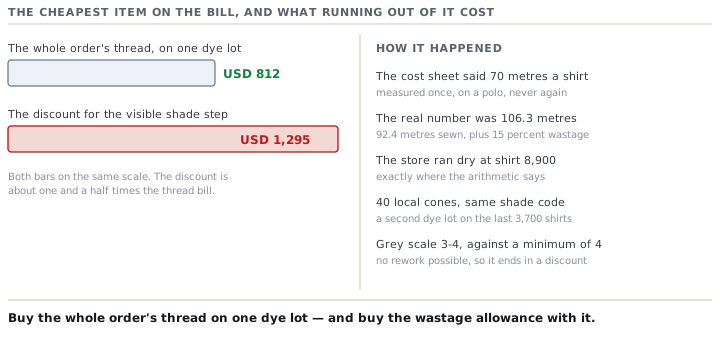
The store has run out of white ticket 120 at shirt number 8,900. The merchandiser buys 40 cones locally the same afternoon — same brand, same ticket, same shade code — and the line does not stop for an hour. Nobody logs it.
Eleven days later Nordbeck's inline inspector puts two shirts side by side on a windowsill and asks why the topstitching on the plackets is a different white. It is a different dye lot. On the cone the two look identical. On a placket, in daylight, against a white oxford, they do not.
The thread for this entire order cost USD 812. The discount that settled the argument cost USD 1,295.
Ticket, Tex and Nm — one number in three dialects
Every thread you will ever buy is described by its linear density, and the trade uses three systems that all mean the same thing.
Tex is a direct system: grams per 1,000 metres. Bigger Tex, thicker thread. Nm, the metric count, is indirect: metres per gram, so bigger Nm means finer. A thread is usually spun as singles and twisted in plies, which is why a spec reads Nm 120/3 — three plies of Nm 120 singles, giving a resultant count of Nm 40.
Ticket number is the commercial label on the cone, and it is defined from the resultant count:
Resultant Nm = singles Nm / number of plies
Ticket        = 3 x resultant Nm
Tex           = 1000 / resultant Nm
Therefore Ticket = 3000 / Tex| Ticket | Resultant Nm | Tex | Typical needle | What it sews |
|---|---|---|---|---|
| 180 | 60 | 16.7 | Nm 65 to 70 | Fine silk, lightweight linings, blouse topstitch |
| 120 | 40 | 25.0 | Nm 70 to 80 | Shirting, blouses, light jersey — the general workhorse |
| 80 | 26.7 | 37.5 | Nm 90 to 100 | Trousers, jackets, medium wovens |
| 60 | 20 | 50.0 | Nm 100 to 110 | Denim seams, workwear, heavy topstitch |
| 40 | 13.3 | 75.0 | Nm 120 to 130 | Outerwear, upholstery-weight seams |
| 30 | 10 | 100.0 | Nm 130 to 140 | Webbing, bags, heavy decorative topstitch |
Two cautions before you quote any of this back to a supplier. Branded ticket numbers are nominal, not arithmetic: a mill's ticket 120 in one range and ticket 120 in another can differ by several Tex, so a like-for-like substitution is checked against Tex, never against the ticket printed on the label. And a ticket number says nothing at all about what the thread is made of.
Construction: what the thread is, not how thick it is
| Construction | What it is | Tensile at Tex 25 | Strengths | Where it belongs |
|---|---|---|---|---|
| Spun polyester | Staple polyester fibres spun and plied | 12.5 newtons | Cheap, soft, hides stitches, sews forgivingly | General shirting, blouses, most lockstitch seams |
| Core spun | Continuous filament core wrapped in staple | 16.0 newtons | Highest seam strength, best at high speed, low needle heat | Denim, workwear, stretch, any critical seam |
| Textured filament | Bulked continuous polyester filament | 9.0 newtons | Soft against skin, excellent coverage | Overlock and coverstitch loopers only, never a needle thread |
| Bonded filament | Continuous filament with a resin bond | 40.0 newtons | Very high strength, abrasion resistant | Bags, webbing, harnesses, footwear |
The one line to memorise from that table is the third. Textured filament belongs in a looper and nowhere else. It has the lowest strength and it will not take the tension a needle thread sees; put it in the needle because it looked soft and the seam will grin open the first time somebody puts the garment on.
The core-spun row earns its price on speed, not on the datasheet. A needle running at 5,000 stitches a minute through a heavy seam reaches a temperature that softens polyester. Spun polyester frays and breaks; a core-spun thread's cotton or polyester wrap takes the friction while the filament core takes the load. If a line is losing minutes to thread breaks, the answer is usually the construction, not the operator.
Seam strength, computed
A seam is not as strong as its thread. It is as strong as its thread multiplied by how much thread is in it, and the working estimate the trade uses for a lockstitch is:
Seam strength per cm = stitch density per cm x thread breaking strength x 1.5Nordbeck require 80 newtons per centimetre on the side seam of OS-220. The oxford breaks at 340 newtons on a grab test, so the fabric is not the limit here.
- Ticket 120 spun polyester, 12.5 newtons, at 5 stitches per centimetre: 5 x 12.5 x 1.5 = 93.8 newtons per centimetre. Passes, with room.
- Ticket 180, 8.5 newtons, at the same 5 stitches per centimetre: 5 x 8.5 x 1.5 = 63.8 newtons per centimetre. Fails.
That is the whole argument against letting a costing exercise drop a ticket to save money. The saving between those two tickets across this order is under USD 90. The failure it produces is a seam that opens in wear, which is a return, not a defect report.
There is a limit in the other direction, and it is the part people miss. A thread much stronger than the fabric does not make a stronger garment — it makes the fabric tear along the stitch line instead of the thread breaking. On a lightweight shell, a seam that fails at the thread is repairable; a seam that fails by ripping the cloth is not.
Consumption: the arithmetic nobody does until they run out
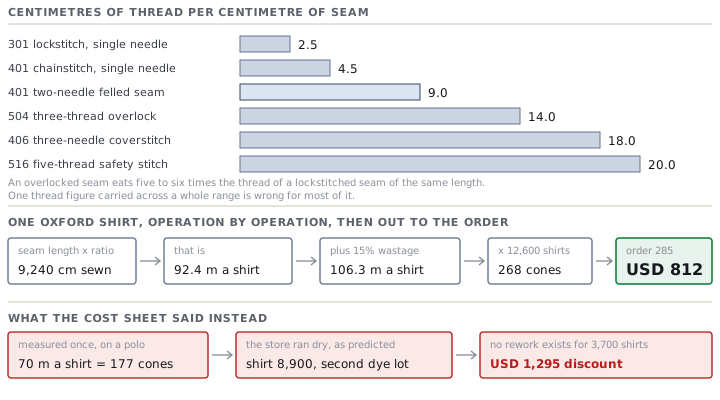
Thread consumption is stitch length multiplied by a consumption ratio that depends only on the stitch type. Every stitch type has one, and they are not close to each other.
| Stitch | Name | Ratio, thread to seam |
|---|---|---|
| 301 | Single-needle lockstitch | 2.5 |
| 401 | Two-thread chainstitch, single needle | 4.5 |
| 401 | Two-needle felled seam, both needles and loopers | 9.0 |
| 504 | Three-thread overlock | 14.0 |
| 516 | Five-thread safety stitch | 20.0 |
| 406 | Three-needle bottom coverstitch | 18.0 |
An overlocked seam eats between five and six times the thread a lockstitched seam of the same length does. That is why a jersey tee and a woven shirt of similar size can differ by a factor of two in thread cost. It is also why a costing sheet that carries one thread figure for a whole range is wrong for most of it.
Here is OS-220, operation by operation.
| Operation | Stitch | Seam length in cm | Ratio | Thread in cm |
|---|---|---|---|---|
| Collar and band | 301 | 260 | 2.5 | 650 |
| Cuffs and sleeve plackets | 301 | 340 | 2.5 | 850 |
| Front placket and hem | 301 | 300 | 2.5 | 750 |
| Yoke and shoulder | 401 two-needle | 190 | 9.0 | 1,710 |
| Armhole, felled | 401 two-needle | 220 | 9.0 | 1,980 |
| Side and sleeve seam, felled | 401 two-needle | 250 | 9.0 | 2,250 |
| Buttonholes, twelve | 304 | 45 each | — | 540 |
| Button sewing, twelve | 301 | 30 each | — | 360 |
| Label and pocket attach | 301 | 60 | 2.5 | 150 |
| Sewn total | 9,240 |
Nine thousand two hundred and forty centimetres is 92.4 metres of thread sewn into the garment. Now add wastage, which is real and which is not a rounding error: thread pulled off at every seam start and end, cone changeovers, tension re-setting, thread breaks, needle re-threading, the tails cut at trimming. Fifteen percent is the normal allowance for a woven shirt on a clean line; a line running badly can reach twenty-five.
- 92.4 metres x 1.15 = 106.3 metres per shirt.
- 12,600 shirts x 106.3 metres = 1,339,380 metres.
- At 5,000 metres per cone that is 268 cones. Order 285 cones to cover the colour split and part-used cones at changeover.
- 285 cones x USD 2.85 = USD 812.25.
- Per shirt: USD 0.06, which is 0.8 percent of the FOB price.
Now go back to the opening. The costing sheet for OS-220 carried 70 metres a shirt, a figure somebody had once measured on a polo and never re-measured. Seventy metres buys 177 cones. The store ran dry at shirt 8,900, exactly as the arithmetic says it would, and the emergency purchase put a second dye lot into the last 3,700 shirts.
Why thread shade is approved on its own
A buyer approves fabric colour, and then approves thread colour separately, and merchandisers new to the job read that as duplication. It is not.
The thread is a different substrate. A polyester thread and a cotton-rich oxford take dye by different chemistry, so the recipe that hits the shade on the cloth will not hit it on the cone. Worse, the pair can be metameric — a genuine match under one light source and a visible mismatch under another. A thread approved in a factory lit by daylight-simulating D65 can be plainly wrong under the TL84 fluorescents of a European store, which is the light the customer actually buys under. So the submission names its illuminants, and it is judged under all of them.
Three working rules:
- Match the thread to the bulk fabric, not to the Pantone reference and not to the lab-dip swatch. The bulk is what the customer sees.
- For a seam thread that will sit inside the seam, choose one shade darker than the fabric. Thread reads lighter when sewn, because light catches the twist.
- Topstitch thread is its own approval, with its own submission and its own shade band, because it is exposed and because it is often a deliberate contrast.
Allow 10 to 14 days for a thread shade approval and put it on the critical path next to the fabric approval. A factory that has approved fabric and no approved thread cannot start bulk sewing, and that is a delay nobody puts in the calendar because the thread is the cheapest thing in the bill of materials.
Prompt · Calculate thread for the whole order, and buy it once
At costing, and again the day the purchase order for thread is raised — before a re-order can put a second dye lot into the same garment.
Act as a senior industrial engineer in a garment factory. I need a thread consumption and purchase plan for one style. Style facts: buyer [BUYER], PO [NUMBER], style [STYLE], garment [DESCRIPTION], order quantity [QTY] pcs, colour split [PASTE], FOB [PRICE]. Here is the operation bulletin, one line per operation, with the stitch type, the machine and the seam length in centimetres: [PASTE THE BULLETIN]. Thread specification: needle thread [CONSTRUCTION AND TICKET], looper thread [CONSTRUCTION AND TICKET], topstitch thread [CONSTRUCTION AND TICKET]. Cone length [METRES] metres, price [PRICE] per cone. Historic wastage on this line, if known: [PERCENT]. Do the following. First, apply the standard consumption ratio for each stitch type, show the ratio you used per line, and total the sewn thread per garment in metres, split by needle, looper and topstitch. Second, add a wastage allowance, state the percentage you applied and why, and give the finished consumption per garment. Third, convert to cones per colour, rounding up per colour rather than across the order, and give the total purchase value. Fourth, tell me the seam strength I should expect on the critical seam at the specified ticket and stitch density, and whether it meets [REQUIREMENT]. Fifth, tell me exactly which garment areas would show a dye-lot step if I ran short and re-ordered mid-production, and what I should buy today so that cannot happen. Show every calculation. If any operation in the bulletin has no stitch type, list it and refuse to estimate it rather than guessing.
AI can make mistakes — check anything you act on.
Check yourselfA costing sheet carries 70 metres of thread for a shirt whose sewn seams measure 92.4 metres. What is the real number, and what does the gap actually cost?Show the answer
The real number is the sewn length plus wastage — 92.4 metres times 1.15 is 106.3 metres, so the sheet is short by roughly a third. The direct cost of the error is trivial: the difference is about USD 0.02 a shirt. The real cost is that the store runs dry mid-order and the replacement comes from a different dye lot, which on white topstitching is a visible shade step and a discount. On this order the whole thread bill was USD 812 and the settlement was USD 1,295. Under-buying thread is never a thread problem; it is a shade-continuity problem wearing a stock problem's clothes.
Check yourselfA line is losing time to needle-thread breaks on a heavy denim topstitch. The thread is spun polyester, correct ticket, correct needle. What do you change?Show the answer
The construction, not the ticket. At high speed through a thick seam the needle heats enough to soften polyester, and a spun thread frays and snaps at the eye. A core-spun thread of the same Tex puts a staple wrap around a filament core: the wrap takes the friction and heat, the core takes the load, and breaks fall away. Check the needle for a burr and the thread path for a rough guide at the same time, but if those are clean the answer is core spun. Never solve it by dropping to a thinner ticket to reduce friction — that trades a stopped machine for a weak seam, which is the one you find out about after shipping.