Lessons · Lesson 3 of 3
The four-cent button that nearly took the order
Specify, test and control the trims — buttons, zips, elastics, labels, cords and snaps — that carry almost none of the cost and all of the risk.
Lesson 3 of 3 · 33 min
The situation
Buttons, zips, elastic, labels, tags and the polybag come to a few cents between them. Nobody argues about those lines on a bill of materials. They are also the lines most likely to stop a shipment. Each is a physical object that can pull off, snap, corrode or say something the law does not allow. This lesson takes each family in turn, and shows which test finds the failure before a customer does.
8 August, 11:40, a childrenswear unit in Tenth of Ramadan City. PO HF-9033 for the UK retailer Halloway and Finch: 9,800 girls' jersey dresses, ages 2 to 6, style GD-114, FOB USD 5.95, order value USD 58,310. Packed, cartoned, booked on a vessel in four days.
The third-party safety report lands instead. Twenty dresses, five from each size, tested for attached-component strength. Halloway and Finch require every attached component on a children's garment to survive 70 newtons held for 10 seconds. That is above the 50 newtons that the toy-safety baseline applies to parts on articles for under-threes. A dress is worn, pulled and chewed for hours a day rather than held for minutes.
Two of the twenty buttons came away. One at 48 newtons. One at 61 newtons.
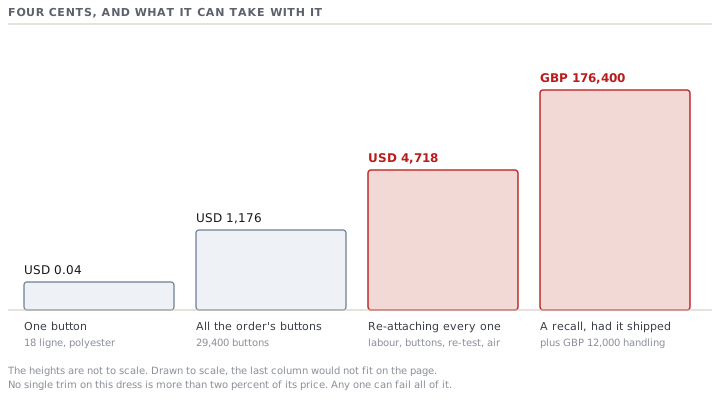
The button is a four-hole polyester 18 ligne, three to a dress on the back opening. It costs USD 0.04. The three of them together are USD 0.12, which is 2.0 percent of the price of the dress.
Why it failed, in arithmetic
The tech pack specifies 16 stitches of ticket 60 core-spun thread with a lock at the end. The floor sewed 8 stitches of ticket 120 spun polyester, because that is what was already threaded for the rest of the dress and because nobody had written the button-attach thread on the operation bulletin.
A working estimate for button-attachment strength is the number of stitches multiplied by the thread's breaking strength, times a factor of about 0.6 for the angle of pull and the wear at the hole edge.
- Specified: 16 stitches x 32 newtons x 0.6 = 307 newtons.
- Sewn: 8 stitches x 12.5 newtons x 0.6 = 60 newtons.
Sixty newtons is not a defect that appears in one dress in a hundred. It is a lot whose attachment strength is centred just below the requirement, so a random sample of twenty finds two failures and would have found more at twenty-five. Halloway and Finch did not reject two dresses. They rejected the specification.
What a four-cent button cost
The dresses could not ship. Every button on every dress had to come off and go back on to specification.
| Line | Working | Cost |
|---|---|---|
| Remove 29,400 buttons | 15 seconds each, 122.5 hours at USD 2.10 | USD 257 |
| Re-sew to specification | 22 seconds each, 179.7 hours at USD 2.10 | USD 377 |
| Replacement buttons, the removed ones being damaged | 29,400 at USD 0.04 | USD 1,176 |
| Third-party re-test, twenty pieces | USD 640 | |
| Air freight on 3,000 pieces to hold the launch date | 540 kilograms at USD 4.20 | USD 2,268 |
| Total | USD 4,718 |
The buttons for the whole order cost USD 1,176. Getting them attached properly the second time cost four times that, and the order still went out late.
And that is the good outcome, because it was caught. Halloway and Finch's safety clause charges a supplier the retail value of recalled stock plus a handling fee. At a GBP 18 retail price, 9,800 dresses is GBP 176,400 of stock, plus roughly GBP 12,000 of handling — for a component that costs four cents and is not, on any cost sheet anywhere, considered a risk.
Hold both numbers in your head for the rest of this lesson. No single trim on this dress is more than two percent of its price. Any one of them can fail one hundred percent of it.
The trim bill, itemised
| Trim | Specification | Cost per dress |
|---|---|---|
| Buttons, three | Four-hole polyester, 18 ligne | USD 0.12 |
| Sewing and overlock thread | Ticket 120 spun in needles, textured filament in loopers | USD 0.09 |
| Waistband elastic | Knitted, 25 millimetres, 0.62 metres | USD 0.08 |
| Main label | Woven damask, folded, soft edge | USD 0.02 |
| Care and content label | Printed satin, four languages | USD 0.015 |
| Size label | Printed, heat-cut and folded | USD 0.008 |
| Swing tag, pin and barcode | USD 0.043 | |
| Polybag, sticker and desiccant | USD 0.036 | |
| Total trims | USD 0.412 |
That is 6.9 percent of the FOB price, spread across eight items, none of which individually looks worth an argument. It is exactly this shape — many small numbers — that makes trims the least reviewed and most frequently failing part of a bill of materials.
Zips
Three constructions, and they are not interchangeable.
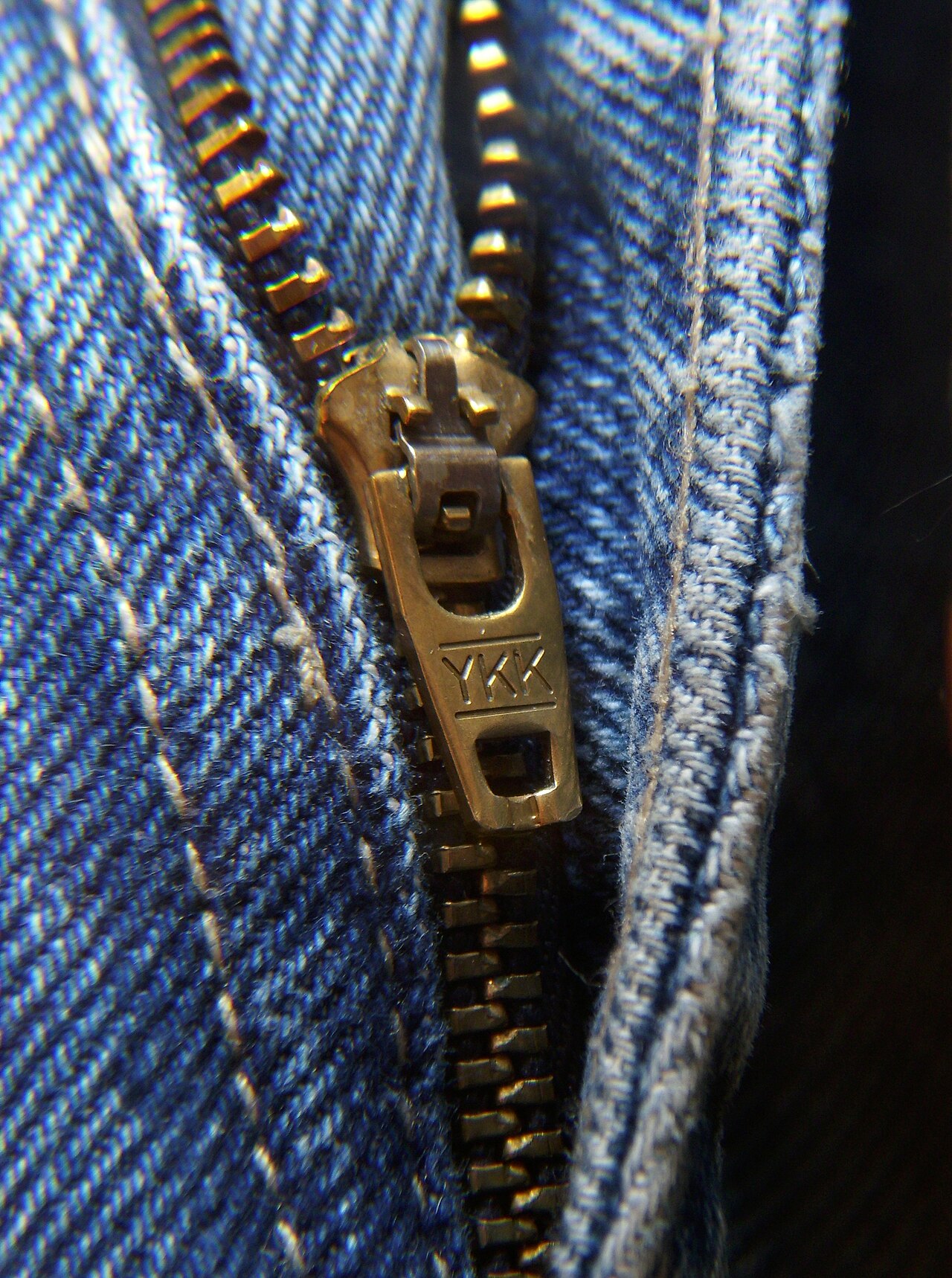
Coil is a nylon monofilament wound into a spiral and sewn to the tape. It is light, flexible, cheap and — the property that matters — self-healing: strain the chain sideways and the coils usually re-mesh. It is the default in dresses, light jackets and anything that needs to curve.
Moulded teeth are injection-moulded onto the tape in acetal or polyester. Stronger than coil at the same size, available in any colour, and not self-healing: force it and the tooth is gone. Outerwear, luggage, workwear.
Metal teeth are clamped individually onto the tape in brass, aluminium or a nickel-free alloy. The strongest and the heaviest. Brass tarnishes against sweat, aluminium can leave grey marks on pale fabric, and every metal chain and puller must be tested for nickel release.
| Construction and size | Cross-wise strength | Self-healing | Where it belongs |
|---|---|---|---|
| Nylon coil, size 3 | 250 newtons | Yes | Dresses, skirts, light jackets, cushion covers |
| Nylon coil, size 5 | 350 newtons | Yes | Jackets, bags, curved openings |
| Moulded acetal, size 5 | 400 newtons | No | Outerwear, technical shells |
| Metal brass, size 5 | 450 newtons | No | Denim, workwear, heavy jackets |
Nickel is a legal matter, not a quality one. Prolonged-skin-contact items are held to a release limit of 0.5 micrograms per square centimetre per week under the European method. The certificate a supplier hands you covers the lot they tested, not the supplier, not the article and not the next delivery. A trim supplier who cannot give you a lot number on the certificate has given you a marketing document.
The zip failure that reaches customers is rarely a broken chain. It is a puller whose plating flakes after twenty washes, a slider whose lock will not hold on a garment that is sat in, or a chain that no longer matches the shell after garment dyeing. In that last case the tape took the dye and the teeth did not. All three are found by washing a made-up garment, and by nothing else.
Buttons
| Material | What it is | What fails |
|---|---|---|
| Polyester resin | Cast rod, turned and drilled | Crazes or yellows above the pressing temperature; shade shifts between casting lots |
| Corozo | Turned from the tagua nut | Takes dye unevenly; moves with humidity; each one slightly different, which is the point and also the complaint |
| Metal, zinc alloy or brass | Cast or stamped, then plated | Nickel release; plating flakes; heavy enough to distort a light knit |
| Shell, mother of pearl | Cut from shell | Brittle — breaks under a presser foot, in a laundry, and in a domestic tumble dryer |
Size is quoted in ligne. One ligne is one fortieth of an inch, so a ligne is 0.635 millimetres: an 18 ligne button is 11.43 millimetres across and a 40 ligne button is 25.4 millimetres. Specify ligne and thickness together — two buttons of the same ligne and different thickness sew differently and sit differently in a buttonhole.
Test buttons on the garment, not on the button. The attachment pull test is the one that matters. Next to it sits an impact test — a set number of drops onto a hard surface — for anything brittle, plus an industrial-laundry cycle if the garment will ever see one.
Elastics
Three constructions again, and the difference shows the moment you stretch them.
- Woven elastic keeps its width under tension, is the strongest and the most expensive, and is what a waistband that must survive two years of wear is made of.
- Knitted elastic is softer and cheaper, and narrows under tension. Correct for underwear and childrenswear, where softness against skin wins.
- Braided elastic narrows the most and is for casings and cords, never for an exposed waistband.
The number that decides whether a waistband is still a waistband next spring is permanent set: stretch a measured length to a stated elongation, hold it, release it, and measure how much of the stretch it never gave back.
GD-114 specifies a maximum of 8 percent permanent set after 30 minutes at 100 percent elongation. A later delivery of the same article number, from the same supplier, came in at 14 percent. On a relaxed waistband of 62 centimetres that is a finished waistband of 70.7 centimetres after a few washes — the age-4 dress now measures the age-6 specification, and it sags off the child rather than failing any single test.
Labels, tapes, cords and snaps
Labels are the only trims with a legal function. Fibre composition, care instructions, country of origin and the responsible economic operator for the destination market are not quality attributes — they are conditions of sale. A wrong composition is a customs and market-surveillance problem that a discount does not settle. Beyond the words: a heat-cut label edge scratches, which on a children's neckline produces returns that read as "itchy" and get recorded as a fabric complaint. Fold the edges or specify a soft-cut label, and put the label in the side seam where the design allows it.
Interfacing and stay tapes are the trims that vanish from cost sheets. A fusible straight-grain tape on a shoulder seam, an armhole tape, a bias stay at a neckline. Each is a few cents, and each is in the sample because the sample room knows the garment needs it. Each is missing from the costing because nobody wrote it on the bill of materials. It surfaces in bulk as either a cost claim or a shoulder seam that has grown by a centimetre.
Drawcords are regulated on children's garments. Under the European standard for cords and drawstrings, garments for young children up to age 7 must carry no cords or drawstrings in the hood and neck area at all. For ages 7 to 14, a waist cord must not extend more than 140 millimetres beyond the garment when it is laid flat. Separately, the tipping on the cord end is a small part like any other and gets the same pull test, and a cord lock is both a small part and a choking risk in its own right.
Snaps — prong snaps for jersey, post-and-socket for wovens — fail at the setting, not at the component. The die and the anvil must match the snap, the press pressure must be set for the fabric thickness, and a mis-set die leaves either a loose snap or a sharp burr on the underside. The same 70 newton pull test applies, and any garment with a metal snap goes through metal detection before packing.
Controlling all of it
| Trim | What fails | Test | When |
|---|---|---|---|
| Buttons and snaps | Attachment strength | Pull test on the finished garment | First-off, hourly, and pre-shipment |
| Buttons, brittle materials | Breakage | Impact and laundry cycle | Trim approval, then each lot |
| Zips | Strength, slider lock, plating, shade after wash | Cross-wise strength, wash a made-up garment | Trim approval, then each lot |
| Metal components | Nickel release | Certificate against a named lot | Every lot, never a blanket certificate |
| Elastic | Permanent set, width under tension | Set test at stated elongation | Inward goods, every lot |
| Labels | Wording, composition, edge | Read against the approved artwork and the destination rules | Artwork approval and inward goods |
| Cords | Length and location rules, tip pull-off | Measure on a flat garment; pull the tip | Design stage, then inward goods |
| Interlining and tapes | Peel bond | Peel test dry and after wash | Every fusing lot |
Prompt · Turn a bill of materials into a trim test plan
As soon as the trim card is approved and before the first trim delivery is booked in.
Act as a senior quality manager for a garment exporter, specialising in trims and accessories. Here is the trim section of my bill of materials for one style, with supplier, article number, description and cost per garment: [PASTE THE TRIM BOM]. Garment: [DESCRIPTION], end user [ADULT / CHILD AND AGE RANGE], destination market [MARKET], buyer [BUYER], care instruction [CARE], order quantity [QTY] pcs, FOB [PRICE]. The buyer's testing manual says: [PASTE OR SUMMARISE THE RELEVANT SECTIONS]. Build me a trim test plan as a table with one row per trim and these columns: what can fail, the specific test that finds it, the acceptance limit, whether the test is on the trim or on the finished garment, at which stage it happens (trim approval, inward goods, first-off, in-line, pre-shipment), and who performs it. Then do four more things. First, flag every trim on this list that is a small part or a metal component and say which regulation or buyer rule applies to it for this end user and this market. Second, name any trim whose specification is incomplete — a size without a thickness, a colour without an illuminant, an attachment without a stitch count — and say exactly what is missing. Third, work out each trim's cost as a percentage of FOB and put that column beside the risk, so I can see which of my cheapest lines carries my largest exposure. Fourth, tell me which of these trims must be traceable by lot in my cartons, and why. Do not treat a supplier certificate as a test result unless it names a lot number.
AI can make mistakes — check anything you act on.
Prompt · Cost the response to a failed trim test
The day a pull test, a nickel report or an elastic set result comes back failed on packed or part-packed goods.
Act as a senior garment export merchandiser. A trim test has failed on goods that are packed or nearly packed. Facts: buyer [BUYER], PO [NUMBER], style [STYLE], [QTY] pcs, end user [ADULT / CHILD AND AGE], FOB [PRICE] per piece, order value [VALUE], my cost per piece [COST]. The failed trim is [TRIM], supplier [SUPPLIER], article [ARTICLE], lot [LOT], cost [PRICE] per garment and [NUMBER] per garment. The test and result: [TEST, LIMIT, MEASURED VALUES ON EACH SPECIMEN]. Production status: [QTY] fully packed, [QTY] sewn not packed, [QTY] in cut. Ship date [DATE], port cut-off [DATE], today [DATE]. Rework rates on this operation: removal [SECONDS] per piece, re-application [SECONDS] per piece, loaded labour [RATE] per hour. Replacement trim availability: [LEAD TIME]. Air freight [RATE] per kg, garment weight [KG]. Buyer's safety and chargeback clauses: [PASTE THE EXACT WORDING]. Give me: (1) whether this is a lot problem or a process problem, argued from the spread of the measured values, and therefore whether sorting is defensible at all or whether every piece must be reworked; (2) each option costed in dollars and as a percentage of order margin — rework all, sort and rework the failures, replace the trim entirely, part shipment, ship under concession; (3) whether a concession is even available for this failure given the end user and the market, and if not, say so plainly and stop offering it; (4) the exposure if this shipped and the failure were found in the market, using the buyer's own clause and a stated retail price; (5) the containment I must show the buyer for them to keep the order rather than cancel it. Be blunt about which option you would take and what it rests on.
AI can make mistakes — check anything you act on.
Check yourselfA button pull test on a children's order fails at 48 and 61 newtons against a 70 newton requirement. The buttons themselves are the approved article. Where do you look first, and what does the result tell you about the rest of the lot?Show the answer
Look at the attachment operation, not at the button: the stitch count, the thread ticket and construction, and whether the button-attach thread is written on the operation bulletin at all. Attachment strength is roughly stitches times thread strength times a factor of about 0.6, so eight stitches of ticket 120 spun polyester gives about 60 newtons where sixteen stitches of ticket 60 core-spun gives about 307. As for the rest of the lot: two failures in twenty does not mean eighteen good dresses. It means the lot's attachment strength is centred just below the requirement, so every garment is marginal and the sample simply found the tail. That is why the answer is re-attaching all of them, not sorting.
Check yourselfYour trim supplier sends a nickel-release certificate with the shipment of metal zips. Is the requirement met?Show the answer
Not yet. A certificate is evidence about the lot that was tested, and it is only useful if it names that lot and the lot number matches what is in your cartons. A certificate with a supplier name, an article number and no lot reference proves nothing about the goods in front of you, because the plating bath, the alloy and the process can change between lots on the same article number. Ask for the lot number on the certificate, check it against the delivery, and keep the pair together in the trim file. The same logic applies to every trim that is bought by article number and behaves by lot, which is all of them.