Lessons · Lesson 3 of 3
The batch, the range and the stenter
Why a small colour costs more a kilo than a large one and exactly where the line falls, how one machine sets width, weight and shrinkage at the same time, and what a shade that misses actually costs once the calendar is priced.
Lesson 3 of 3 · 38 min
Four ways to get colour into cloth, and they are not substitutes
Cloth is made colourless and coloured afterwards, in the last building it passes through. That same building fixes its final width, its weight and how much it will shrink. All of that is settled at the very end, once every other cost has already been spent. So a mistake made here is the most expensive kind. This lesson is about the machines in that building, and about what happens when a colour comes out wrong.
Fauzia Qureshi's processing house has two shapes of machine in it. The difference between the two shapes explains most of what a merchandiser finds confusing about dyehouse pricing. Liquor ratio is the weight of water in the machine for every kilo of cloth: 1:6 means six litres to the kilo.
| Class | How the cloth meets the liquor | Liquor ratio | Batch or continuous | What it is for |
|---|---|---|---|---|
| Soft-flow jet | The cloth circulates as a rope, driven along by a jet of liquor | 1:6 | Batch | Knits and light wovens, 200 to 600 kg at a time |
| Jigger | Open-width cloth passes back and forth between two rollers through a shallow trough | 1:2.5 | Batch | Wovens where a crease would be fatal, small lots |
| Beam | Cloth wound on a perforated beam, liquor pumped through it | 1:8 | Batch | Delicate cloth that will not take mechanical action |
| Continuous pad-steam range | Cloth runs through a padder and a steamer without stopping | about 1:1 add-on | Continuous | Long runs of one shade |
A batch machine does the same thing to every kilo it holds, so its cost per kilo is almost flat. A 200 kg batch and a 520 kg batch take about the same hours, so the small one costs more per kilo. But within one machine size the number barely moves. A continuous range has almost no cost per kilo at all, and a large fixed cost every time it is threaded and brought to shade. Those are two different cost shapes, and everything below falls out of the difference between them.
One jet batch, costed
| Line | Basis | Cost, USD |
|---|---|---|
| Water and effluent | 1:6 on 520 kg is 3,120 L a fill, nine fills, at USD 0.00142 a litre | 39.87 |
| Steam | 2.9 kg a kilo of cloth at USD 0.0184 | 27.75 |
| Power | 24 kW for 8.4 h at USD 0.096 | 19.35 |
| Labour | two operators, 8.4 h, USD 1.05 | 17.64 |
| Machine | USD 168,000 over 12 years and 7,728 hours, for 8.4 h | 15.22 |
| Dyestuff | 2.8% on weight of fibre, 14.56 kg at USD 12.40 | 180.54 |
| Salt | 60 g/L in 3,120 L, 187.2 kg at USD 0.106 | 19.84 |
| Alkali and auxiliaries | measured | 46.30 |
| The batch | 366.52 | |
| A kilo | 0.7048 |
A reactive dye is one that bonds chemically to the cotton, and it needs salt and alkali to do it. Look at what carries the cost. Dyestuff, salt and auxiliaries are 67.3% of the cost of dyeing a kilo. Machine, power, steam and labour together are 21.8%, and water and effluent another 10.9%. Carry that into every conversation about dyehouse capacity. A dyehouse is a chemicals business with machines in it. A mill that offers you a discount for a longer run is not offering you machine time. It is offering you the fixed part of a different machine.
The range, and where it overtakes the jet
| Line | Cost an hour, USD |
|---|---|
| Machine, USD 1,240,000 over 12 years and 7,728 hours | 13.37 |
| Power, 195 kW | 18.72 |
| Steam, 1.6 kg a kilo of cloth | 38.46 |
| Water, 12 L a kilo | 22.26 |
| Labour, four people | 4.20 |
| Dyestuff, a measured 24.8 g a kilo | 401.69 |
| Other chemicals | 53.56 |
| An hour | 552.26 |
| A kilo | 0.4228 |
The range dyes a kilo for USD 0.2820 less than the jet, which is 40% cheaper. It also uses 11% less dyestuff a kilo, because a padder puts on exactly what it puts on, while a jet has to fill a bath. But it has to be started.
threading up and running to shade, 38 min at USD 552.26/h    USD 349.76
210 grey metres run out of shade, head and tail, at 1.1771   USD 247.19
one shade-correction stop of 14 min                          USD 128.86
                                          setup, per shade   USD 725.81

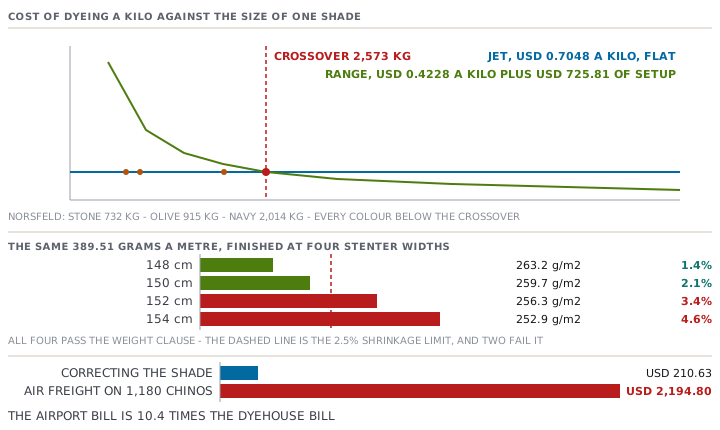
crossover = 725.81 / 0.28205 = 2,573 kg of one shade
Below 2,573 kilos of one colour, the jet is cheaper. Above it, the range is. That single number answers the question every merchandiser eventually asks: why a small colour costs more a kilo than a large one, when it is the same cloth and the same dye.
| Colour | Metres | Kilos at 389.51 g a metre | Machine |
|---|---|---|---|
| Stone | 1,880 | 732.3 | Jet |
| Navy | 5,170 | 2,013.8 | Jet |
| Olive | 2,350 | 915.4 | Jet |
| Programme | 9,400 | 3,661.5 |
Every colour on this programme goes on the jet, and the largest is at 78% of the crossover. Put navy on the range and it costs 2,013.8 times USD 0.4228 plus the USD 725.81 setup, which is USD 1,577.22 against USD 1,419.43 on the jet. That is USD 157.79 worse. This is why the wet-processing line in lesson 2 was built at the jet rate. Mercerising is a caustic soda treatment that makes cotton stronger and brighter, and the stenter is the machine that sets the final width, covered further down.
preparation: singe, desize, scour, bleach     USD 0.1932 a kilo
mercerising                                   USD 0.1900
dyeing, on the jet                            USD 0.7048
stenter finishing                             USD 0.2800
                                              USD 1.3680 a kilo
x 0.38951 kg a finished metre               = USD 0.5329 a metre
Had the programme been quoted at the range rate it would have been USD 0.4230 a metre, and the quotation would have been USD 0.11 a metre light on a fabric selling at USD 2.0350. Ask which machine a dyeing price was built on. A quotation that assumes the range, on a programme that lands on the jet, is a 5% error nobody notices until the invoice.
The stenter sets three things at once, and you can only specify two
Everything above delivers a fixed quantity of dyed cloth: 389.51 grams a finished metre. The stenter decides what that becomes. It grips the cloth at both edges, holds it at a set width, feeds it in faster than the chain takes it away by a set amount, and dries it at a set temperature. Width, weight per square metre and residual shrinkage all come out of those settings, and they are not independent of one another.
Weight is arithmetic. The grams a metre are already fixed, so grams a square metre are just those grams divided by the width. Shrinkage is not arithmetic. It is measured, because it depends on how hard the cloth is being pulled.
| Stenter width | Finished g/m² | Width-way residual shrinkage | Passes Norsfeld's 260 g/m² ± 5%? | Passes shrinkage ≤ 2.5%? |
|---|---|---|---|---|
| 148 cm | 263.2 | 1.4% | Yes | Yes |
| 150 cm | 259.7 | 2.1% | Yes | Yes |
| 152 cm | 256.3 | 3.4% | Yes | No |
| 154 cm | 252.9 | 4.6% | Yes | No |
Read the last two columns together, because that is the trap. The weight tolerance is wide enough to hide the shrinkage failure. All four settings pass on grams a square metre. Only two pass on shrinkage. A mill under pressure to deliver width, or a merchandiser being offered a wider cloth as a favour, is choosing a shrinkage figure without saying so.
And the favour is real money, which is what makes it dangerous. At 152 cm the marker could go to 148 cm, taking consumption from 1.5419 to 1.5211 metres and saving USD 0.0424 a garment, which is USD 254.42 on 6,000 chinos. That is a genuine saving, offered in exchange for a garment that shrinks 3.4% across after washing and comes back. Ask for the shrinkage at the width you are being offered, in writing, before you take the metres.
The shade that missed
Norsfeld's navy was approved on a lab dip: a small trial dyeing, 20 grams in a beaker at a liquor ratio of 1:20. It was dyed in bulk at 1:6 in a 520 kg jet. Different liquor ratio, different mechanical action, different heating rate, different salt concentration, a different bale of cloth. One of the four navy batches came out outside Norsfeld's contractual tolerance.
There are 520 kg of it, and it already has this much money in it:
grey cloth, works cost                       USD 3.2150 a kilo
preparation and mercerising                  USD 0.3832
the dyeing that failed                       USD 0.7048
                                             USD 4.3030 a kilo   =  USD 2,237.57
Topping means running the batch again with a little more dye to push the shade where it should be. A reductive strip means chemically pulling the dye back out so the cloth can be dyed again from scratch. A stocklot is cloth sold off cheaply to whoever will take it.
| Route | What happens | Cost, USD |
|---|---|---|
| Topping | 4.6 h in the jet with 0.35% more dye; six fills instead of nine | 108.21 |
| Topping, expected | Sundarvan's last 40 navy toppings: 31 reached tolerance, 9 needed a strip after | 210.63 |
| Strip and re-dye | A reductive strip of 2.8 h, then the full 8.4 h cycle again | 455.23 |
| Write off | Sunk USD 2,237.57 less a stocklot realisation of USD 1.15 a kilo | 1,639.57 |
So the arithmetic is not close, and it is worth knowing exactly how far from close. Take a batch of B kilos. A strip and re-dye costs USD 0.8754 a kilo plus USD 96.00 of laboratory re-matching. A write-off loses USD 3.1530 a kilo, after salvage. If the correction has a probability p of working, and the cloth is scrap if it does not:
96.00 + 0.8754 B + (1 - p) x 3.1530 B  =  3.1530 B
                              96.00     =  B x (3.1530 p - 0.8754)
                                    B   =  96.00 / (3.1530 p - 0.8754)

at Sundarvan's measured p = 37/40 = 0.925   B = 47 kg
re-dyeing is never worth it below           p = 27.8%
The break-even batch is 47 kilos, and the smallest batch Sundarvan's jets will run is 180. So at every size the mill can physically dye, re-dyeing beats writing off. Anyone who says a lot is not worth re-dyeing is not making an arithmetic argument. The real limits are elsewhere, and they should be named. The cloth loses about 7% of its tensile strength in a reductive strip, so the correction is available once and not twice. And a strip plus a re-dye is 11.2 hours of a jet that other orders are queued for.
What the failure was worth avoiding
Put the whole exposure together: USD 210.63 in the dyehouse plus USD 2,194.80 in the air, which is USD 2,405.43 for one shade that misses. Sundarvan's measured first-time-right rate, going from an approved lab dip straight into bulk, is 68% across its last hundred shades. With a bulk-scale trial first — 40 kilos on the sample jet at the same liquor ratio, one day, USD 62.40 — it is 94%.
straight to bulk    0.32 x 2,405.43                    =  USD 769.74 a shade
with a trial        62.40 + 0.06 x 2,405.43            =  USD 206.73 a shade
                                              saving       USD 563.01 a shade
                                    over three shades      USD 1,689.03
A USD 62.40 trial that costs one day is worth USD 563.01 and buys back four. That is the whole argument for a bulk-scale trial. It is why an experienced merchandiser asks for one on every new shade in a critical colour, rather than treating it as caution.
Check yourselfA dyehouse quotes you USD 0.51 a kilo for a 6,000 kg black and USD 0.79 a kilo for an 800 kg pale blue in the same quality, and you suspect you are being loaded on the small lot. How do you find out, and what would make the quotation honest?Show the answer
The two prices almost certainly come off two different machines, and that is a mechanism rather than a loading. Ask for the crossover: the batch machine's cost a kilo, the range's cost a kilo, and the setup the range carries every time it is threaded and brought to shade. At Sundarvan those were USD 0.7048, USD 0.4228 and USD 725.81, giving a crossover of 2,573 kg. So a 6,000 kg shade runs on the range and an 800 kg one cannot, and the difference between the two prices is real. Then check the shape of the two numbers against that structure. A range price should be nearly flat per kilo once you are well past the crossover. A batch price should be nearly flat per kilo within one machine size. So if you are quoted three different per-kilo prices for three batch lots of 600, 800 and 1,000 kilos, that is a loading and not a mechanism. Those three lots take the same hours in the same machine. The quotation becomes honest the moment it names the machine each colour runs on. Ask for that colour by colour, because a programme usually splits across both.
Check yourselfA mill offers to finish your 250 g/m² cotton twill at 154 cm instead of the 150 cm you specified, at the same price, saying it will improve your marker. Your specification allows 250 g/m² ± 5% and a maximum 3% shrinkage. What is it actually offering you and what do you ask for?Show the answer
It is offering you the same mass of cloth spread over more area. The grams a linear metre are already fixed by the time the cloth reaches the stenter. So widening from 150 to 154 divides that fixed mass by a larger width. The fabric goes from 250 g/m² to 250 times 150 over 154, which is 243.5 g/m². That is still inside a ± 5% band of 237.5 to 262.5, so it passes the weight clause and looks free. What it is not free in is shrinkage. Holding the cloth 4 cm wider on the pins means the width-way relaxation it has not yet done is larger, and your 3% clause is the one at risk. So the thing to ask for is the measured width-way residual shrinkage at 154 cm on this exact quality — not at 150, and not on a similar article — in writing, before you take the metres. Two other things follow. Weigh the delivered cloth yourself and check it against 243.5 rather than 250, because the tolerance band is doing the work of hiding the change. And price what you are gaining. If the wider cloth saves a centimetre of marker it may be worth a few hundred dollars on the order. That is a real number, and a small one against the cost of garments coming back from the consumer's first wash.
Prompt · Decide a failed shade, and price the calendar not the dyehouse
When a bulk shade has missed tolerance, or before committing a new shade in a critical colour straight from a lab dip.
Help me decide what to do with a shade that has missed, and stop me arguing about the wrong number.

First, establish what is already in the cloth. Ask me for the works cost a kilo of the greige, the preparation and mercerising if any, and the dyeing that failed. Add them up, and tell me the money sitting in the batch. Then ask what the cloth would fetch as a stocklot or a downgrade, because the write-off loss is the difference between those two and not the full value.

Then price the routes separately, and do not blend them. Topping: the shortened cycle, the fills, the extra dye, and the mill's MEASURED success rate on that shade family, not its opinion of its success rate. Strip and re-dye: the strip cycle with its chemicals, plus a full dye cycle. Ask what the strip does to tensile strength, because that decides whether the correction is available twice or only once. Write-off: sunk value less salvage. Give me the expected cost of the topping route as its own cost, plus the failure probability times the strip-and-re-dye cost.

Then show me the break-even, so I know how far from the line I am. For a batch of B kilos, with a re-dye at r a kilo plus a fixed laboratory re-matching cost L, a net write-off loss of w a kilo and a correction success probability p, re-dyeing beats writing off above B equals L divided by w times p minus r. Solve it, compare it against the mill's smallest economic batch, and tell me the probability below which re-dyeing is never worth it. If the break-even is smaller than any batch the mill can run, say so plainly. That means anyone claiming the lot is not worth re-dyeing is not making an arithmetic argument, and I should ask what the real objection is.

Now the part everyone forgets. Price the CALENDAR. Ask how many jet-hours the correction takes, what is queued behind it, and how many days the lot moves. Then ask what those days cost downstream: air freight at a rate a piece, a discount, a cancelled delivery. Put the two numbers side by side and tell me the ratio. If the freight is many times the dyehouse cost, say that sentence back to me plainly, because that is the finding, and it decides what I should have spent money on.

Finish with prevention, costed. Ask for the mill's measured first-time-right rate going straight from lab dip to bulk, and its rate with a bulk-scale trial at the production liquor ratio first. Price the trial. Compare the failure probability times the total exposure with and without it, and give me the saving a shade and over the whole programme. Then ask whether that first-time-right rate is split by shade depth. If it is a blended figure being applied to a heavy navy, say the true rate is unknown and probably worse, and do not adjust it quietly.

Two rules. Never let a dyehouse cost stand in for the cost of a failure: name the freight. And never fill an unmeasured success rate with a plausible one. Write unknown, and show me how the answer moves across a range.
AI can make mistakes — check anything you act on.