Lessons · Lesson 2 of 3
The machine sets the limits, the yarn sets the price
How a loom's insertion system, a knitting machine's diameter and gauge, and the width of a reed decide what a fabric can be — and why the machine that decides all of that is under six per cent of what you pay for the cloth.
Lesson 2 of 3 · 40 min
The fabric, and what is already fixed before anyone designs it
Woven cloth is made by holding threads taut and passing another thread across them, over and under. The threads held taut along the length are the warp. The thread passed across is the weft. Knitted cloth is made a different way: loops of one thread are drawn through one another.
A fabric buyer hears two refusals more than any others. The cloth cannot be made as wide as she wants, and she must order far more than she needs. Both are usually true. This lesson works out the reason behind each.
SV-2210 is Norsfeld's chino twill: a 3/1 twill, 9,400 metres, in stone, navy and olive. Sundarvan weaves it on air-jet looms at 165 cm reed width. The reed is the comb the warp threads pass through, and its width sets the width of the cloth on the machine. The cloth comes off grey — undyed and unfinished — at 158 cm, and finishes at 150 cm.
Here is the construction. Every figure in this lesson comes out of it. Ends are warp threads, picks are weft threads, and take-up is the extra warp length used up by the up-and-down path the thread takes through the cloth.
grey, on the loom
  reed width          165 cm        grey cloth width   158 cm
  warp    Ne 20 carded ring   50 ends/cm    take-up 6%
  weft    Ne 16 rotor         24.4 picks/cm

warp in one grey metre  7,900 ends x 1.06 m x 29.53 tex  =  247.24 g
weft in one grey metre  2,440 picks x 1.65 m x 36.91 tex =  148.58 g
                                              cloth       =  395.83 g
                                              grey         =  250.5 g/m2

finishing: 6.0% shorter, 7.5% lighter, 158 cm to 150 cm
finished  395.83 x 1.06383 x 0.925 = 389.51 g a metre  =  259.7 g/m2
Norsfeld's specification says 260 grams a square metre, plus or minus 5%. The construction gives 259.7 and is signed off. Hold on to the number 389.51 grams. Lesson 3 turns out to be about which fabric that same 389.51 grams becomes.
Three ways to get the weft across
A loom's whole identity is how it carries the weft from one edge of the cloth to the other. Everything else about it follows from that.
| Class | How the weft crosses | Measured on SV-2210 | What it will not take | Where it belongs |
|---|---|---|---|---|
| Rapier | A flexible tape carries the weft to the middle and hands it to a second tape | 620 picks a minute | Very little. It will carry almost any weft | Fancy yarns, many colours, short runs |
| Air-jet | A main nozzle fires the weft and relay nozzles push it along | 980 picks a minute | A weft that will not fly: hairy, slack, slubby, very coarse | Long runs of one plain weft |
| Projectile | A gripper shuttle is thrown across and carried back outside the shed | 420 picks a minute | Nothing much, but it is slow at apparel widths | Very wide cloth, heavy cloth |
Those are the three refusals a merchandiser actually meets. "We cannot run that weft on the air-jet" is a real physical statement. The yarn has to be blown down a tunnel of air and arrive straight, on time, every time, and a hairy or weak yarn does not. But it is not a refusal to weave the fabric. The question is what the alternative costs.
| Line | Air-jet, USD | Rapier, USD | Projectile, USD |
|---|---|---|---|
| Depreciation, over 12 years and 7,728 hours | 0.9921 | 0.8411 | 1.2724 |
| Power, including the compressor's share | 0.9024 | 0.3936 | 0.6528 |
| Weaver, fitter, supervision | 0.0818 | 0.0925 | 0.1130 |
| Parts and maintenance | 0.3100 | 0.2700 | 0.4200 |
| Total a loom-hour | 2.2862 | 1.5972 | 2.4582 |
The air-jet costs 43% more an hour than the rapier, almost all of it compressed air and the machine's own price. It also runs 58% faster. Those two nearly cancel each other out.
metres of grey cloth an hour = picks a minute x 60 x efficiency / 2,440 picks a metre

air-jet     980 x 60 x 0.88 / 2,440  =  21.21 m/h   USD 2.2862 / 21.21 = 0.1078 a grey metre
rapier      620 x 60 x 0.92 / 2,440  =  14.03 m/h   USD 1.5972 / 14.03 = 0.1139 a grey metre
projectile  420 x 60 x 0.91 / 2,440  =   9.40 m/h   USD 2.4582 /  9.40 = 0.2616 a grey metre

x 1.06383 grey metres a finished metre:
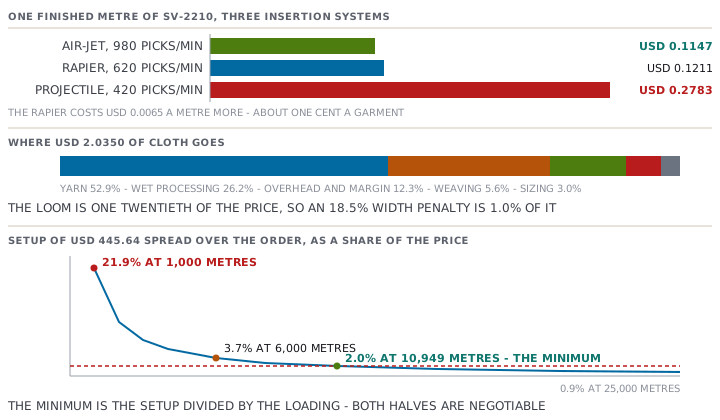
air-jet USD 0.1147   rapier USD 0.1211   projectile USD 0.2783
The rapier costs six tenths of a cent a finished metre more than the air-jet. On the 1.5419 metres a chino takes, that is one cent a garment. So when the mill says the weft will not fly, the right answer is not to fight for the air-jet. It is to ask for the rapier price, and to check that it has not moved by more than a cent. It should not have.
The projectile is a different matter, and its number says why. At apparel width it costs two and a half times as much a metre as an air-jet, because it is a slow machine being asked to weave a narrow cloth. Projectiles earn their keep at widths the other two cannot reach: sheeting, bedding, technical cloth. A mill that offers you one for a 150 cm chino is telling you the loom is standing idle.
Where the money in a metre of cloth actually is
| Element | USD a finished metre | Share of the price |
|---|---|---|
| Yarn: 271.44 g of Ne 20 warp at USD 2.62, 163.13 g of Ne 16 weft at USD 2.24 | 1.0766 | 52.9% |
| Sizing the warp | 0.0610 | 3.0% |
| Weaving, air-jet | 0.1147 | 5.6% |
| Wet processing, built in lesson 3 at USD 1.3680 a kilo | 0.5329 | 26.2% |
| Works cost | 1.7851 | |
| Overhead and margin at 14% | 0.2499 | 12.3% |
| Ex-mill | 2.0350 | 100% |
Sizing is a starch coating put on the warp so it survives the loom. Ex-mill means the price at the mill gate, before any freight.
The loom is 5.6% of what you pay for the cloth. That number should change where you spend your attention. Every argument you have ever had about looms is an argument about a twentieth of the price. The yarn, which lesson 1 showed is mostly cotton, is more than half of it.
It also puts a ceiling on the next section. Whatever the width arithmetic does to the loom, it can only move about a twentieth of the price.
The width the mill will not itemise
Sundarvan's air-jets take a reed up to 190 cm. The chino is woven at 165. The loom-hour cost is the same either way. So the narrower the cloth, the fewer square metres come off the machine in an hour. That is offset a little, because a shorter flight lets the machine run faster.
| Grey width | Reed | Picks a minute | Grey m² an hour | Loom cost a grey m², USD | Index |
|---|---|---|---|---|---|
| 124 cm | 130 cm | 1,090 | 29.25 | 0.07817 | 118.5 |
| 158 cm | 165 cm | 980 | 33.51 | 0.06823 | 103.4 |
| 172.6 cm | 180 cm | 910 | 33.99 | 0.06727 | 102.0 |
| 182 cm | 190 cm | 880 | 34.66 | 0.06597 | 100.0 |
A cloth woven at 124 cm on a 190 cm loom costs 18.5% more a square metre to weave than the same cloth at the machine's full width. No mill itemises that. A mill quotes one price a linear metre for a quality, and the loading is buried inside it. This is the real content of the folk belief that narrow cloth is dear. It is true, and here is the size of it.
Now put it against the previous table, because that is the discipline. Weaving is 5.6% of the price, so an 18.5% swing in weaving is 1.0% of the fabric price. It is real. It is not where the money is.
Where the money is, is the marker. A marker is the cutting plan: all the pattern pieces of a garment laid out on the cloth width, arranged to waste as little as possible. Aparna's chino marker is 146 cm wide and lays at 82.4% efficiency, on a garment whose patterns cover 1.855 m². That is 1.5419 metres a chino, and USD 3.1379 of cloth. Sundarvan can weave the same quality at 164 cm finished, which would let the cutting room re-plan to a 160 cm marker.
150 cm cloth at USD 2.0350   marker 146 cm at 82.4%   1.5419 m   USD 3.1379
164 cm cloth at USD 2.2211   marker 160 cm at 85.1%   1.3624 m   USD 3.0259
                                          saving        USD 0.1120 a garment
                                          on 6,000      USD 671.86
Against that stands the cost of putting a new construction on the loom, which the next section builds: USD 94.94 of extra setup over simply tying in another warp of the running article. Net USD 576.92, and Norsfeld would take it.
The minimum order quantity, derived rather than quoted
Every mill quotes a minimum, and almost none of them explain it. It is not folklore. It is one division. Here is Sundarvan's, measured on the chino. Drawing-in means threading every warp thread through the loom by hand, which a new construction cannot avoid. Gaiting means mounting the warp beam and getting the loom running.
| Element | Basis | Cost, USD |
|---|---|---|
| Reed re-dented to the new sett | 3.5 h at USD 1.32 | 4.62 |
| Direct warping, 7,800 ends | 5.8 h at USD 26.40 a machine-hour with labour | 153.12 |
| Sizing, one box charge and the run | 4.1 h at USD 41.50 | 170.15 |
| Drawing-in 7,800 ends, which a new construction cannot avoid | 9.5 h at USD 8.60 | 81.70 |
| Gaiting the beam and running in | 2.6 loom-hours at USD 2.2862 plus a fitter at USD 1.62 | 10.16 |
| Run-in cloth off shade and off pick | 22 grey metres at USD 1.1771 | 25.90 |
| Setup, one loom, one construction | 445.64 |
Sett is how many threads per centimetre the reed holds, and re-denting means re-spacing the reed for a new sett. Sundarvan's own rule is that setup may not add more than 2% to a quality's price. So:
minimum order = 445.64 / (0.02 x 2.0350) = 10,949 finished metres

     1,000 m   USD 0.4456 a metre   21.9% of the price
     3,000 m   USD 0.1485            7.3%
     6,000 m   USD 0.0743            3.7%
    10,949 m   USD 0.0407            2.0%
    25,000 m   USD 0.0178            0.9%
The minimum is the setup divided by the tolerance. Both halves are negotiable and neither is a law. A buyer who will accept a 4% loading gets a 5,475 metre minimum, and that is an honest trade rather than a favour.
Note also what the 2% rule does to a repeat order. A running article does not need re-denting or drawing-in. The new warp is knotted to the tail of the old one on a tying-in machine, 1.4 hours at USD 9.80. That is why the extra setup for a new width was USD 94.94 rather than USD 445.64. And it is why the first order of an article and the fifth are two very different jobs carrying the same price.
Knitting: two numbers on the machine decide what you can have
A circular knitting machine is described by two numbers. Between them they fix more about the fabric than any specification you will write.
Diameter fixes the width. The needles sit round a cylinder, so the tube's circumference is the cylinder's circumference. No amount of finishing invents cloth that was never knitted. Sundarvan's jersey quality relaxes to a measured 63.5% of the machine circumference when the tube is cut open and laid flat.
30 inch machine   pi x 30 x 2.54 = 239.39 cm   x 0.635 = 152.0 cm open width
34 inch machine   pi x 34 x 2.54 = 271.31 cm   x 0.635 = 172.3 cm open width

for 180 cm you need 180 / 0.635 = 283.5 cm of circumference = a 35.5 inch machine
Sundarvan has 30 inch and 34 inch machines. So "we cannot give you 180 cm jersey" is simply true, and it is true for a reason you can check on the back of an envelope. The relaxation factor is not a constant. It belongs to the yarn, the stitch length and the finishing route, and it has to be measured on the quality you are actually buying. But it is a measurement the mill has, because it makes this cloth every week.
Gauge fixes the yarn. Gauge is how many needles the machine has per inch, and that decides how much room a loop has. The knitting master's working rule at Sundarvan is that the natural count for a gauge is roughly the gauge squared over eighteen, with about a quarter either side of it.
| Machine | Needles | Feeders | Natural count, G² / 18 | Working band | Open width |
|---|---|---|---|---|---|
| 30 inch, 24 gauge | 2,256 | 96 | Ne 32 | Ne 24 to Ne 40 | 152.0 cm |
| 34 inch, 24 gauge | 2,556 | 108 | Ne 32 | Ne 24 to Ne 40 | 172.3 cm |
| 30 inch, 28 gauge | 2,632 | 96 | Ne 44 | Ne 33 to Ne 55 | 152.0 cm |
A feeder is one point on the machine where yarn is fed to the needles, and the more of them there are, the more rows the machine makes per turn. That rule is a rule of thumb, not a standard, and Sundarvan treats it as a starting point rather than an answer. But it tells you instantly why the mill that can knit your Ne 30 tee cannot knit a Ne 50 one on the same machine, and it tells you what to ask for instead.
Now the cost, which is the part that makes knitting feel different from weaving. SV-3140 is knitted on the 30 inch, 24 gauge machine at 28 revolutions a minute, with a measured stitch length of 2.85 mm.
yarn in one course = 2,256 needles x 2.85 mm  = 6.4296 m  = 0.1266 g at Ne 30
courses a minute   = 28 rpm x 96 feeders      = 2,688
kilos an hour      = 0.1266 x 2,688 x 60 / 1,000 x 0.88 = 17.96 kg

machine-hour  USD 1.6231     per kilo  USD 0.0904
A course is one row of loops across the fabric. Knitting a kilo of jersey costs nine cents. The yarn in it costs USD 3.4347. Knitting is 2.6% of the greige fabric, less than half the loom's share of a woven cloth. It is the same lesson twice over: the machine decides what is possible, and the yarn decides what it costs.
The knitting setup is small in the same proportion. That is why knitters quote minimums in tonnes and weavers quote them in tens of thousands of metres. A creel is the frame that holds the yarn packages feeding the machine.
creel 96 ends of new yarn, 1.8 h                              USD   1.89
machine standing during creeling, 1.8 h                       USD   2.92
stitch length set, three trial tubes weighed, 2.4 h           USD   6.42
34 kg of trial fabric at USD 3.5251 greige                    USD 119.85
                                                     setup    USD 131.08

minimum at the same 2% rule = 131.08 / (0.02 x 3.5251) = 1,859 kg
Set that against weaving's 10,949 metres, which is 4,265 kg of the same cloth: USD 22,281 of woven against USD 6,553 of jersey. The size of a mill's minimum tells you which machine you are talking to. A knitter quoting a 10-tonne minimum is quoting a commercial policy, not a setup.
Check yourselfA mill quotes your 148 cm poplin at USD 1.84 a metre and tells you its looms are 190 cm machines. You ask why it cannot give you 178 cm and it says the reed is available but the minimum would be 12,000 metres. What is it really telling you, and what would you check before pushing?Show the answer
It is telling you two separate things, and they should not be answered together. The width is available, so the refusal is not technical. A 190 cm machine holds a 178 cm cloth and will weave it. It will weave it slightly cheaper per square metre than the 148 cm one, because the loom-hour cost is the same and more cloth comes off it. The minimum is the setup divided by whatever loading the mill will tolerate. A new sett means a new reed, a new warp and drawing-in rather than tying-in. At Sundarvan that came to USD 445.64, against a USD 94.94 increment for a width change on the same sett. So the first question is which of those two this is, because the answer changes the minimum by a factor of five. Before pushing at all, check the thing that decides whether the exercise is worth anything: lay the marker at 178 cm and measure its efficiency. If it lays no better than the 148 cm marker, the wider cloth buys nothing and you have spent a setup to get there. And check the mill's finishing width, because a loom that can weave 178 cm is no use if the stenter stops at 170.
Check yourselfYour knitter has 30 inch and 32 inch machines, all 20 gauge, and its jersey relaxes to 64% of the machine circumference. You need 165 cm open width in Ne 26. Can it be done, and what is the honest answer to give the designer?Show the answer
Work the width first. A 30 inch machine gives pi times 30 times 2.54, which is 239.4 cm of circumference, and at 64% that is 153.2 cm open width. A 32 inch gives 255.4 cm and 163.4 cm. Neither reaches 165, and the 32 inch misses by 1.6 cm. That is close enough to be worth asking the knitter to measure the relaxation on this exact quality, rather than quoting the house figure. A 64.6% factor would clear it. If it does not clear, no finishing route invents the width, and the honest answer to the designer is that the marker has to be planned at 163 cm, not that the mill is being difficult. The count is the easier half. At 20 gauge the working rule puts the natural count at 400 over 18, about Ne 22, with a band of roughly Ne 17 to Ne 28. So Ne 26 sits inside it, near the fine end, and should knit. Expect the knitter to want a slightly longer stitch length, and expect the fabric to be lighter than the same count on a 24 gauge machine.
Prompt · Test a fabric width, and work out the minimum order yourself
Before accepting a mill's minimum order quantity, or before asking for a width that is not the mill's running one.
Act as a check on a fabric width and a minimum order quantity. Take them in that order, and do not let me collapse them into one question.

First the machine. Ask me what the mill weaves this quality on, and what the maximum reed width of that machine is. The reed is the comb the warp threads pass through, and it sets the cloth width. For a knit, ask for the machine diameter and gauge instead. For a woven, work out the loom's cost per square metre of grey cloth at my width and at the machine's full width: loom-hour cost, divided by picks a minute times sixty times efficiency divided by picks a metre, times the cloth width. Tell me the percentage penalty of running narrow. Then put it in proportion at once. Ask me what weaving is as a share of the fabric price, because it is usually around a twentieth, and multiply the two. Give me the answer in cents a metre, not in percentages of weaving. A large percentage of a small number is a small number, and I will otherwise over-react to it.

For a knit, do the width arithmetic properly, and tell me when the answer is simply no. Finished open width is the machine circumference — pi times the diameter in inches times 2.54 — times the mill's MEASURED relaxation factor for this exact quality. Ask for that factor as a measurement, and refuse a house average. If the width I want needs a diameter the mill does not own, say so plainly. No finishing route invents cloth that was never knitted. Then check the count against the gauge with the working rule that the natural count is roughly the gauge squared over eighteen, with about a quarter either side. Say whether my yarn sits inside that band.

Now the marker, and this is the part that decides everything. A marker is the cutting plan: the pattern pieces laid out across the cloth width. Before I pay anything for a width change, make me lay the actual marker at the new width and measure its efficiency. Work out consumption both ways, as pattern area divided by marker efficiency divided by marker width. Cost it at each cloth price, and multiply by the order. Then show me the same calculation with the new marker at the OLD efficiency, as the pessimistic case, because a wider cloth does not always nest better. If the pessimistic case is negative, tell me the whole decision rests on an unmeasured number, and to stop until it is measured.

Then the minimum. Ask the mill to itemise the setup: reed, warping, sizing, drawing-in or tying-in, mounting the beam and running in, and the run-in cloth that is scrapped. For a knit, ask for creeling, the machine standing, stitch-length setting and the trial fabric. Ask what loading on the price the mill is prepared to carry, as a percentage. The minimum is the setup divided by that percentage times the price, and both halves are negotiable. Ask separately whether this is a NEW construction or a repeat of a running article, because knotting a new warp to the old one costs a fraction of threading one in by hand, and the two minimums differ by several times.

Two rules. Never let a width saving be justified by an assumed marker efficiency. If it has not been laid, write unknown, and give me the exposure in both directions. And check the mill's finishing width as well as its weaving width, because a loom that reaches 190 cm is no use behind a stenter that stops at 180.
AI can make mistakes — check anything you act on.