Lessons · Lesson 1 of 3
The count, the staple and the eight-week answer
Why the same ring frame makes a third less yarn when you ask for a finer yarn, how to check from the bale whether a rotor can spin what you want at all, and how to split a mill's lead time into the days that are machine and the days that are queue.
Lesson 1 of 3 · 40 min
The mill, the programme, the basis
Cloth starts as loose fibres twisted into a thread. How fine that thread is decides almost everything that follows. It sets what the cloth costs, which machine can make it, and how long you wait. A spinning mill gives a customer three answers: it cannot be done, it costs this much more, it takes this long. All three are said in the tone of facts. This lesson is about telling which ones are.
Two words first, because everything below uses them. Count is how fine a yarn is. It is written as a number after "Ne", the English cotton count. The higher the number, the finer the yarn. Staple is how long the cotton fibres in the bale are.
Sundarvan Mills is at Bhilwara in Rajasthan. It is vertically integrated, which means it does every step itself: a spinning plant with ring and rotor frames, a weaving shed, a circular knitting hall, and a processing house that dyes and finishes what the other three make. It sells cloth, not garments. Everything in this course happens inside that one company, and every figure is Sundarvan's own.
Four people appear.
- Devendra Solanki is the spinning master. Counts, twist, staple and the mixing are his.
- Nalini Rathore is the mill's cost engineer. Every machine-hour rate in this course is hers.
- Fauzia Qureshi runs the processing house.
- Aparna Dey is the senior merchandiser at the garment factory that buys from Sundarvan. This course is written for her. She buys fabric. She does not run a mill. And she is told again and again that something cannot be done.
The work runs through all three lessons. It is the Norsfeld autumn 2027 programme, for Norsfeld, a Nordic mid-market retailer. It has two fabrics in it: SV-2210, a cotton chino twill, 9,400 metres; and SV-3140, a cotton single jersey for tee shirts.
Say the basis once, because every figure below is built on it. All money is US dollars. Sundarvan runs 350 days a year on three shifts, so a machine is scheduled for 8,400 hours. Measured use across 2027 was 92%, which gives 7,728 productive machine-hours a year. Power costs USD 0.096 a kilowatt-hour on the mill's own 2027 tariff. A mill operative costs USD 1.05 an hour, fully loaded, and a fitter USD 1.62. Machines are written off over 12 years in equal yearly amounts, with nothing assumed left at the end. That is an assumption, and it is stated as one. Cotton at the mill gate, on Sundarvan's own 2027 contracts, is USD 1.66 a kilo at an upper-half mean length of 26.5 mm, USD 1.92 at 28.5 mm and USD 2.34 at 31.5 mm. Upper-half mean length is the average length of the longer half of the fibres, and it is the length figure the trade quotes. Waste sells too: the combed line gets a blended USD 0.74 a kilo for noil and soft waste, and the carded line USD 0.62. Noil is the short fibre combed out of the cotton on purpose.
Three ways to make a yarn, and they are three different businesses
| Class | How the twist gets in | What it gives you | What it cannot do |
|---|---|---|---|
| Ring | A small metal traveller is dragged round a ring, twisting and winding at the same time | The widest range of counts, the strongest yarn, the best feel | Run fast. The traveller has a speed ceiling |
| Rotor, open-end | Fibres are opened back to single fibres, thrown into a groove turning above 100,000 revolutions a minute, and peeled off twisted | Very high output, no roving frame, no winding | Hold a yarn together below about a hundred fibres across the yarn |
| Air-jet, vortex | Compressed air wraps the trailing fibre ends round a straight core | The highest output of all, the least hairiness | Make a strong yarn in pure cotton. It wants man-made fibre |
Track 1 taught these as three yarn characters. Here they are three machines. The difference matters, because a machine costs the same by the hour whatever count it is making. That one fact drives almost everything in this lesson.
The check that answers "we cannot spin that"
Aparna asks Sundarvan for Ne 40 on the rotor, because the rotor quotation is the cheap one. Devendra Solanki says no. He is right, and she can prove it from the bale.
A rotor holds the yarn together by wrapping some fibres round the outside of the strand while the groove twists the rest. Below a certain number of fibres across the yarn there is not enough overlap to carry the load, and the yarn breaks. Sundarvan's floor rule is 100 fibres, and Solanki will not run below it.
Counting them takes two numbers you already have. Tex is a way of writing how heavy a yarn or a fibre is: grams per 1,000 metres.
yarn linear density, tex = 590.5 / Ne
fibre linear density, tex = 0.03937 x micronaire

fibres across the yarn
  = (590.5 / Ne) / (0.03937 x micronaire)
  = 590.5 / (0.03937 x micronaire x Ne)
  = 14,999 / (micronaire x Ne)

so, near enough:   n  =  15,000 / (micronaire x Ne)
Micronaire is one number that mixes two things: how fine the fibre is and how ripe it is. So this is a working estimate, not a measurement. On unripe cotton it flatters the count. On the ripe cotton Sundarvan buys it is close enough to decide with.
| Count | At micronaire 4.2, the standing mix | At micronaire 3.6, a finer cotton |
|---|---|---|
| Ne 20 | 179 | 208 |
| Ne 30 | 119 | 139 |
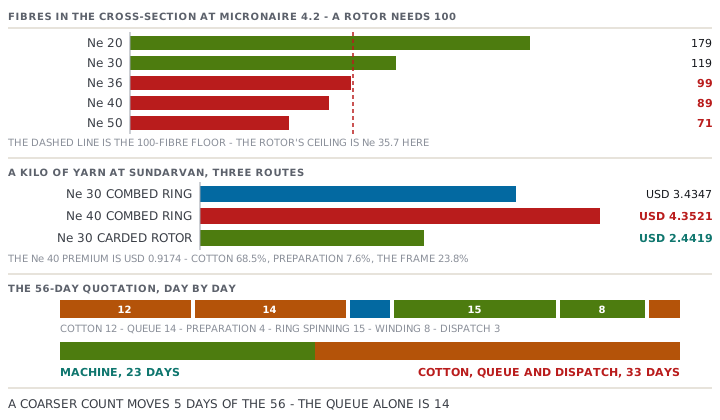
| Ne 36 | 99 | 116 |
| Ne 40 | 89 | 104 |
| Ne 50 | 71 | 83 |
Read the first column. On Sundarvan's standing mix, the rotor's ceiling is where 15,000 divided by 4.2 times the count reaches 100. That is Ne 35.7. Ne 40 gives 89 fibres, so the answer is no. Ne 30 gives 119, so the answer is yes.
Now read the second column, because that is the useful half. The ceiling belongs to the cotton as much as to the machine. On a 3.6-micronaire cotton, Ne 40 has 104 fibres and comes back inside the rule. So "we cannot spin Ne 40 on the rotor" is true of this mixing and not true in general. The next question is not an argument. It is: what micronaire is in the bale you are quoting me?
What an hour of a spindle costs
Every conversion cost in a spinning mill is one division: the cost of an hour of the machine, divided by what the machine makes in that hour. Nalini Rathore keeps the top half of that sum.
| Line | Basis | Cost a spindle-hour, USD |
|---|---|---|
| Depreciation | USD 486,000 a frame of 1,260 spindles, 12 years, 7,728 productive hours | 0.004159 |
| Power | 0.0398 kilowatts a spindle, including its share of the suction, at USD 0.096 | 0.003821 |
| Labour | one operative per 1,400 spindles at USD 1.05 | 0.000750 |
| Travellers, parts, humidification | measured over 2027 | 0.001520 |
| Total | 0.010250 |
Now the bottom half of the sum, and that is where the count does its damage. A ring frame twists and winds in the same motion. So the length it delivers is the spindle speed divided by the number of turns it has to put in per unit of length. The count sets the turns: the twist multiplier is held constant, so turns per inch rise with the square root of the count. And a finer yarn weighs less per metre. Both effects push the same way.
turns per inch     = twist multiplier x sqrt(Ne)        [3.6 for this knitting yarn]
delivery, in/min   = spindle speed / turns per inch     [17,500 rpm]
grams per hour     = delivery x 60 x tex / 1,000 x 0.95 [95% measured efficiency]

Ne 30:  TPI 19.72   delivery 22.54 m/min   25.29 g a spindle-hour
Ne 40:  TPI 22.77   delivery 19.52 m/min   16.43 g a spindle-hour

ratio = (40/30)^1.5 = 1.5396
Output per spindle-hour falls with the one-and-a-half power of the count. That is the whole mechanism. It needs no data, and it is the single most useful thing in this lesson. Going from Ne 30 to Ne 40 makes the yarn 33% finer and cuts the weight coming off the machine by 35.0%. Same frame, same hours, same people, a third less product.
So the conversion cost is USD 0.010250 divided by 0.02529 kg at Ne 30, which is USD 0.4053 a kilo. At Ne 40 it is USD 0.010250 divided by 0.01643 kg, which is USD 0.6240 a kilo.
Where the price rise actually comes from
Sundarvan quotes Ne 40 combed at USD 0.92 a kilo over Ne 30 combed. Aparna's instinct is that the machine is slower, so the machine is the cost. Build it and see.
| Line | Ne 30 combed ring | Ne 40 combed ring | Ne 30 rotor, carded |
|---|---|---|---|
| Raw cotton needed for one kilo of yarn | 1.2623 kg at 28.5 mm | 1.3238 kg at 31.5 mm | 1.1085 kg at 26.5 mm |
| Cotton, less the waste it sells back | USD 2.2295 | USD 2.8581 | USD 1.7729 |
| Preparation: blowroom to roving | USD 0.6100 | USD 0.6800 | USD 0.3400 |
| Spinning machine | USD 0.4053 | USD 0.6240 | USD 0.2990 |
| Winding, clearing, splicing, packing | USD 0.1900 | USD 0.1900 | USD 0.0300 |
| Works cost a kilo | USD 3.4347 | USD 4.3521 | USD 2.4419 |
The Ne 40 premium is USD 0.9174, and it splits like this: cotton USD 0.6287, preparation USD 0.0700, the ring frame USD 0.2187. As shares, 68.5% of the price rise is cotton and 23.8% is the machine. The finer count needs a longer, finer, dearer staple, and it needs more of it, because a finer yarn is combed harder: 18% noil against 14%.
That changes what there is to negotiate. You cannot argue with the ring frame, because the one-and-a-half power law is physics. You can absolutely ask why a 31.5 mm staple is in the mixing, whether 30.5 mm would carry Ne 40 combed, and what that would take off the price.
Now read the third column, because it makes the same point harder. Rotor yarn is USD 0.9928 a kilo cheaper than ring yarn at the same count, a saving of 28.9%, and everybody calls that "the rotor is cheaper".
cotton, a shorter staple the rotor can use   0.4566   46.0%
preparation, no combing and no roving        0.2700   27.2%
the spinning machine itself                  0.1063   10.7%
winding, which the rotor does not need       0.1600   16.1%
                                             0.9928
Only 10.7% of the rotor's advantage is the rotor. Nine tenths of it is the cotton the machine lets you buy, and the two machines it lets you skip. That is worth knowing before you argue about spinning systems, because you are almost never arguing about the spinning system.
One measurement goes the other way, and it is worth having. At the machine, the ring frame uses 1.57 kilowatt-hours a kilo at Ne 30 and the rotor uses 1.68. So the rotor is 7.0% more power-hungry per kilo. A rotor turning above 100,000 revolutions a minute, with its suction, draws six and a half times the power of a spindle for six times the output. The rotor route still uses less power overall, but only because it has no roving frame and no winder in it. Anybody who tells you open-end spinning is the low-energy machine is describing the route, not the machine.
Eight weeks, taken apart
Norsfeld's tee programme needs 62,000 kg of Ne 40 combed. Sundarvan quotes eight weeks. Aparna assumes, as most people do, that eight weeks is spinning time and that a coarser count would cut it.
Sundarvan's ring plant has 30,240 spindles, and 11,340 of them are free in the window. At 16.43 grams a spindle-hour and 22.08 productive hours a day, that is 4,113 kg a day. So 62,000 kg is 15.1 days on the frames.
| Element | Days | Machine? |
|---|---|---|
| Cotton: fixing the contract, delivery, conditioning the bales | 12 | No — buying |
| Queue: the free frames are committed until day 14 | 14 | No — other customers |
| Preparation, blowroom to roving, overlapped with the ring frames | 4 | Partly |
| Ring spinning, 62,000 kg on 11,340 spindles | 15 | Yes |
| Winding, clearing, splicing, conditioning, packing | 8 | Yes |
| Dispatch to the knitter | 3 | No |
| Total | 56 |
Twenty-three of the fifty-six days are machine. Thirty-three are not. And the count, which drives the price hard, barely touches the calendar. At Ne 30 the same 11,340 spindles deliver 6,333 kg a day, and spinning falls from 15 days to 9.8. The whole count change is worth 5 days out of 56, or 8.9%. The fourteen days of queue are worth nearly three times as much as the count. Unlike the count, they are negotiable, because a queue is a commercial arrangement and the one-and-a-half power law is not.
Check yourselfA mill tells you it cannot spin Ne 34 on its rotors. Its classing data shows the mixing it would use is micronaire 4.6, upper-half mean length 27.2 mm. Is the refusal sound, and what do you ask next?Show the answer
Run the check. 15,000 divided by 4.6 times 34 is 96 fibres across the yarn, under the hundred-fibre floor a rotor needs to hold a yarn together. So on that mixing the refusal is sound, and you should accept it rather than push. What you ask next is what would change it. At micronaire 4.2 the same count gives 105 and comes back inside. So the question is whether the mill can put a finer cotton in the mixing for this lot, and what that costs a kilo. That turns a refusal into a quotation. Ask for the ring alternative in the same call, because the ring frame has no such floor at this count and will quote. Expect it to be dearer, and expect most of the difference to be the cotton rather than the frame. And treat the number as a working estimate, not a measurement. Micronaire mixes fineness with ripeness, so on unripe cotton it reads finer than the fibre really is, and the true fibre count is worse than 96, not better.
Check yourselfYour mill quotes Ne 24 combed ring at USD 3.06 a kilo and Ne 32 combed ring at USD 3.71, and tells you the difference is the extra machine time. Using Sundarvan's spindle-hour cost of USD 0.010250 and a twist multiplier of 3.6 at 17,500 rpm, how much of the USD 0.65 is really the frame, and what have you learned to ask?Show the answer
Work out both outputs. At Ne 24 the turns per inch are 3.6 times the square root of 24, which is 17.64. So delivery is 17,500 divided by 17.64, which is 992 inches a minute, or 25.20 m/min. At 24.60 tex and 95% efficiency that is 35.35 grams a spindle-hour, and the conversion cost is 0.010250 divided by 0.03535, which is USD 0.2900 a kilo. The quick route to the second figure is the one-and-a-half power law: output falls by 32 over 24 raised to the power 1.5, a factor of 1.5396, giving 22.96 grams an hour and USD 0.4464 a kilo. So the frame accounts for USD 0.1564 of the USD 0.65, which is 24.1% of it. The other three quarters is cotton, combing and the extra preparation a finer count needs. What you have learned to ask is what staple and what noil percentage sit behind the finer count, because that is where the money is, and it is the only part anybody can negotiate. Note also that the frame's share here is smaller than in the Ne 30 to Ne 40 case in the lesson, and the reason is worth carrying. The power law bites harder the finer you go, but so does the staple. Which one wins depends on how far apart the two counts are, and on how much dearer the cotton has to get.
Prompt · Take a yarn quotation and a lead time apart
When a spinner has refused a count, asked for a premium on a finer one, or given you a lead time in weeks.
Help me question a yarn quotation using the mill's own mechanics, and make me ask for the measurements I have not asked for. A count is how fine a yarn is, written as a number after Ne.

Start with the refusal, if there is one. Ask me which spinning system the mill is refusing on: ring, rotor or air-jet. A refusal is almost never about all three. Then ask me for the micronaire and the upper-half mean length of the mixing the mill would actually use. Micronaire is one number for how fine and how ripe the fibre is, and the mill has both figures on its classing data for every bale it owns. Work out the fibres across the yarn as roughly fifteen thousand divided by micronaire times the count, and tell me plainly whether it clears the hundred-fibre floor a rotor needs. If it does not, say the refusal is sound and stop arguing. Then ask what mixing WOULD clear it and what that costs a kilo, because that turns a refusal into a quotation. Warn me that micronaire mixes fineness with ripeness, so on an unripe cotton the estimate flatters the count.

Then take the price apart, and refuse to accept a single number. Ask for the mill's cost of a productive spindle-hour or rotor-hour if it will give it. If it will not, build the machine's share yourself. Output per spindle-hour falls with the one-and-a-half power of the count at a constant twist multiplier. So a move from one count to another changes the conversion cost by that ratio and nothing else. Then split the whole premium into cotton, preparation and machine, and tell me the percentage each one carries. Say out loud which parts I can negotiate. I cannot argue with the power law. I can absolutely ask why a particular staple is in the mixing.

Do the same for any cheaper alternative I am offered. If a rotor or air-jet yarn is quoted against a ring yarn, split the gap into four parts: the cotton the machine allows, the preparation stages it skips, the winding it avoids, and the spinning machine itself. Tell me the machine's share, because it is usually the smallest of the four and it is the one everybody argues about.

Then the lead time. Refuse to accept it as one number. Make me get it broken into cotton buying and conditioning, queue before the frames, preparation, spinning, winding and conditioning, and dispatch. Work out the spinning days yourself, from grams a spindle-hour times the free spindles times the productive hours a day. Then tell me how many days are machine and how many are queue or buying, and which of those are commercially negotiable. Show me what a coarser count would save in days, separately from what it saves in money, because those two are usually very different sizes.

Three rules. Never fill a missing measurement with a typical figure. Write unknown, and tell me to go and get it. Never quote me a machine maker's cycle time or output claim. The only numbers that count are the mill's own measured output on its own cotton. And if a difference comes out inside the error of the assumptions, say so, and tell me to stop spending time on it.
AI can make mistakes — check anything you act on.