Lessons · Lesson 3 of 3
Maintenance is a purchase you already made
Cost breakdown, preventive and condition-based maintenance against each other on one machine, decide a critical spare you may never use, and see what a maintenance log must record before any of it can be calculated.
Lesson 3 of 3 · 38 min
The machine that stops everything
Every machine in a factory is being maintained in one of three ways. In most factories nobody has chosen which. You can wait until it stops, replace its parts on a timetable, or measure something while it runs. This lesson costs all three on a single machine. It picks the kind that stands out in the yard and is noticed only on the morning it will not start.
Lessons 1 and 2 costed a machine Ban Mai does not own. This one costs a machine it has owned for four years and has never thought of as an investment: the 75 kW rotary-screw air compressor in the yard.
It feeds every device in the building that runs on compressed air: foot lifters and thread trimmers on six sewing lines, the pressing section, the bagging bench and the cutting room's clamps. Installed four years ago at USD 38,400, it runs 3,600 hours a year, and when it stops, everything stops.
That last sentence is the whole of this lesson's arithmetic, so price it before anything else.
| Line | Amount, USD |
|---|---|
| Direct labour standing, 310 people at USD 1.34 an hour | 415.40 |
| Supervision and floor overhead not absorbed | 96.20 |
| Contribution on output never recovered: 38% of an hour's USD 148.50 | 56.43 |
| One hour of full floor stop | 568.03 |
The third line is the one that gets argued about, so note what it does not claim. Ban Mai measured that 62% of stopped hours are made up later by overtime or by a faster run, and that the remaining 38% are simply gone. It does not assume the whole hour is lost, and it does not assume none of it is. Both of those assumptions are common and both are wrong. The difference between them on this figure is USD 148.50 an hour against nil.
Three regimes, one machine
There are three ways to maintain anything, and they are not a ladder from bad to good. They are three different bets about how a machine fails.
- Breakdown, also called run to failure: fix it when it stops. It is the right policy for anything whose failure is cheap and whose replacement is quick, such as a light fitting or a hand tool. It is what Ban Mai ran on this compressor until 2026, because nobody had decided anything.
- Preventive: replace or service at fixed intervals, whether or not anything is wrong. It is the right policy where a part genuinely wears out with age or use, and it costs money on every part that did not need replacing yet.
- Condition-based: measure something while the machine runs, and act when the measurement moves. It is the right policy where a failure gives a warning you can detect, and it costs money on the measuring.
Cost all three on this one compressor.
Regime 1: breakdown, 2023 to 2025
Tran Van Tuan rebuilt these three years from purchase invoices and the production stop board, because the maintenance log itself does not contain them. That is a real limitation and it is dealt with at the end of the lesson.
| Year | Events | Hours stopped | Downtime at USD 568.03 | Parts, USD | Outside labour, USD | Total, USD |
|---|---|---|---|---|---|---|
| 2023 | 4 | 12.0 | 6,816.36 | 1,940.00 | 610.00 | 9,366.36 |
| 2024 | 6 | 26.0 | 14,768.78 | 4,830.00 | 1,180.00 | 20,778.78 |
| 2025 | 5 | 19.0 | 10,792.57 | 2,410.00 | 890.00 | 14,092.57 |
| Three years | 15 | 57.0 | 32,377.71 | 9,180.00 | 2,680.00 | 44,237.71 |
| Average a year | 5.0 | 19.0 | 14,745.90 |
Downtime is 73.2% of the cost of this regime, and parts are 20.8%. That ratio is the reason breakdown maintenance is expensive on this machine and would be perfectly sensible on the coffee urn. It has nothing to do with the compressor and everything to do with what stops when the compressor stops.
The 2024 spike was one event. The air-end — the screw element that does the compressing — seized. It took 18 of that year's 26 hours and USD 3,900 of its parts, and it is the subject of the spares section below.
Regime 2: preventive, 2026
Ban Mai put the compressor on the supplier's schedule, driven off the machine's own running-hour counter rather than the calendar, because at 3,600 hours a year the two do not agree.
| Task | Interval, running hours | Times a year | Parts each, USD | Parts a year, USD |
|---|---|---|---|---|
| Air filter element | 1,000 | 3.6 | 34.00 | 122.40 |
| Oil filter | 2,000 | 1.8 | 61.00 | 109.80 |
| Oil separator element | 2,000 | 1.8 | 107.00 | 192.60 |
| Lubricant charge, 40 litres | 4,000 | 0.9 | 395.00 | 355.50 |
| Motor bearing regrease | 2,000 | 1.8 | 46.00 | 82.80 |
| Aftercooler and radiator clean | 2,000 | 1.8 | 58.00 | 104.40 |
| Drive coupling inspect and renew | 6,000 | 0.6 | 210.00 | 126.00 |
| Tuan's own time, 26 hours at USD 2.15 | 55.90 | |||
| Scheduled cost a year | 1,149.40 |
The schedule needs 14.0 hours of the machine a year, and all fourteen are taken inside the Sunday shutdown. So they cost nothing in floor-stop terms, and that is not an accounting trick. It is the single largest thing preventive maintenance buys. Planned downtime taken when the floor is not running is free. The same work done at eleven on a Tuesday costs USD 568.03 an hour. A schedule that cannot be fitted into non-production time has lost most of its value before it starts.
In 2026 the compressor still stopped unexpectedly twice, for 5.0 hours in total.
scheduled                                              USD 1,149.40
unplanned  5.0 h x USD 568.03                          USD 2,840.15
           parts USD 720.00 + outside labour USD 260.00  USD    980.00
total under preventive                                 USD 4,969.55
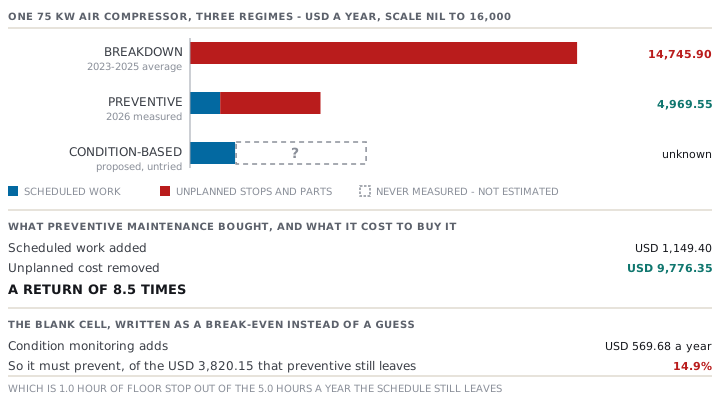
Against the breakdown regime's USD 14,745.90 that is a saving of USD 9,776.35 a year, bought with USD 1,149.40 of scheduled work. That is a return of 8.5 times. Very few things in a factory return 8.5 times, and this one was sitting there for three years because nobody had costed the alternative.
Regime 3: condition-based, proposed
Tuan wants to go further. Three of the intervals above are guesses dressed as policy. The supplier's schedule is written for an average machine in an average building, and Ban Mai's compressor is in a hot yard with a dusty intake. Condition monitoring replaces the guess with a measurement.
- A handheld vibration meter, USD 1,850, read monthly on the air-end and both motor bearings. Five-year life, no residual: the capital recovery factor at 14% over 5 years is 0.291287, so USD 538.88 a year.
- Oil analysis, quarterly, at USD 62 a sample: USD 248.00 a year. Oil analysis is what lets the lubricant run to condition rather than to hours.
- The differential-pressure gauge across the separator is already fitted and nobody reads it. It shows how hard the air has to push to get through. Reading it daily costs nothing and tells you exactly when the separator element is blocking.
- Tuan's measurement time, 18 hours a year at USD 2.15: USD 38.70.
Three intervals then change, and only because something is now being measured.
| Under preventive | Under condition monitoring | |
|---|---|---|
| Lubricant charge | every 4,000 hours, USD 355.50 a year | on oil analysis, measured at 6,000 hours, USD 237.00 |
| Oil filter | every 2,000 hours, USD 109.80 | follows the lubricant, USD 36.60 |
| Separator element | every 2,000 hours, USD 192.60 | on differential pressure, measured at 3,000 hours, USD 128.40 |
| Everything else on the schedule | USD 491.50 | USD 491.50 |
| The measuring itself | nil | USD 825.58 |
| Scheduled cost a year | USD 1,149.40 | USD 1,719.08 |
And now the honest part.
| Regime | Scheduled cost a year, USD | Unplanned cost a year, USD | Total, USD |
|---|---|---|---|
| Breakdown, 2023 to 2025 average, reconstructed | nil | 14,745.90 | 14,745.90 |
| Preventive, 2026, measured | 1,149.40 | 3,820.15 | 4,969.55 |
| Condition-based, proposed | 1,719.08 | unknown | unknown |
Ban Mai has never run condition monitoring on this machine. So it has no measurement of what it would prevent, so the cell is blank. It would be easy to write a number there. Every proposal for condition monitoring the reader will ever be handed has one, usually a percentage taken from a vendor's brochure and applied to a factory the vendor has not visited. In a table where every other figure came from an invoice or a stopwatch, an estimate would be the only weak number, and it would be the one carrying the recommendation.
Publish the break-even instead.
extra scheduled cost   1,719.08 - 1,149.40            = USD 569.68 a year
residual unplanned cost under preventive              = USD 3,820.15 a year
condition monitoring must prevent                     = 14.9% of it

or, in the unit Tuan actually thinks in
569.68 / 568.03                                       = 1.0 hour of floor stop
                                                        out of the 5.0 hours a year
                                                        preventive still leaves
The two percentages differ — 14.9% of the cost against 20% of the hours — because USD 980.00 of what is left is parts and spares, and condition monitoring does not save those simply by predicting the failure. Quote the one that matches what you are claiming.
Hung approved a one-year trial, with the measurement written down in advance. Every unplanned stop in 2027 is to be recorded against whether the vibration reading or the oil analysis had moved beforehand. That is the only way the blank cell ever gets filled, and writing the test down before the year starts is what stops it being filled afterwards with whatever the trial's advocate remembers.
The spare you may never use
The air-end that seized in 2024 costs USD 7,900 and takes 11 weeks by sea. The agent will air-freight one from its regional store in 62 hours door to door for USD 1,340 of freight. The compressor has 4 years of its accounting life left.
Holding one on the shelf is not free.
interest on 7,900.00 at 14%                          = USD 1,106.00 a year
the agent's buy-back offer is 2,370.00, so 5,530.00
is written off over the 4 remaining years            = USD 1,382.50 a year
to hold the spare                                    = USD 2,488.50 a year
Not holding one is not free either, and what it costs depends entirely on something nobody at Ban Mai has checked.
| Spare on the shelf | No spare, hire a stand-by compressor | No spare, no hire available | |
|---|---|---|---|
| Floor stopped | 6 hours | 9 hours | 62 hours |
| Floor-stop cost at USD 568.03 | USD 3,408.18 | USD 5,112.27 | USD 35,217.86 |
| Hire, 3 days at USD 780 plus USD 410 delivery | USD 2,750.00 | ||
| Output lost on the smaller hired unit, 53 hours at 26% of USD 148.50 | USD 2,046.33 | ||
| The air-end | USD 7,900.00 | USD 7,900.00 | USD 7,900.00 |
| Air freight | USD 1,340.00 | USD 1,340.00 | |
| One failure costs | USD 11,308.18 | USD 19,148.60 | USD 44,457.86 |
Turn each comparison into the only question a spare ever really asks: how often would it have to be needed to be worth holding?
if a hire compressor is available
  avoided by holding   19,148.60 - 11,308.18   = USD 7,840.42
  break-even chance    2,488.50 / 7,840.42     = 31.7% a year
                                                 one failure in 3.2 years

if a hire compressor is not available
  avoided by holding   44,457.86 - 11,308.18   = USD 33,149.68
  break-even chance    2,488.50 / 33,149.68    = 7.5% a year
                                                 one failure in 13.3 years
Ban Mai's evidence is one air-end failure in four years of ownership. That is not a failure rate. It is one event, and one event supports almost any rate you like. It happens to sit between the two break-evens, which is the least useful place it could sit.
So the arithmetic does not settle it, and what would settle it is a telephone call. The hire company is 40 km away and owns one unit. Whether it can supply on the day Ban Mai needs it decides which of the two break-evens applies, and the two differ by a factor of 4.2. Nobody has asked.
What the log has to record
Everything above depends on a log, and Ban Mai's log before 2026 recorded two of the seven things it needed to.
| The log must record | Which figure in this lesson needs it | Before 2026 |
|---|---|---|
| The machine, and its running-hour counter at the event | Intervals are set in running hours; the calendar is not the same thing | No |
| Stop start and stop end to the minute, and whether it was planned | 14.0 planned hours cost nothing; 5.0 unplanned hours cost USD 2,840.15 | Date only |
| What actually failed — the part, not the symptom | "Compressor down" cannot tell you whether to hold an air-end | No |
| What was fitted, from which stock, at what price | The parts column, USD 9,180.00 over three years | On invoices, filed elsewhere |
| Who did the work and for how long | The labour column, and whether the work is inside or bought | No |
| What had been measured before the failure | The only thing that can ever fill the blank cell above | No |
| What production stopped, and for how long | The downtime column, which is 73.2% of the breakdown regime | No |
A factory without that log cannot do any of the arithmetic in this lesson. Not part of it. None of it. It cannot state what breakdown maintenance is costing it, so it cannot say what preventive maintenance would save. It cannot set an interval on evidence, so it uses the supplier's. It cannot judge a spare, because it does not know how often the part has failed. And it can never fill the condition-monitoring cell, because it has no record of what was measured before anything broke.
What it can do is start collecting, and the honest entry for the first year is unknown, a word rather than a zero. Course 20.2 has the sharpest version of this: a cutting room's shade-fault register showed two events a year until ply numbering made faults traceable, and then it showed eleven. Nothing had got worse. A register that reports nothing is reporting that it cannot see.
Check yourselfYour supplier's schedule says to change a gearbox oil every 2,000 running hours. Your mechanic says the oil is still clean at 2,000 hours and wants to run to 4,000. Who is right, what would you do, and what would make the mechanic's position dangerous?Show the answer
Neither of them knows yet, because neither has a measurement. The supplier's 2,000 hours is written for an average machine in an average duty, and it is deliberately cautious, because the cost of it being wrong falls on the supplier's reputation rather than on the supplier's oil bill. The mechanic's judgement that the oil looks clean is a real observation, and it is the wrong instrument: what degrades an oil is viscosity change, additive depletion, water and wear metals, and none of those is visible. So do neither. Send a sample for analysis at 2,000 hours and again at 3,000, and let the measurement set the interval. That is precisely the move Ban Mai made on the compressor's lubricant. Analysis there supported 6,000 hours against a schedule saying 4,000, and saved USD 118.50 a year on that line alone. What makes the mechanic's position dangerous is not the doubling. It is doubling an interval on an appearance rather than a measurement. The failure it risks is not a dirty gearbox, it is a seized one, and on a machine that stops a floor the cost downstream is around a hundred times the cost of the oil.
Check yourselfA dealer offers you a critical spare motor for USD 12,000, saying that without it a failure would stop your factory for three weeks. Your factory-stop cost is USD 400 an hour and you run 15 hours a day, six days a week. The dealer would resell the spare to you at 40% if you never use it, and the machine has five years left. What do you need before you can answer, and what does the arithmetic say once you have it?Show the answer
You need three things the dealer has not given you, and one he cannot. From him: what the lead time actually is by air rather than by sea, and what air freight would cost, because three weeks is a sea figure and the whole case rests on it. From your own yard: whether the failure can be worked around at all, by a hire unit, a second machine or a reduced-output route, because that is what decides the size of the loss, not the machine's price. And what you cannot get from anybody is the failure rate on a single machine, so do not pretend to. Work in break-evens instead. Holding costs interest on 12,000 at your cost of capital, plus the write-down of 7,200 over five years, which at 14% is 1,680.00 plus 1,440.00 = USD 3,120.00 a year. Three weeks of stop is 18 days at 15 hours at USD 400 = USD 108,000, against a repair with the spare on hand of perhaps a day, USD 6,000. So roughly USD 102,000 is avoided. The break-even is 3,120.00 over 102,000 = 3.1% a year, or one failure in 33 years. On that comparison you hold it. But notice how completely the answer depends on the three weeks. If an air-freighted motor arrives in four days, the stop is 4 times 15 times 400 = USD 24,000. The avoided loss falls to about USD 18,000, the break-even rises to 17.3%, and the decision becomes genuinely arguable. Establish the lead time before you argue about the probability.
Prompt · Cost three maintenance regimes and decide a critical spare
When a maintenance budget is being set, when a condition-monitoring proposal arrives, or when somebody wants to buy a spare that may never be used.
Help me cost maintenance on ONE machine as a decision rather than as a budget line, and make me start with the thing nobody starts with.

First, before any maintenance figure, price one hour of the machine being down. Ask me what stops when this machine stops - itself, a section, or the whole floor. Then build the hour: people standing, at heads times my fully loaded hourly rate; supervision and overhead not absorbed; and lost contribution, which means asking me what percentage of stopped hours my factory actually recovers later by overtime or a faster run, and applying only the remainder. Do not let me assume the whole hour is lost and do not let me assume none of it is. If I have never measured the recovery percentage, say unknown and give me the answer both ways so I can see the range.

Then cost three regimes on this one machine, in the same table.

Breakdown. Ask me for every unplanned stop over as many years as I have records for: date, hours down, parts, outside labour. If my log does not have hours, tell me so plainly and help me reconstruct from invoices and the production stop board, and label the result as reconstructed. Give me the yearly average, and tell me what percentage of it is downtime rather than parts, because that ratio decides whether run-to-failure is stupid or sensible on this machine.

Preventive. Take my supplier's schedule, convert every interval into times a year using RUNNING hours and not the calendar, and price parts and my own labour. Then ask the question that carries the whole regime: how many of those scheduled hours can be taken inside a shutdown when the floor is not running? Planned time in a shutdown costs nothing; the same work mid-shift costs a full stop hour. Then ask what still broke anyway last year, and put that in a separate column.

Condition-based. Price the measuring itself - instrument capital over its own life at my cost of capital, samples, and the technician's time - and list which intervals would move from a calendar to a measurement, with the saving on each. Then STOP. Do not put a number in the cell for what condition monitoring would prevent unless I have actually run it and measured. Instead give me the break-even: what percentage of my remaining unplanned cost it must prevent to pay for itself, and the same figure expressed in hours of downtime a year. Then write me the one-year trial: what to record, against what, starting when.

Then a critical spare, if I have one in mind. Cost holding it as interest on the money plus the write-down over the machine's remaining life, using the dealer's actual buy-back offer and not a guess. Then cost one failure three ways - with the spare, without it but with whatever workaround exists, and without it and without the workaround. Convert each comparison into a break-even PROBABILITY: holding cost divided by loss avoided, and the same figure as one failure in how many years. Then ask me how many times the part has actually failed, and if the answer is one, tell me plainly that one event is not a rate and that the decision has to rest on the size of the loss and on which assumptions are unverified.

Finish with the log. List the fields my log must carry for every calculation above, and mark which ones it currently has. If it is missing the hours, the failed part, or what was measured beforehand, tell me the honest position: that I cannot do this arithmetic yet, that the correct entry for my first year is the word unknown rather than zero, and that a register reporting nothing is reporting that it cannot see.
AI can make mistakes — check anything you act on.