Lessons · Lesson 1 of 3
What a machine costs, as against what it is priced at
Build a machine's installed cost and its honest hourly rate from the ground up, and see why the rate most factories quote is a small fraction of the real one.
Lesson 1 of 3 · 40 min
The factory, the decision, the basis
A price on a quotation is not what a thing costs you. Anyone who has bought a large appliance knows the small version. It has to be delivered, plumbed in, and somebody has to be shown how to work it. In a factory that same gap runs to tens of thousands of dollars and lasts for years. This lesson builds up, invoice by invoice, what one machine really costs to have standing and working.
Ban Mai Apparel is a workwear factory at Tan Uyen, in Binh Duong province north of Ho Chi Minh City. It employs 920 people on six sewing lines and makes work trousers and jackets in cotton twill. Everything in this course happens inside that building or is decided in its office.
Four people appear.
- Pham Quoc Hung is the managing director. He signs for machines and he owns the payback rule.
- Nguyen Thi Lan is the finance manager. She owns the depreciation policy and the cost of capital, and she is the reason every figure in this course is a yearly figure rather than a per-piece one.
- Le Thi Mai is the industrial engineer. Every measurement here is hers.
- Tran Van Tuan is the maintenance manager. He owns the machine log, and lesson 3 is mostly about what that log does and does not record.
One question runs through all three lessons: should Ban Mai bring garment washing into its own building? It makes 410,000 work trousers a year for Stenmark Workwear, a Swedish supplier of corporate and industrial clothing. Every one of those trousers is washed with enzymes and softened at a wash house 26 km away. The chemistry of that wash belongs to course 3.6 and none of it is decided here. What is decided here is the money.
Say the basis once, because every figure in this course is built on it. All money is US dollars. A wash-hall operator costs USD 1.34 an hour fully loaded — the wage plus the statutory contributions plus a share of supervision — taken from Ban Mai's own 2027 payroll and not from a country average. A mechanic costs USD 2.15 an hour and a supervisor USD 2.90. Ban Mai works 250 days a year on two shifts of 7.5 hours, so a machine is attended — somebody is there to run it — for 3,750 hours a year. Electricity is USD 0.098 a kWh, steam USD 0.0214 a kg, and water with its effluent charge USD 0.74 a cubic metre. A finished, unwashed trouser is worth USD 4.62 when it leaves for the wash house.
Two more numbers, and they are policies rather than facts.
- The cost of capital is 14% a year. That is what money has to earn inside the factory to be worth putting there. Ban Mai's term loan is at 11.5% and the board adds 2.5 points, because money put into a machine is money not available for cloth. The 14% is a decision the board made and wrote down. Yours will differ, and it should be written down too.
- Depreciation is straight line over 8 years with a 10% residual on wash-hall equipment, and over 15 years with no residual on building work. Straight line means the same amount is written off every year. The residual is what the policy assumes the machine is still worth at the end. That is Ban Mai's own written accounting policy.
The price and the cost are two different numbers
The machine at the centre of lesson 1 is a 110 kg front-loading washer-extractor: a drum that washes a load and then spins it dry enough to go into a tumble dryer. It was quoted at USD 46,000 ex-works, which means the price at the supplier's factory gate, before anybody moves it.
That is the number in the proposal, and it is not what the machine costs.
| Line | Amount, USD | Where the figure came from |
|---|---|---|
| The machine, quoted ex-works | 46,000.00 | the supplier's quotation |
| Sea freight, inland haulage, marine insurance | 3,400.00 | the forwarder's invoice |
| Import duty and customs clearance | 2,760.00 | as invoiced on Ban Mai's own entry |
| Foundation, plinth and drainage trench | 5,200.00 | local contractor's quotation |
| Steam pipework, trap set and condensate return | 4,300.00 | |
| Electrical supply, isolator and cabling | 1,900.00 | |
| Commissioning and three days of supplier training | 2,600.00 | |
| Installed cost | 66,160.00 |
The purchase price is 69.5% of the installed cost, and the installed cost is 1.44 times the price. Nothing in that table is exotic. A machine has to arrive, clear customs, stand on something, be connected to steam, water, drainage and power, and be handed over to somebody who can run it. Every one of those is an invoice with a date on it, and none of them is in the quotation.
Three further costs attach to the machine every year without being part of what it cost to install.
- Spares held on the shelf. Ban Mai would hold USD 3,800 of parts against this machine. That money is not spent, it is tied up: at 14% it costs USD 532.00 a year to keep sitting there. Lesson 3 asks whether one particular spare is worth holding at all.
- Floor space. The machine and its working area take 18 m² of a building that costs USD 41 a m² a year to own and run: USD 738.00.
- Insurance on the asset, as invoiced: USD 331.00.
And one more, which is the weakest figure on this page and is flagged as such: maintenance at USD 2,180.00 a year. That is the supplier's service schedule, priced at Ban Mai's own labour rate and parts prices. It is a preventive plan. It contains no allowance for anything breaking, because a service schedule never does. Lesson 3 shows what that gap is worth, and the answer is not small.
The hours are the other half of the deception
An hourly rate is a total divided by hours. The hours are chosen at least as often as they are measured.
Ban Mai's wash requirement is 410,000 trousers a year. A trouser weighs 0.62 kg dry, so a 110 kg drum takes 110 divided by 0.62 = 177 trousers a load. The wash-and-extract cycle is a measured 58 minutes.
loads a year   = 410,000 / 177        = 2,317 loads
machine minutes = 2,317 x 58          = 134,386 minutes
machine hours   = 134,386 / 60        = 2,239.8, taken as 2,240 hours
So the machine is attended for 3,750 hours and runs for 2,240. That is a utilisation of 59.7% — the share of the attended hours in which the drum is actually turning. The wash hall is manned across both shifts because the sewing floor feeds it unevenly. The gap between the two figures is not waste to be removed; it is the shape of the work. But it is the difference between a rate that is right and a rate that is 40% too low. The hours a factory quotes a machine rate on are almost always the attended ones. They are the ones on the shift roster. The running hours are on a counter nobody reads.
Charging capital properly
Before the rate can be built, one piece of arithmetic has to be right, because most factory cost models get it wrong in the same direction.
The usual shortcut is straight-line depreciation plus interest on the average book value. Ban Mai's finance manager does not use it, and here is why.
straight line   (66,160.00 - 6,616.00) / 8              = USD 7,443.00 a year
average book    (66,160.00 + 6,616.00) / 2              = USD 36,388.00
interest on it  36,388.00 x 0.14                        = USD 5,094.32 a year
shortcut total                                          = USD 12,537.32 a year
The correct charge does two things at once. It brings the capital back, and it pays 14% on whatever is still outstanding at every point. That is exactly what a loan repayment does. It uses two factors, and both come from one number.
1.14^8                                        = 2.8525864
annuity factor    (1 - 1 / 2.8525864) / 0.14  = 4.6389
capital recovery  1 / 4.6389                  = 0.215570
sinking fund      0.215570 - 0.14             = 0.075570

annual capital charge
  = 66,160.00 x 0.215570  -  6,616.00 x 0.075570
  = 14,262.11 - 499.97
  = USD 13,762.14 a year
The shortcut is USD 1,224.82 a year lower. It understates the capital charge by 8.9%, and it always understates it, never the reverse. Averaging the book value pretends that half the money came back at the start of the life. It does not. It comes back gradually, and money that has not come back yet is still being paid for. Nothing in this course uses the shortcut again.
The ladder
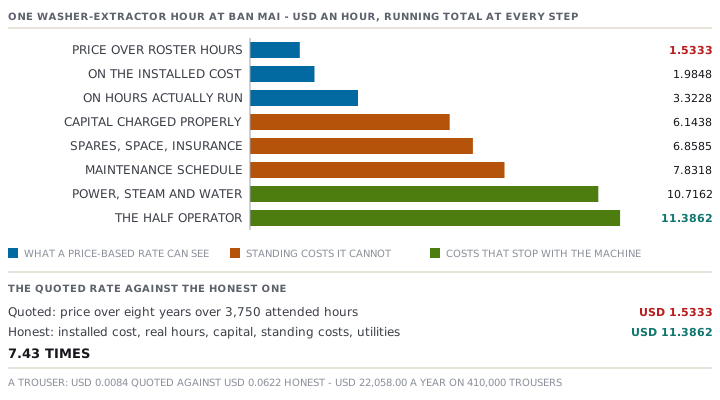
Now build the rate one honest step at a time, on the 2,240 hours the counter reads.
| What the step puts back | Rate an hour, USD | |
|---|---|---|
| 1 | Purchase price over 8 years over 3,750 attended hours | 1.5333 |
| 2 | The installed cost instead of the price, less the residual the policy assumes | 1.9848 |
| 3 | The 2,240 hours the counter reads instead of the 3,750 on the roster | 3.3228 |
| 4 | Capital charged properly, at USD 13,762.14 a year | 6.1438 |
| 5 | Spares holding, floor space and asset insurance, USD 1,601.00 a year | 6.8585 |
| 6 | Maintenance at the supplier's schedule, USD 2,180.00 a year | 7.8318 |
| 7 | Measured power, steam, water and effluent | 10.7162 |
| 8 | The half operator the machine needs | 11.3862 |
Steps 7 and 8 are the only ones that are not a yearly total divided by hours, so they are worth writing out.
electricity   9.4 kW measured over a cycle x USD 0.098      = USD 0.9212 an hour
steam         62 kg an hour measured       x USD 0.0214     = USD 1.3268
water and effluent  0.86 m3 an hour        x USD 0.74       = USD 0.6364
                                                              USD 2.8844 an hour

one operator runs the washer and the dryer, so the washer carries half
of USD 1.34                                                 = USD 0.6700 an hour
The honest rate is USD 11.3862 an hour and the quoted rate is USD 1.5333, a factor of 7.43. Read the ladder again and note where the money is. Step 4 alone, the cost of capital done properly, adds USD 2.82 an hour. That is more than the entire naive rate. Steps 1 to 6 are the machine standing still. Step 7 is the only part that stops when the machine stops.
Turn it into the unit everybody argues in.
machine time a trouser = (58 / 60) / 177          = 0.005461 hours

at the honest rate     0.9666667 x 11.3862 / 177  = USD 0.0622 a trouser
at the quoted rate     0.9666667 x 1.5333  / 177  = USD 0.0084 a trouser
difference                                        = USD 0.0538 a trouser
on 410,000 trousers                               = USD 22,058.00 a year
USD 22,058.00 a year of real cost is invisible to the rate the factory quotes. That is on one machine, before a single chemical, a dryer or a supervisor has been costed. It is what lesson 2 has to work with.
Two assumptions, weighed rather than defended
An advanced course owes the reader the size of its own uncertainty, not a claim that it has none. Two numbers above are assumptions, and both can be tested by moving them.
The residual. The policy assumes the machine is worth 10% of its installed cost after eight years. Nobody at Ban Mai has asked a dealer what an eight-year-old washer-extractor fetches in Binh Duong. It is unknown. At a residual of nil the capital charge becomes the full 66,160.00 times 0.215570 = USD 14,262.11. The rate rises by 499.97 over 2,240 = USD 0.2232 an hour, and the honest rate becomes USD 11.6094, which is 2.0% higher. So the assumption is worth two per cent of the rate, the answer is one telephone call away, and until somebody makes it the right word is unknown rather than ten.
The life. This is the larger one, and it is a different kind of thing. The eight years is an accounting life: a policy, reviewable, and limited by what the tax authority accepts. The economic life is a physical question about drum bearings, shell corrosion and whether spares are still made. Ban Mai's own boiler house has a machine bought in 1998 still doing its job. Put a twelve-year life through the same arithmetic. The capital recovery factor becomes 0.176670, the sinking fund factor 0.036670, and the charge falls to 66,160.00 times 0.176670 less 6,616.00 times 0.036670 = USD 11,445.88 a year. The rate falls by 2,316.26 over 2,240 = USD 1.03 an hour, from USD 11.3862 to USD 10.3522. That is a change of 9.1%.
Neither number is a measurement of anything. One is a policy set by an accountant and a tax code. The other is a guess about bearings. They are not the same kind of claim, they are frequently the same number in a cost model, and the word "depreciation" hides the difference. Say which one you mean, every time.
Check yourselfA supplier tells you their machine costs USD 3.10 an hour to own and run, and offers a spreadsheet showing it. What do you ask for, in order, and what would make you distrust the figure even if every line in the spreadsheet is right?Show the answer
Ask three things in order. First, is the capital in it the purchase price or the installed cost, and what is in the installation? Freight, duty, foundation, connections, commissioning and training all have invoices, and none of them is in a quotation. At Ban Mai the installed cost was 1.44 times the price. Second, how many hours a year is the total divided by, and is that a shift roster or a machine counter? Ban Mai's roster says 3,750 and the counter says 2,240, and using the roster makes any rate about 40% too low. Third, is there a charge for the cost of capital, and at what rate? A rate built from straight-line depreciation alone charges nothing at all for the money. Even the common shortcut of interest on average book value understates the charge by 8.9%. What should make you distrust the figure anyway is this: a supplier's hourly rate is built on the supplier's assumptions about your utilisation, your wage rate, your electricity price and your maintenance regime, and they have measured none of them. The rate is not a property of the machine. It is a property of the machine in your building.
Check yourselfBan Mai is quoted USD 18,000 for a second tumble dryer. Freight, duty and connection would add USD 5,900. It would run 1,100 hours a year, need USD 640 a year of maintenance, USD 210 of insurance, occupy 9 m2, and draw USD 4.16 an hour of gas and power. No operator is added. Using this lesson's policy and factors, what is the honest hourly rate, and which single figure in it would you go and check first?Show the answer
Installed cost is 18,000 plus 5,900 = USD 23,900.00, and the residual at 10% is USD 2,390.00. The capital charge is 23,900.00 times 0.215570 less 2,390.00 times 0.075570 = 5,152.12 less 180.61 = USD 4,971.51 a year. Floor space is 9 times USD 41 = USD 369.00. So the yearly standing cost is 4,971.51 plus 640.00 plus 210.00 plus 369.00 = USD 6,190.51, which over 1,100 hours is USD 5.6277 an hour. Add USD 4.16 of gas and power and you get USD 9.7877 an hour. The figure to check first is the 1,100 hours. It is the divisor of everything above the utilities line, and it is the only number here that is a plan rather than a measurement. If the second dryer actually runs 700 hours, the standing cost becomes USD 8.8436 an hour and the total becomes USD 13.0036, a third higher. A wrong maintenance figure or a wrong residual would move the answer by a few per cent. Check the divisor before you check anything above it.
Prompt · Build a machine's installed cost and its honest hourly rate
When a machine is being quoted, or when somebody hands you a cost per machine-hour and you have to decide whether to believe it.
Help me find out what a machine would actually cost me to have running, and do not let me use the quotation as the answer.

Start with the capital, and make me fill in every line even where the answer is nil. The quoted price ex-works. Freight, inland haulage and insurance. Import duty and customs clearance, as invoiced on my own entry - and tell me not to carry anybody else's duty figure, because it is national, it changes and it is often waived for exporters. Foundation, plinth, drainage. Every service connection the machine needs: power, steam, water, drain, gas, compressed air. Commissioning, and the training that makes somebody able to run it. Add them and tell me the installed cost as a MULTIPLE of the quoted price, because that multiple is the sentence I need to take to my board.

Then three annual costs that are not part of the installation. The spares I will hold, priced, and the cost of capital on that money sitting there. The floor space, in square metres times what a square metre of my building costs a year - and ask me whether the space has a better use, because if it does the right charge is what that use earns and I probably have not measured it. Asset insurance as invoiced.

Now the hours, and refuse the first answer I give. Ask me how many hours a year the shift roster says the machine is attended. Then ask me what its own running-hour counter reads, or if it has none, make me compute running hours from cycle time times annual volume. Show me both numbers and the utilisation between them, and tell me plainly that using the roster makes every rate too low.

Charge capital properly. Do not use straight-line depreciation plus interest on average book value - that understates the charge and always in the same direction. Use the capital recovery factor at my cost of capital over my policy life, less the sinking fund factor on my assumed residual. Show me the factors and the arithmetic, and show me what the shortcut would have given so I can see the size of the difference.

Then build the rate as a LADDER, one step at a time, so I can see where the money enters: price over roster hours, then installed cost, then real running hours, then capital done properly, then the standing costs, then maintenance, then measured utilities, then the fraction of an operator the machine needs. Give me a running total at every step.

Four rules. Never fill a missing measurement with a typical figure - write unknown and tell me what it would take to find out. Name my depreciation life and my residual as POLICY, not physics, and show me what the rate does if I change each of them, so I know how much of the answer they are carrying. Tell me to check my depreciation policy with whoever files my accounts, because useful lives and methods are set by jurisdiction and mine may not be free to choose. And if my maintenance figure came from a supplier's service schedule, tell me it is a floor rather than an estimate, because a service schedule contains no allowance for anything breaking.
AI can make mistakes — check anything you act on.